Chapter 2 of 13
NCERT Solutions

Host–Vector System

CBSE · Class 12 · Biotechnology

NCERT Solutions for Host–Vector System — CBSE Class 12 Biotechnology.

Interactive on Super Tutor

Studying Host–Vector System? Get the full interactive chapter.

Quizzes, flashcards, AI doubt-solver and a step-by-step study plan — built for ncert solutions and more.

1,000+ Class 12 students started this chapter today

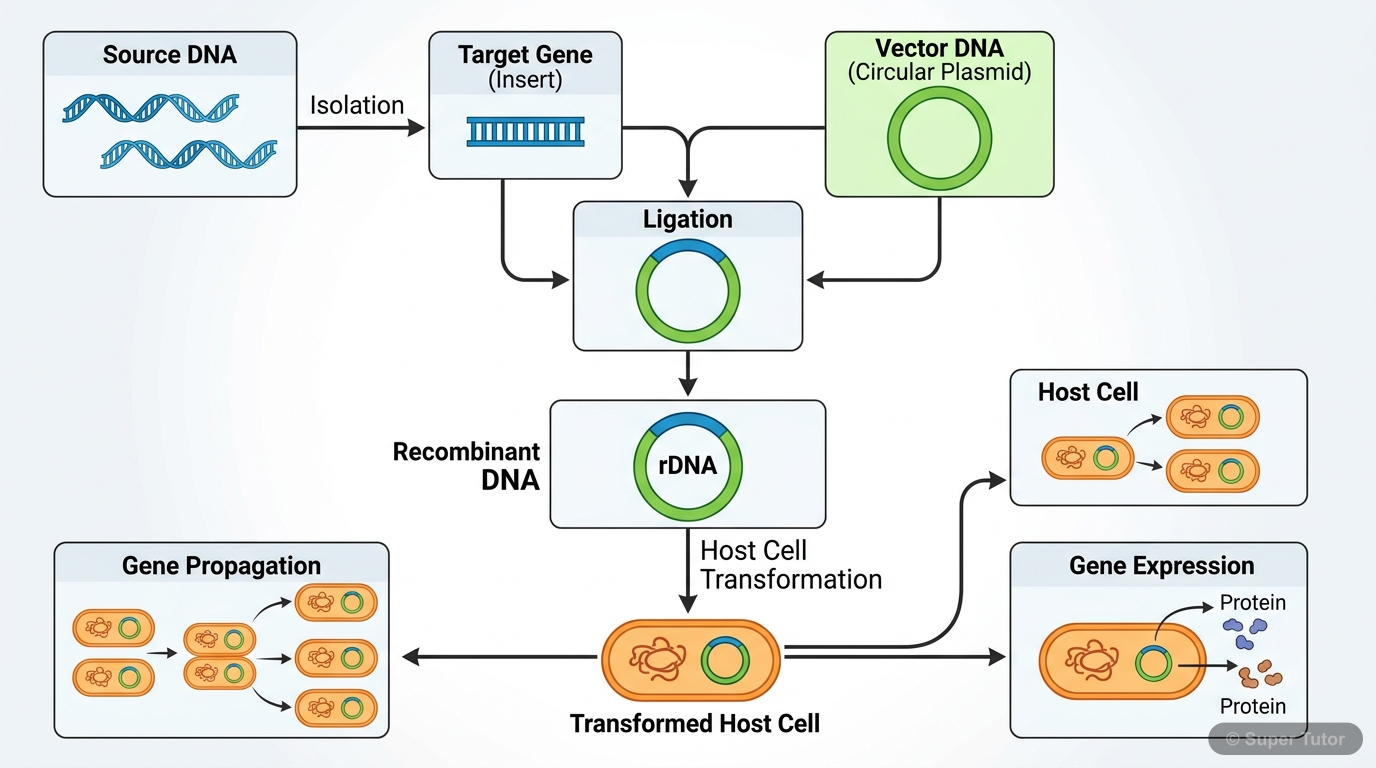
A flowchart illustrating the two major steps of recombinant DNA technology: isolation of target gene (insert) and its insertion into a vector to form recombinant DNA (rDNA), followed by introduction i
Super Tutor

Super Tutor has 16+ illustrations like this for Host–Vector System alone — flashcards, concept maps, and step-by-step visuals.

See them all
14 Questions Solved · 1 Section

EXERCISES

1Describe the importance of host vector system in rDNA technology.Show solution
Given/Concept: rDNA technology is a two-component system consisting of a compatible host and a vector.

Importance of Host–Vector System:

1. Vector (Vehicle for DNA): The vector carries the foreign/target gene into the host cell. It provides the essential sequences (ori, selectable markers, MCS) required for replication and expression of the inserted gene.

2. Host (Cellular Machinery): The host cell provides all the enzymatic and metabolic machinery (DNA polymerase, RNA polymerase, ribosomes, etc.) needed for replication, transcription, and translation of the cloned gene.

3. Compatibility: The vector must be compatible with the host so that the origin of replication (ori) is recognised by the host's replication machinery, allowing autonomous replication of the recombinant DNA.

4. Selection of Recombinants: Selectable markers on the vector (e.g., antibiotic resistance genes) allow identification and selection of transformed host cells that carry the recombinant DNA.

5. Gene Expression: Expression vectors carry inducible promoters and termination sequences that allow the host's transcription/translation machinery to produce the desired protein product.

6. Amplification: Once inside the host, the vector replicates to produce multiple copies of the cloned gene, enabling large-scale production of the gene product.

Conclusion: Without a compatible host–vector system, it would be impossible to introduce, maintain, replicate, and express foreign DNA. The system is therefore the cornerstone of all rDNA technology applications such as production of insulin, vaccines, and gene therapy.
2What are the major characteristics of a vector?Show solution
Concept: A vector is a DNA molecule used to carry foreign genetic material into a host cell. An ideal cloning vector must possess the following major characteristics:

1. Small Size: The vector should be small in size so that it can easily enter the host cell and is less susceptible to mechanical shearing. Smaller vectors also replicate more efficiently.

2. Origin of Replication (ori): The vector must have an ori sequence so that it can replicate autonomously inside the host cell, independent of the host chromosome. This ensures maintenance and amplification of the cloned gene.

3. Unique Restriction Endonuclease Sites (Multiple Cloning Site / MCS): The vector should have unique (single) recognition sites for one or more restriction enzymes. This allows the vector to be cut at a specific location for insertion of foreign DNA without disrupting essential genes.

4. Selectable Marker: The vector must carry at least one selectable marker gene (e.g., antibiotic resistance genes like ampRamp^R, tetRtet^R) to distinguish transformed cells (those that have taken up the vector) from non-transformed cells.

5. Low Copy Number or High Copy Number as Required: Depending on the purpose, the vector should replicate to an appropriate copy number — high copy number for gene amplification, low copy number for stable maintenance of large inserts.

6. Ability to Accept Large DNA Inserts: The vector should be able to accommodate a reasonably large fragment of foreign DNA.

7. Suitable for Packaging (for phage vectors): Phage-based vectors should be packageable into phage particles for efficient delivery into host cells.

Summary Table:

| Characteristic | Purpose |
|---|---|
| Small size | Easy entry, efficient replication |
| ori | Autonomous replication |
| Unique restriction sites | Insertion of foreign DNA |
| Selectable marker | Identification of transformants |
| Suitable copy number | Amplification/stability |
3What is plasmid and what are its different types?Show solution
Definition of Plasmid:
A plasmid is a circular, extra-chromosomal, double-stranded DNA (dsDNA) molecule found in bacteria (and some eukaryotes) that is capable of autonomous replication independent of the host chromosome. Plasmids are typically small (1–200 kb) and carry genes that confer selective advantages to the host.

Key Features:
- Circular dsDNA
- Self-replicating (has its own ori)
- Usually non-essential for normal cell survival
- Can be transferred between cells (conjugation, transformation)

Types of Plasmids:

1. Fertility (F) Plasmids (Sex Plasmids):
- Carry genes for conjugation (transfer of genetic material between bacteria).
- Example: F plasmid of *E. coli*.

2. Resistance (R) Plasmids:
- Carry genes for resistance to antibiotics (e.g., ampicillin, tetracycline) or heavy metals.
- Important in clinical microbiology and used as selectable markers in cloning vectors.
- Example: pBR322.

3. Col Plasmids (Colicinogenic Plasmids):
- Carry genes encoding colicins — proteins that kill other bacteria.
- Example: ColE1 plasmid of *E. coli*.

4. Degradative Plasmids:
- Carry genes that allow the host to metabolise unusual substances like toluene, salicylic acid, etc.
- Example: TOL plasmid of *Pseudomonas putida*.

5. Virulence Plasmids (Ti Plasmids):
- Carry genes that make the host bacterium pathogenic.
- Example: Ti (Tumour-inducing) plasmid of *Agrobacterium tumefaciens*, widely used in plant genetic engineering.

6. Episomes:
- Plasmids that are capable of integrating into the host chromosome.
- Example: F plasmid can exist as an episome.

Based on Copy Number:
- Stringent plasmids: Low copy number (1–5 copies per cell); replication is tightly controlled.
- Relaxed plasmids: High copy number (10–200 copies per cell); replication is less tightly controlled. Example: ColE1.
4Discuss the strategy applied for the development of (pBR322) plasmid cloning vectors.Show solution
Introduction:
pBR322 is one of the most widely used artificial plasmid cloning vectors for *E. coli*, constructed in 1977 by Bolivar and Rodriguez (hence 'BR' in the name; '322' is the clone number).

Strategy for Development of pBR322:

Step 1 – Selection of Source Plasmids:
pBR322 was constructed by combining DNA segments from three naturally occurring plasmids:
- pSF2124 – provided the ampRamp^R (ampicillin resistance) gene.
- pSC101 – provided the tetRtet^R (tetracycline resistance) gene.
- pMB1 (ColE1 derivative) – provided the origin of replication (ori).

Step 2 – Incorporation of Essential Features:
The following essential elements were incorporated:

| Feature | Source | Function |
|---|---|---|
| ori (origin of replication) | pMB1 | Autonomous replication in *E. coli* |
| ampRamp^R gene | pSF2124 | Selectable marker (ampicillin resistance) |
| tetRtet^R gene | pSC101 | Selectable marker (tetracycline resistance) |
| Unique restriction sites | Engineered | Cloning of foreign DNA |

Step 3 – Unique Restriction Sites:
pBR322 contains unique restriction sites within or near the selectable marker genes:
- EcoRI, ClaI, HindIII sites are present in the tetRtet^R gene.
- PstI, PvuI sites are present in the ampRamp^R gene.
- BamHI, SalI sites are at the junction of tetRtet^R and ampRamp^R.

This allows insertional inactivation — when foreign DNA is inserted into a restriction site within a marker gene, that gene is disrupted, enabling identification of recombinants.

Step 4 – Insertional Inactivation Strategy:
- If foreign DNA is inserted at the BamHI site (within tetRtet^R), the recombinant clone will be ampRamp^R but tetStet^S (tetracycline sensitive).
- Non-recombinant clones will be both ampRamp^R and tetRtet^R.
- By replica plating on ampicillin and tetracycline plates, recombinants can be identified.

Properties of pBR322:
- Size: 4.36 kb (small, efficient)
- Copy number: ~15–20 copies per cell (relaxed replication)
- Hosts: *E. coli* and related bacteria

Conclusion:
The strategy involved combining the best features of multiple natural plasmids — a functional ori, two selectable markers, and unique restriction sites — to create a versatile, small, and efficient cloning vector.
5Briefly describe the structure of lambda bacteriophage and also discuss the role of lambda phage based vectors.Show solution
Structure of Lambda (λ) Bacteriophage:

Lambda phage is a temperate bacteriophage that infects *E. coli*. Its structure includes:

1. Head (Icosahedral Capsid): Contains the linear double-stranded DNA genome of approximately 48.5 kb.

2. Tail: A flexible tail with tail fibres used for attachment to the host cell surface.

3. Genome: Linear dsDNA with cohesive ends (cos sites) — 12-nucleotide single-stranded complementary overhangs at each end. These cos sites allow circularisation of the genome after injection into the host.

4. Genetic Organisation: The genome is divided into:
- Left arm: Genes for head and tail proteins (structural genes).
- Right arm: Genes for DNA replication, recombination, and lysis.
- Central region (~15 kb): Non-essential region that can be replaced by foreign DNA.

Life Cycle:
- Lytic cycle: Phage injects DNA → replicates → produces new phage particles → lyses the host cell.
- Lysogenic cycle: Phage DNA integrates into host chromosome as a prophage and replicates with the host.

---

Role of Lambda Phage-Based Vectors:

Typical lambda-derived vectors fall into two broad classes:

1. Insertion Vectors:
- The non-essential central region is replaced by a single unique restriction site where foreign DNA is inserted.
- Can accommodate inserts of up to ~10 kb.
- Example: λgt10, λgt11
- Used for constructing cDNA libraries and expression of cloned genes.

2. Replacement (Substitution) Vectors:
- The non-essential central region (~15 kb) is removed and replaced by foreign DNA.
- Can accommodate larger inserts of up to ~20–23 kb.
- Example: EMBL3, EMBL4, Charon vectors
- Used for constructing genomic DNA libraries.

Advantages of Lambda Vectors:
- High efficiency of DNA delivery into *E. coli* via in vitro packaging.
- Can carry larger inserts than plasmids.
- Easy screening of recombinants by plaque formation.
- Suitable for constructing genomic and cDNA libraries.

Conclusion:
Lambda phage vectors are powerful tools in molecular cloning, especially for constructing gene libraries due to their ability to carry large DNA inserts and their high transfection efficiency.
6Discuss the M13 based vectors and its application.Show solution
M13 Bacteriophage:
M13 is a filamentous bacteriophage of *E. coli*. Its key features are:
- Genome: 6.4 kb long circular single-stranded DNA (ssDNA) packaged in a tubular (filamentous) capsid.
- It infects only *E. coli* strains carrying the F pilus (F+^+ strains).
- M13 does not lyse the host cell; instead, it causes a chronic infection, continuously releasing phage particles.
- Inside the host, the ssDNA is converted to a double-stranded replicative form (RF) which replicates like a plasmid.

M13-Based Vectors:

The most well-known M13-based vector is M13mp18 (and its complement M13mp19).

Construction of M13mp18:
- A lacZ gene fragment (encoding β-galactosidase) was inserted into the M13 genome.
- A Multiple Cloning Site (MCS/polylinker) containing several unique restriction sites was engineered within the lacZ gene.
- This allows blue/white colour selection of recombinants.

Blue/White Selection:
- When no insert is present: lacZ gene is intact → β-galactosidase is produced → cleaves X-gal (chromogenic substrate) → blue plaques.
- When foreign DNA is inserted into MCS: lacZ gene is disrupted → no functional β-galactosidase → white plaques (recombinants).

Applications of M13-Based Vectors:

1. Production of Single-Stranded DNA:
- M13 phage particles contain ssDNA. This ssDNA can be easily isolated and used as a template for DNA sequencing (Sanger's dideoxy method).

2. Site-Directed Mutagenesis:
- The ssDNA template from M13 vectors is ideal for introducing specific mutations into cloned genes using synthetic oligonucleotide primers.

3. Construction of cDNA Libraries:
- M13 vectors can be used to clone cDNA for library construction.

4. Probe Preparation:
- Single-stranded DNA probes of defined sequence can be produced for hybridisation experiments.

Conclusion:
M13-based vectors are invaluable tools in molecular biology, particularly for DNA sequencing and site-directed mutagenesis, owing to their ability to produce single-stranded DNA templates.
7Differentiate between cosmids and phagemids.Show solution
Differentiation between Cosmids and Phagemids (Phasmids):

| Feature | Cosmid | Phagemid (Phasmid) |
|---|---|---|
| Definition | Hybrid vector combining plasmid sequences with lambda cos sites | True combination vector between phage and plasmid |
| Components | Plasmid DNA (ori, selectable markers, restriction sites) + lambda cos sites | Lambda phage DNA segments (lytic genes) + linearised plasmid DNA in the middle |
| Structure | Circular DNA | Linear duplex DNA; ends are lambda segments, middle is linearised plasmid |
| Replication | Replicates like a plasmid inside the host | Can replicate as a plasmid (plasmid mode) or as a phage (lytic mode) |
| Packaging | Can be packaged in vitro into lambda phage coats (due to cos sites) | Contains all lambda genes required for lytic infection |
| Insert Size | Can carry large inserts of 35–45 kb | Carries inserts of moderate size |
| Use | Construction of genomic libraries; cloning large DNA fragments | Versatile — can switch between phage and plasmid modes |
| Example | pHC79, pJB8 | P1 phage-based vectors |
| Lytic Ability | Cannot carry out lytic infection (lacks phage structural genes) | Can carry out lytic infection (has all lambda lytic genes) |

Summary:
- A cosmid is essentially a plasmid that has been given the ability to be packaged into lambda phage coats by incorporating cos sites, but it lacks the phage structural genes.
- A phasmid is a true hybrid that contains all the genetic information of both a phage and a plasmid, and can function as either.
8Why is a vector required for cloning of a gene?Show solution
Concept: Gene cloning involves introducing a foreign gene into a host cell and producing multiple copies of it.

Reasons why a vector is required for gene cloning:

1. Carrier of Foreign DNA:
A vector acts as a vehicle to carry the foreign (target) gene into the host cell. Naked DNA cannot efficiently enter host cells and is rapidly degraded by nucleases.

2. Autonomous Replication:
The vector contains an origin of replication (ori) that allows it to replicate independently within the host cell. Without a vector, the foreign DNA cannot replicate on its own inside the host (it lacks an ori recognised by the host).

3. Amplification of the Gene:
Once inside the host, the vector replicates to produce many copies (depending on copy number), thereby amplifying the cloned gene. This is essential for obtaining sufficient quantities of the gene or its product.

4. Stable Maintenance:
The vector ensures stable maintenance of the foreign gene in the host cell over many generations, as it is replicated along with the vector during cell division.

5. Selection of Transformed Cells:
Vectors carry selectable marker genes (e.g., antibiotic resistance) that allow identification and selection of host cells that have successfully taken up the recombinant vector.

6. Expression of the Cloned Gene:
Expression vectors carry promoters, ribosome binding sites, and termination sequences that allow the host's machinery to transcribe and translate the cloned gene into a protein product.

7. Controlled Insertion:
Vectors have unique restriction sites (MCS) that allow precise insertion of the foreign DNA at a defined location.

Conclusion:
Without a vector, the foreign gene cannot enter the host cell, cannot replicate, cannot be maintained stably, and cannot be expressed. The vector is therefore an absolute requirement for gene cloning.
9A plasmid capable of getting integrated into host chromosome is called:
(a) Col plasmid
(b) Episome
(c) Ti plasmid
(d) R plasmid
Show solution
Correct Answer: (b) Episome

Justification:
An episome is a type of plasmid that has the ability to exist either as an autonomous, self-replicating extrachromosomal element OR to integrate into the host chromosome and replicate along with it. The F (fertility) plasmid of *E. coli* is a classic example of an episome. Col plasmids produce colicins, Ti plasmids cause crown gall disease in plants, and R plasmids carry antibiotic resistance genes — none of these are defined by their ability to integrate into the host chromosome.
10Why the replication of single copy plasmid called stringent replication?Show solution
Concept: Plasmids differ in their copy number — the number of copies maintained per host cell.

Stringent Replication:
The replication of single-copy (or low-copy-number) plasmids is called stringent replication because:

1. Tight Regulation: The replication of these plasmids is tightly coupled and coordinated with the replication of the host chromosome. The plasmid replicates only once per cell cycle, just like the host chromosome.

2. Control Mechanism: The host cell exerts strict control over the initiation of plasmid replication, ensuring that only one (or very few) copies are present per cell.

3. Result: Only 1–5 copies of the plasmid are maintained per cell.

4. Analogy: The word 'stringent' means strict or precise — the replication is strictly controlled and does not occur independently of the cell cycle.

Contrast with Relaxed Replication:
In contrast, relaxed replication (as in ColE1-type plasmids) is not tightly coupled to the cell cycle, allowing the plasmid to replicate multiple times per cell cycle, resulting in 10–200 copies per cell.

Conclusion:
Single-copy plasmid replication is called stringent because it is strictly regulated and synchronised with host chromosome replication, maintaining a fixed low copy number per cell.
11Identify the incorrect match pair from the following:
(i) Multicopy plasmid — (a) Stringent replication
(ii) Col plasmid — (b) Kills bacteria
(iii) pBR322 — (c) Plasmid
(iv) Prophage — (d) Phage genome inserted into a host genome
Show solution
Correct Answer: (i) Multicopy plasmid — (a) Stringent replication is the INCORRECT match.

Justification:

- (i) Multicopy plasmid — Stringent replication: INCORRECT.
Multicopy plasmids undergo relaxed replication (not stringent). Relaxed replication is not tightly coupled to the cell cycle, allowing multiple rounds of replication per cell cycle, resulting in high copy numbers (10–200 copies per cell). Stringent replication is associated with single-copy (low-copy-number) plasmids.

- (ii) Col plasmid — Kills bacteria: CORRECT.
Col plasmids encode colicins, which are bacteriocins (protein toxins) that kill other bacteria of the same or related species.

- (iii) pBR322 — Plasmid: CORRECT.
pBR322 is indeed an artificially constructed plasmid cloning vector.

- (iv) Prophage — Phage genome inserted into a host genome: CORRECT.
A prophage is the integrated form of a temperate phage genome within the host bacterial chromosome.

Therefore, the incorrect match is (i) — Multicopy plasmid should be matched with relaxed replication, not stringent replication.
12How can a large size eukaryotic gene insert be cloned?Show solution
Problem: Eukaryotic genes are often very large (hundreds of kilobases), and conventional plasmid or phage vectors can only accommodate small inserts (up to ~20 kb for lambda vectors).

Strategies for Cloning Large Eukaryotic Gene Inserts:

1. Cosmid Vectors:
- Cosmids are hybrid vectors (plasmid + lambda cos sites).
- They can be packaged into lambda phage coats and can accommodate inserts of 35–45 kb.
- Suitable for cloning large genomic fragments.

2. Yeast Artificial Chromosomes (YACs):
- YACs are the most powerful vectors for cloning very large DNA fragments.
- A YAC vector contains: yeast telomeric sequences (TEL), a centromeric sequence (CEN), an autonomously replicating sequence (ARS), and selectable markers.
- YACs can accommodate inserts of 200 kb to 2 Mb (megabases).
- They behave like artificial chromosomes inside yeast (*Saccharomyces cerevisiae*) cells.
- Ideal for cloning entire eukaryotic genes including introns and regulatory regions.
- Used in the Human Genome Project.

3. Bacterial Artificial Chromosomes (BACs):
- Based on the F plasmid of *E. coli*.
- Can carry inserts of 100–300 kb.
- More stable than YACs.

4. P1-Derived Artificial Chromosomes (PACs):
- Based on bacteriophage P1.
- Can carry inserts of 100–300 kb.

5. cDNA Cloning (for expression studies):
- If the goal is to express the gene (not study its genomic organisation), cDNA (complementary DNA, made from mRNA using reverse transcriptase) can be cloned.
- cDNA lacks introns and is much smaller than the genomic gene.
- Can be cloned into standard plasmid or phage vectors.

Conclusion:
For cloning large eukaryotic genomic inserts, YAC vectors are the most suitable as they can accommodate inserts up to 2 Mb. For moderately large inserts, cosmids or BACs are preferred. For expression purposes, cDNA cloning is the strategy of choice.
13Assertion: An ideal vector should have selectable marker.
Reason: Selectable markers are required to screen out transformation.
(a) Both assertion and reason are true and the reason is the correct explanation of the assertion.
(b) Both assertion and reason are true but the reason is not the correct explanation of the assertion.
(c) Assertion is true but reason is false.
(d) Both assertion and reason are false.
Show solution
Correct Answer: (a) Both assertion and reason are true and the reason is the correct explanation of the assertion.

Justification:

Assertion is TRUE: An ideal vector must carry a selectable marker gene (e.g., antibiotic resistance genes like ampRamp^R, tetRtet^R). This is one of the essential characteristics of a cloning vector.

Reason is TRUE and correctly explains the Assertion:
Selectable markers are genes that allow the experimenter to distinguish between:
- Transformed cells (cells that have taken up the vector) — these survive on selective medium (e.g., medium containing antibiotic).
- Non-transformed cells (cells that have not taken up the vector) — these are killed or do not grow on selective medium.

Furthermore, through insertional inactivation (inserting foreign DNA into the marker gene), recombinant clones (with insert) can be distinguished from non-recombinant clones (without insert).

Thus, selectable markers are indeed required to screen/select for transformation events, which directly explains why an ideal vector must have a selectable marker.

Answer: (a)
14Assertion: Cosmid is a hybrid vector.
Reason: Cosmid has properties of both plasmids and lambda phage vector.
(a) Both assertion and reason are true and the reason is the correct explanation of the assertion.
(b) Both assertion and reason are true but the reason is not the correct explanation of the assertion.
(c) Assertion is true but reason is false.
(d) Both assertion and reason are false.
Show solution
Correct Answer: (a) Both assertion and reason are true and the reason is the correct explanation of the assertion.

Justification:

Assertion is TRUE: A cosmid is indeed a hybrid (combination) vector. It is constructed by combining elements from two different types of vectors.

Reason is TRUE and correctly explains the Assertion:
Cosmids possess properties of both plasmids and lambda phage vectors:

*From Plasmid:*
- Origin of replication (ori) — allows autonomous replication inside the host cell like a plasmid.
- Selectable marker genes (e.g., antibiotic resistance).
- Unique restriction endonuclease sites for cloning.

*From Lambda Phage:*
- cos sites (cohesive end sequences) — allow the cosmid DNA to be packaged in vitro into lambda phage coat proteins, enabling efficient delivery into *E. coli* host cells.

Because cosmids combine the replication and selection properties of plasmids with the packaging efficiency of lambda phage (via cos sites), they are correctly called hybrid vectors. The reason directly and correctly explains why cosmids are called hybrid vectors.

Answer: (a)

Stuck on a step?

Ask Super Tutor AI to explain any solution on this page in a simpler way — free, 24x7.

Ask a Doubt Free

Frequently Asked Questions

What are the important topics in Host–Vector System for CBSE Class 12 Biotechnology?
Host–Vector System covers several key topics that are frequently asked in CBSE Class 12 board exams. Focus on the core concepts listed on this page and practise related questions to build confidence.
How to score full marks in Host–Vector System — CBSE Class 12 Biotechnology?
Start by understanding all key concepts. Practise previous year questions from this chapter. Revise formulas and definitions regularly. Use flashcards for quick revision before the exam.
Where can I get free NCERT Solutions for Host–Vector System Class 12 Biotechnology?
This page has free step-by-step NCERT Solutions for every exercise question in Host–Vector System (CBSE Class 12 Biotechnology) — written the way examiners award marks: given, formula, working, answer.

Sources & Official References

Content is aligned to the official syllabus. Refer to the board website for the latest curriculum.

For serious students

Get the full Host–Vector System chapter — for free.

Quizzes, flashcards, AI doubt-solver and a step-by-step study plan for CBSE Class 12 Biotechnology.