Sound Waves Characteristics and Applications — NCERT Solutions
CBSE · Class 9 · Science
NCERT Solutions for Sound Waves Characteristics and Applications, CBSE Class 9 Science: 55 textbook questions solved step by step.
Interactive on Super Tutor
Studying Sound Waves Characteristics and Applications? Get the full interactive chapter.
Quizzes, flashcards, AI doubt-solver and a step-by-step study plan — built for NCERT solutions and more.
Free trial, no card needed.
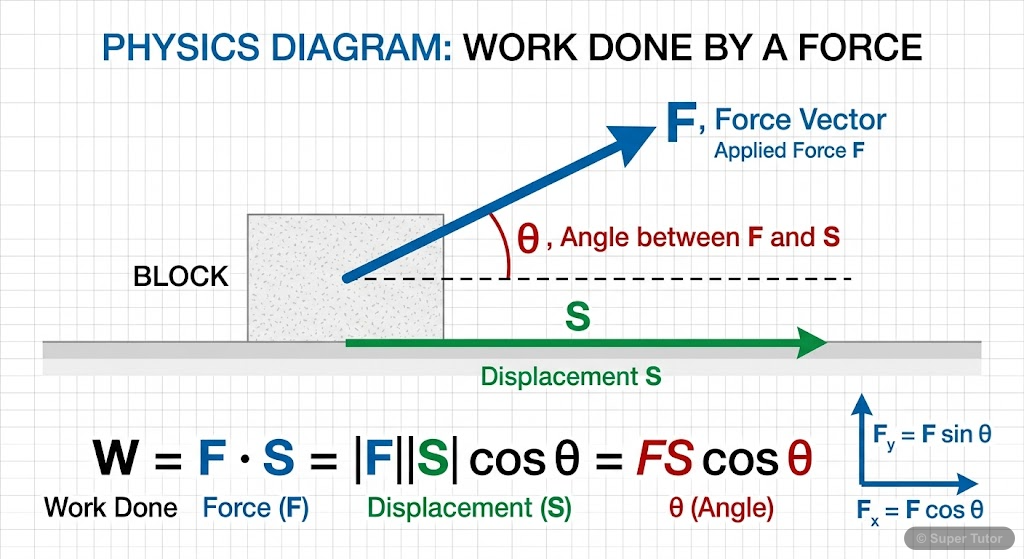
One of 5 illustrations for Sound Waves Characteristics and Applications in Super Tutor — alongside flashcards, concept maps and practice questions.
The first 28 solutions are open to read. The other 27 are free with a Super Tutor account.
Think It Over
1Two astronauts are repairing the arm of a space station together during a spacewalk. Can they talk to each other and hear the sounds of metal clanking as they do on the Earth?
How do most bats use sound to locate their prey in the dark at night?Show solution
No. In outer space there is a near vacuum, so sound cannot propagate. Therefore astronauts cannot directly hear each other speak or hear metal clanking. They communicate using special devices fitted into their spacesuits.
Most bats locate prey by echolocation: they emit short bursts of ultrasonic waves, and by sensing the reflected echoes they determine the position of obstacles and prey.
2Which form of energy gets converted to sound energy? How is sound produced and how does it reach our ears?Show solution
Sound is produced by vibrations. Energy from the vibrating source changes into sound energy. Sound then reaches our ears by propagating through a medium such as air, liquid, or solid, in the form of sound waves made of alternate compressions and rarefactions.
Activity 10.1: Let us explore
3Holding the box steady with one hand, pluck the rubber band with a finger. Do you hear any sound?Show solution
Yes, when the stretched rubber band is plucked, it vibrates and produces sound.
4Pluck the rubber band again and watch it carefully. Is it vibrating?Show solution
Yes, the rubber band is vibrating when plucked.
5Wait till the rubber band stops vibrating. Do you still hear the sound?Show solution
No. Once the rubber band stops vibrating, the sound also stops.
6Change the tension in the rubber band by stretching it more or loosening it slightly and plucking it each time. Does the sound change? What changes do you notice?Show solution
Yes. When the tension is increased, the rubber band vibrates faster and the sound becomes higher in pitch. When the tension is loosened slightly, it vibrates slower and the sound becomes lower in pitch. So the change noticed is mainly in the frequency of sound.
7Remove the rubber band from the box. Stretch it between two fingers and pluck it near your ear. Is the sound still produced? Is it as loud as before?Show solution
Yes, sound is still produced when the rubber band is plucked between two fingers. But it is usually not as loud as before, because the box helps in making the sound louder.
Threads of Curiosity
1How do humans and animals create sound? While talking or singing, gently touch your throat. Do you feel vibrations anywhere? In humans and some other animals, sound is produced by the vibration of vocal cords, which are tightly stretched muscular flaps located inside the voice box or larynx, in the throat (Fig. 10.3). The tongue, lips, mouth and nasal cavity in humans help in converting sound into speech or music.
Some animals produce sound by striking or rubbing certain body parts. For example, grasshoppers and crickets rub their wings or legs to produce sound.Show solution
Humans and some animals create sound by vibrations. In humans, sound is produced by the vibration of the vocal cords inside the larynx or voice box. The tongue, lips, mouth, and nasal cavity help convert sound into speech or music. Some animals produce sound by striking or rubbing body parts; for example, grasshoppers and crickets rub their wings or legs to produce sound.
2How do humans and animals create sound? While talking or singing, gently touch your throat. Do you feel vibrations anywhere?Show solution
Yes. While talking or singing, if you gently touch your throat, you can feel vibrations there. These vibrations are from the vocal cords.
Activity 10.2: Let us explore
3Strike one of the prongs of the tuning fork gently against the rubber pad (Fig. 10.4b) and bring it close to your ear. Do you hear a sound? (Take care not to strike the tuning fork against a hard surface).Show solution
Yes. A vibrating tuning fork brought near the ear produces sound, so you hear it.
4Now, gently touch a water surface with one of the vibrating prongs of the tuning fork. Do you see waves forming on the surface of water?Show solution
Yes. The vibrating prongs disturb the water surface, so waves form on the water.
5Repeat step 3 a few times while bringing the prongs of the tuning fork near your ear in different orientations. Do you hear the sound?Show solution
Yes. You hear the sound in different orientations because the tuning fork is vibrating and sound spreads in different directions.
Pause and Ponder
1Explore various ways of producing sound.Show solution
Sound can be produced in many ways, such as by plucking strings, striking metal objects, blowing through air columns like a flute, and by vibrating membranes. You can also explore sound from everyday objects and animals that produce sound by rubbing or striking parts of their bodies.
2Make a list of different types of musical instruments and identify their vibrating parts which produce sound.Show solution
Examples:
- Sitar — vibrating strings
- Tabla — vibrating membrane
- Flute — vibrating air column
- Tanpura — vibrating strings
- Mridangam — vibrating membrane
- Bansuri — vibrating air column
3Assertion (A): We cannot hear the sound of a bell ringing in a closed jar after most of the air is pumped out.
Reason (R): Sound requires a medium to travel.
Choose the correct statement:
(i) Both A and R are true, but R is not the correct explanation of A.
(ii) Both A and R are true, and R is the correct explanation of A.
(iii) A is true, but R is false.
(iv) A is false, but R is true.Show solution
The assertion is true because when most air is removed, sound cannot travel well. The reason is also true because sound needs a material medium to travel. The reason correctly explains the assertion.
So the correct statement is (ii).
4Assertion (A): Compressions and rarefactions move through the medium.
Reason (R): Individual particles of the medium continuously move forward with the wave.
Choose the correct statement:
(i) Both A and R are true, but R is not the correct explanation of A.
(ii) Both A and R are true, and R is the correct explanation of A.
(iii) A is true, but R is false.
(iv) A is false, but R is true.Show solution
The assertion is true: compressions and rarefactions move through the medium. The reason is false because the particles do not move forward with the wave; they only oscillate about their mean positions.
So the correct statement is (iii).
5When sound travels from a tuning fork to your ear, which of the following actually reaches your ear?
(i) Air particles near the tuning fork
(ii) Energy carried by sound waves
(iii) The tuning fork material
(iv) A continuous stream of compressed airShow solution
What reaches your ear is not the material of the tuning fork or air particles themselves, but the energy carried by sound waves.
So the correct option is (ii).
7Conduct Activity 10.1 once again with a thick rubber band and then with a thin rubber band. Does the thin rubber band vibrate faster than the thick rubber band? If yes, how do the frequency and time period of the sound produced by the thin rubber band differ from that of the thick rubber band?Show solution
Yes. The thin rubber band vibrates faster than the thick rubber band. So the sound produced by the thin rubber band has higher frequency and shorter time period than that of the thick rubber band.
8If the frequency of a sound wave produced by an oscillating piston of a long tube filled with air is , then how many oscillations does the piston complete per minute?Show solution
Frequency means 20 oscillations per second.
In 1 minute = 60 s,
So the piston completes 1200 oscillations per minute.
9For the sound wave represented by the graph shown in Fig. 10.19, what is half of its wavelength?Show solution
In such a graph, half of the wavelength would be half the distance between two consecutive crests or troughs.
10Table 10.1 shows the speed of sound in a few media at atmospheric pressure.
Table 10.1: Speed of sound in different media at
| State | Substance/Medium | Approximate speed |
|---|---|---|
| Solid | Steel | 5000 m s-1 |
| Liquid | Water | 1500 m s-1 |
| Gas | Air | 340 m s-1 |
Compare the speeds in different media by finding the ratio of
(i) the speed of sound in water with respect to the speed in the air.
(ii) the speed of sound in steel with respect to the speed in the water.Show solution
Given speeds:
- Water =
- Air =
- Steel =
(i) Ratio of water to air:
(ii) Ratio of steel to water:
So the ratios are 75:17 and 10:3.
11Two friends are standing along a steel fence at a distance of 340 m from each other (Fig. 10.23). Gunjan places her ear over the fence and her friend knocks the fence with a metal object. Using the values of the speed of sound in steel and air given in Table 10.1, calculate the time difference between the sound that reached Gunjan through the airShow solution
Sound reaches through steel faster than through air.
Distance =
Time through air:
Time through steel:
Time difference:
So the sound through steel reaches about 0.932 s earlier than through air. The difference in arrival times is 0.932 s.
12An experiment is being set up that requires echoes to arrive at least 0.2 s after the emission of sound. What minimum distance should a reflecting surface be placed at? Assume the speed of sound to be .Show solution
For an echo, the sound must travel to the reflecting surface and back in 0.2 s.
So one-way time =
Distance from reflecting surface:
So the reflecting surface should be at least 34.3 m away.
13Sound travels much farther in water than light, and thus, is used for various underwater applications. A sonar signal sent to find the depth of ocean takes 4 s to return. What is the depth of the ocean at that location if the speed of sound in seawater is ?Show solution
The sonar signal takes 4 s for a round trip, so one-way time is
Depth of ocean:
So the depth is 3000 m.
3Assertion (A): We cannot hear the sound of a bell ringing in a closed jar after most of the air is pumped out.
Reason (R): Sound requires a medium to travel.
Choose the correct statement:Show solution
Both statements are true. In a closed jar after most air is pumped out, sound cannot be heard because sound requires a medium to travel. So the reason correctly explains the assertion.
Therefore the correct option is (ii).
4Assertion (A): Compressions and rarefactions move through the medium.
Reason (R): Individual particles of the medium continuously move forward with the wave.
Choose the correct statement:Show solution
A is true because sound travels as alternating compressions and rarefactions through a medium. R is false because the particles of the medium do not move forward with the wave; they only vibrate about their mean positions. So the correct statement is (iii) A is true, but R is false.
5When sound travels from a tuning fork to your ear, which of the following actually reaches your ear?Show solution
What reaches the ear is not the air particles themselves or the tuning fork material. In sound propagation, energy is transferred through the medium by sound waves. So the correct choice is (ii) Energy carried by sound waves.
10Table 10.1 shows the speed of sound in a few media at atmospheric pressure.
Table 10.1: Speed of sound in different media at Show solution
The table shows the speed of sound in different media at . The approximate speeds are: steel = 5000 m s, water = 1500 m s, and air = 340 m s. The order is solid > liquid > gas.
Activity 10.3: Let us investigate
Free with a Super Tutor account
Free with a Super Tutor account
Activity 10.4: Let us investigate
Free with a Super Tutor account
Activity 10.7: Let us experiment (demonstration activity)
Free with a Super Tutor account
Free with a Super Tutor account
Free with a Super Tutor account
Activity 10.8: Let us experiment (demonstration activity)
Free with a Super Tutor account
Revise, Reflect, Refine
(i) Sound shows reflection
(ii) Sound needs a medium to propagate
(iii) Sound has frequency
(iv) Sound carries energy
Free with a Super Tutor account
(i) wavelength
(ii) speed
(iii) number of compressions per second
(iv) time period
Free with a Super Tutor account
(i)
(ii)
(iii)
(iv)
Free with a Super Tutor account
Free with a Super Tutor account
Free with a Super Tutor account
Free with a Super Tutor account
Free with a Super Tutor account
Free with a Super Tutor account
Free with a Super Tutor account
Free with a Super Tutor account
Free with a Super Tutor account
Free with a Super Tutor account
Free with a Super Tutor account
Free with a Super Tutor account
Free with a Super Tutor account
Free with a Super Tutor account
Free with a Super Tutor account
Free with a Super Tutor account
The Journey Beyond
Free with a Super Tutor account
(i) https://phet.colorado.edu/en/simulations/sound-waves/
(ii) https://musiclab.chromeexperiments.com/Experiments
(iii) https://phyphox.org/experiments
Free with a Super Tutor account
27 more solved questions in Sound Waves Characteristics and Applications
They are free with a Super Tutor account, along with practice quizzes and flashcards for this chapter. Free to start, no card needed.
Frequently Asked Questions
What are the important topics in Sound Waves Characteristics and Applications for CBSE Class 9 Science?
Are these NCERT Solutions for Sound Waves Characteristics and Applications free?
How should I revise Sound Waves Characteristics and Applications for Class 9 exams?
Sources & Official References
- NCERT Official — ncert.nic.in
- CBSE Academic — cbseacademic.nic.in
- CBSE Official — cbse.gov.in
- National Education Policy 2020 — education.gov.in
Content is aligned to the official syllabus. Refer to the board website for the latest curriculum.
More resources for Sound Waves Characteristics and Applications
Practice Quiz
Test yourself with a quick quiz
Important Questions
Exam-style questions with answers
Revision Notes
Key points for last-minute revision
Formula Sheet
The chapter's formulas in one place
Chapter Summary
Understand the chapter at a glance
Concept Maps
See how topics connect
Study Plan
Step-by-step plan for this chapter
Flashcards
Quick-fire cards for active recall
Syllabus
What topics to cover
For serious students
Get the full Sound Waves Characteristics and Applications chapter — start free.
Quizzes, flashcards, an AI doubt solver and a study plan for CBSE Class 9 Science. Free to start, no card needed.