Interpretation of Topographical Maps-I — Practice Quiz
ICSE · Class 10 · Geography
Try a 4-question quiz on Interpretation of Topographical Maps-I for ICSE Class 10 Geography: tap an answer to check it and see why.
Interactive on Super Tutor
Studying Interpretation of Topographical Maps-I? Get the full interactive chapter.
Quizzes, flashcards, AI doubt-solver and a step-by-step study plan — built for practice quiz and more.
Free trial, no card needed.
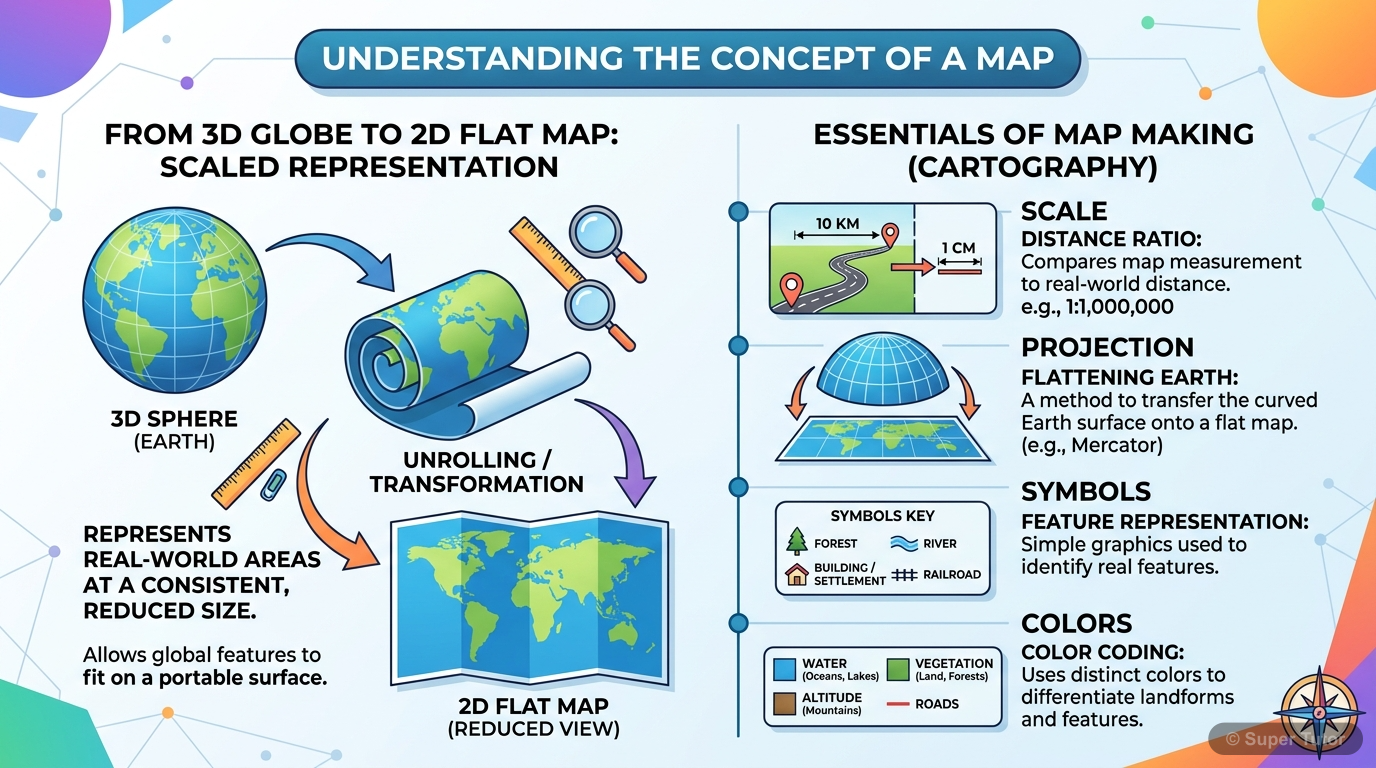
One of 9 illustrations for Interpretation of Topographical Maps-I in Super Tutor — alongside flashcards, concept maps and practice questions.
See them allQuick Quiz: Interpretation of Topographical Maps-I
0/4Tap an answer to check it instantly. No sign-up needed for these 4.
What is the scale of the topographical sheets G43S7 and G43S10 mentioned in the textbook?
What color is used to represent cultivable land on topographical maps?
What does the term 'topography' mean?
Who was the first Surveyor General of India?
Sample Questions
Which of the following features are shown in blue color on topographical maps?
Show answer
Perennial streams, Lakes and ponds, Lined wells
Blue color is used to represent all water features including perennial streams, lakes, ponds, and perennial lined wells. Forest areas are shown in green, and contour lines are shown in brown.
What is the contour interval for the topographical sheets mentioned in the textbook?
Show answer
20 metres
The textbook specifically mentions that the contour interval is 20 metres, which means the vertical distance between two adjacent contour lines is 20 metres.
Which types of settlements can be identified on topographical maps?
Show answer
Nucleated settlements, Linear settlements, Scattered settlements
Topographical maps show three main types of settlements: nucleated (clustered together), linear (along roads), and scattered (dispersed over large areas). Circular settlements are not a standard classification.
What does a spot height represent on a topographical map?
Show answer
Height of a particular point above sea level
A spot height shows the exact height of a particular point measured above sea level, displayed as a number like .240, meaning 240 metres above sea level.
+40 more questions on Interpretation of Topographical Maps-I (ICSE Class 10 Geography)
Practise AllFrequently Asked Questions
What are the important topics in Interpretation of Topographical Maps-I for ICSE Class 10 Geography?
How many practice questions are there for Interpretation of Topographical Maps-I?
Sources & Official References
Content is aligned to the official syllabus. Refer to the board website for the latest curriculum.
More resources for Interpretation of Topographical Maps-I
Important Questions
Exam-style questions with answers
Revision Notes
Key points for last-minute revision
Formula Sheet
The chapter's formulas in one place
Chapter Summary
Understand the chapter at a glance
Concept Maps
See how topics connect
Study Plan
Step-by-step plan for this chapter
Flashcards
Quick-fire cards for active recall
Syllabus
What topics to cover
For serious students
Get the full Interpretation of Topographical Maps-I chapter — start free.
Quizzes, flashcards, an AI doubt solver and a study plan for ICSE Class 10 Geography. Free to start, no card needed.