Interpretation of Topographical Maps-I — Flashcards
ICSE · Class 10 · Geography
36 flashcards for Interpretation of Topographical Maps-I (ICSE Class 10 Geography) to test yourself on key terms and facts. Sample: "What is a map?"
Interactive on Super Tutor
Studying Interpretation of Topographical Maps-I? Get the full interactive chapter.
Quizzes, flashcards, AI doubt-solver and a step-by-step study plan — built for flashcards and more.
Free trial, no card needed.
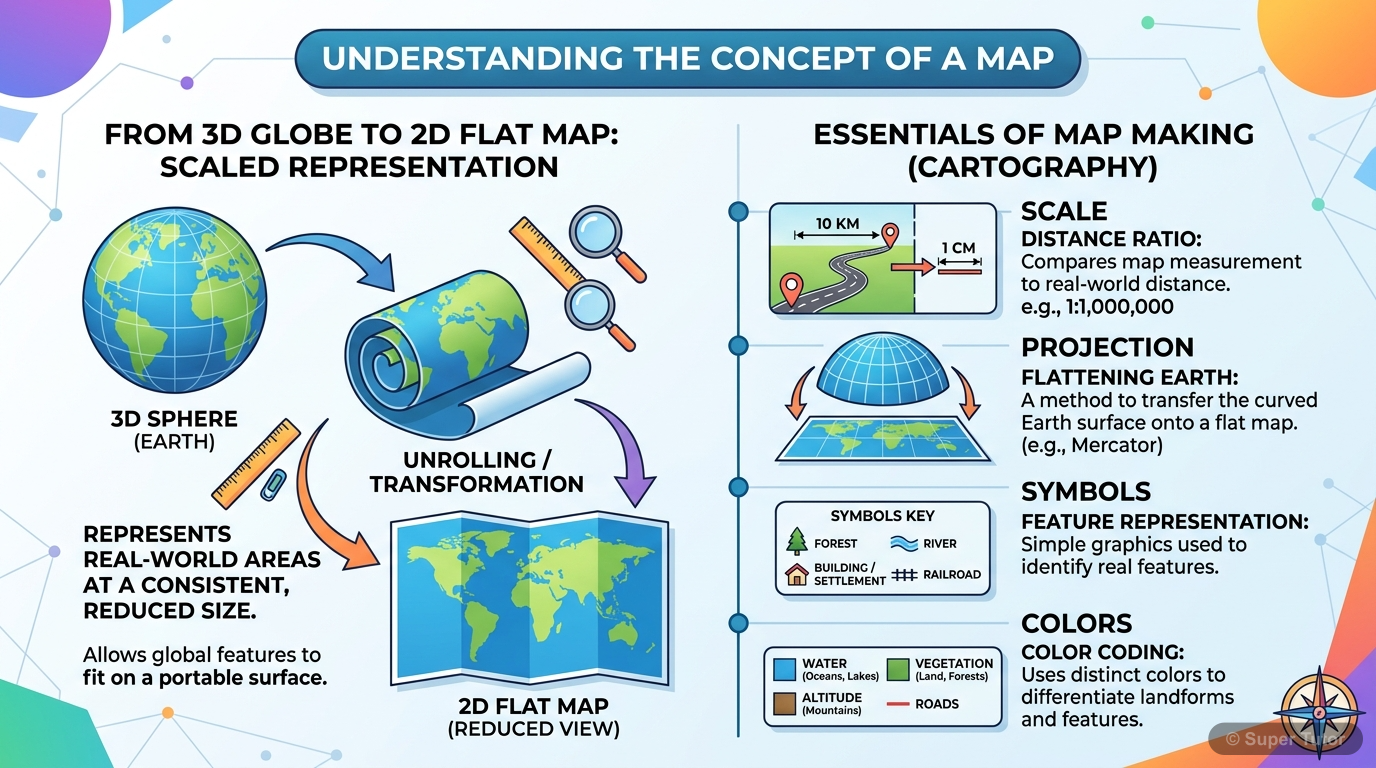
One of 9 illustrations for Interpretation of Topographical Maps-I in Super Tutor — alongside flashcards, concept maps and practice questions.
See them allWhat is a map?
Answer
A map is a two dimensional scaled representation of the Earth's surface or a part of it, showing physical and human-made features through a combination of symbols lines and colours. It is also a simpl…
Why are map projections needed in map making?
Answer
The Earth is three-dimensional, but a map is flat. A map projection helps represent the curved surface of the Earth on a plane surface. Without projection, the positions of places on a flat map would …
What does cartography mean?
Answer
Cartography is the art of map drawing which represents the world and its features on a flat surface. It is an important part of geography because it helps in presenting large amounts of information in…
What is the difference between a large scale map and a small scale map?
Answer
Large scale means large amount of detail and it can only show a small area. Small scale means small amount of detail and it can show a large area. A topographical sheet at 1:50,000 is much more detail…
What is the scale of Survey Map No. G43SI0?
Answer
Representative Fraction (R.F.) scale of Survey Map G43SI0 is 1 : 50,000. The map scale equivalence is 2 cm = 1 km on this map.
What is contour interval?
Answer
Contour Interval: 20 m. It is the vertical distance between two adjacent contour lines, also called vertical interval (VI). On this map, successive contours differ by 20 metres in height.
What is a contour on a topographical map?
Answer
Contour - Lines drawn in brown, joining place of equal height above the sea level. Contours help to show the shape of the land and the height of hills, slopes, and valleys.
How are heights shown on a topographical map?
Answer
Heights and contours are given in metres and above Indian mean sea level. Spot heights show the height of a particular point, and relative heights show differences in height such as embankments, wells…
+28 more flashcards
Practise AllFrequently Asked Questions
What are the important topics in Interpretation of Topographical Maps-I for ICSE Class 10 Geography?
How many flashcards are available for Interpretation of Topographical Maps-I?
How should I revise Interpretation of Topographical Maps-I for the ICSE Class 10 board exam?
Sources & Official References
Content is aligned to the official syllabus. Refer to the board website for the latest curriculum.
More resources for Interpretation of Topographical Maps-I
Practice Quiz
Test yourself with a quick quiz
Important Questions
Exam-style questions with answers
Revision Notes
Key points for last-minute revision
Formula Sheet
The chapter's formulas in one place
Chapter Summary
Understand the chapter at a glance
Concept Maps
See how topics connect
Study Plan
Step-by-step plan for this chapter
Syllabus
What topics to cover
For serious students
Get the full Interpretation of Topographical Maps-I chapter — start free.
Quizzes, flashcards, an AI doubt solver and a study plan for ICSE Class 10 Geography. Free to start, no card needed.