Interpretation of Topographical Maps-I
ICSE · Class 10 · Geography
Quick revision notes for Interpretation of Topographical Maps-I — ICSE Class 10 Geography. Key concepts, formulas, and definitions for last-minute revision.
Interactive on Super Tutor
Studying Interpretation of Topographical Maps-I? Get the full interactive chapter.
Quizzes, flashcards, AI doubt-solver and a step-by-step study plan — built for revision notes and more.
1,000+ Class 10 students started this chapter today
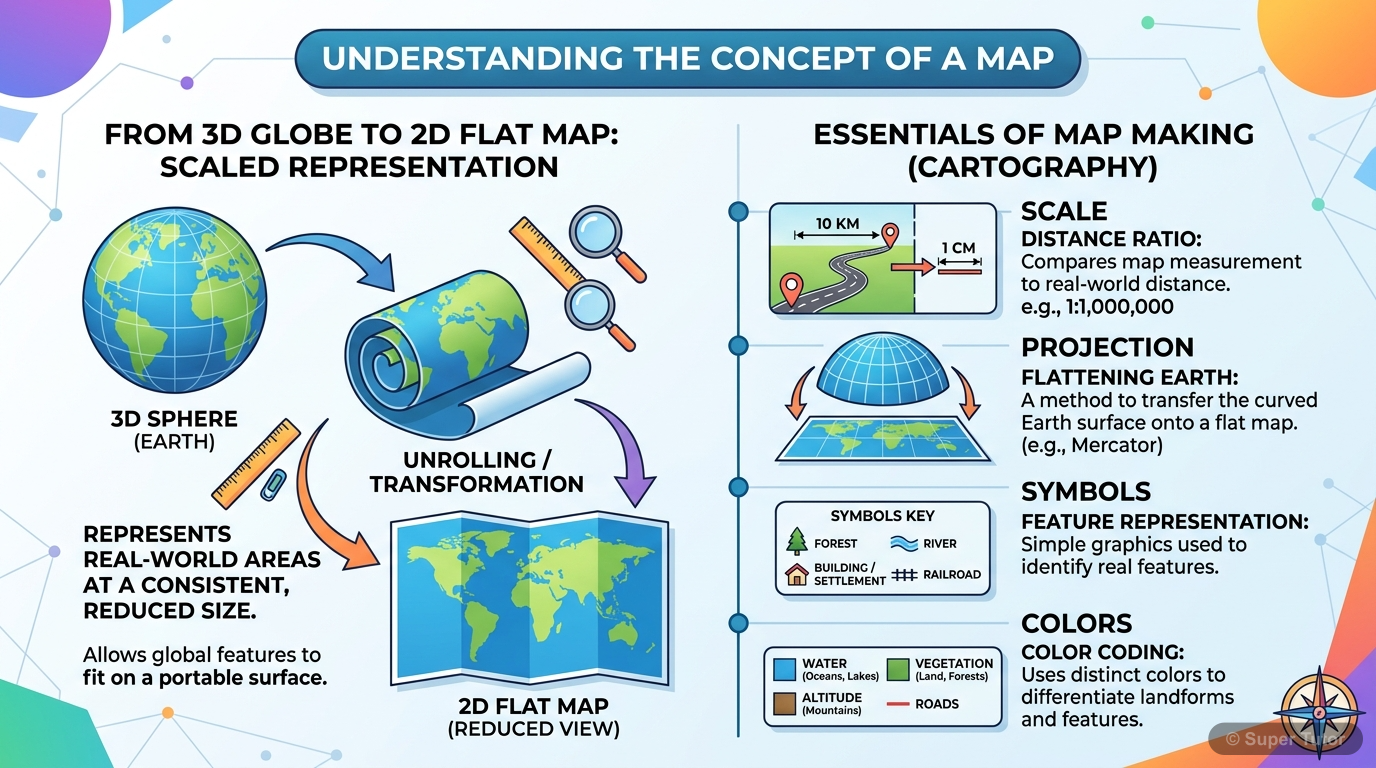
Learn better with visuals Super Tutor has hundreds of illustrations like this across every chapter — all free to try.
Get startedKey Topics to Revise
1. Concept of a Map and Scale
- A map is a two dimensional scaled representation of the Earth's surface or a part of it, showing physical and human-made features through a combination of symbols lines and colours.
- A map is a simplified, two-dimensional depiction of the whole or part of the three-dimensional earth, drawn using a system of map projections.
- Maps are selective, symbolised and generalised representations of the earth's surface on a plane surface at a reduced scale.
2. Topographical Maps and Survey of India
- Topographical or Ordnance Survey Maps were first made for the British Army around 1765 under Maj. General Roy.
- The Survey of India Department was established by the British in India in 1767.
- Major James Renell was the first Surveyor General of India.
3. Conventional Colours and Signs
- Conventional colours are accepted all over the world and help in reading topographical maps correctly.
- Yellow colour stands for cultivable land.
- Orange colour stands for plateau.
4. Open Series Maps and Sheet Numbering
- Open Series Maps were introduced as per the National Map Policy of 2005 by Survey of India.
- They replaced the previous India and Adjacent Countries numbering system.
- The map series is based on Universal Transverse Mercator projection on WGS-1984 datum.
Get complete notes with diagrams and examples
Full NotesKey Concepts
Frequently Asked Questions
What are the important topics in Interpretation of Topographical Maps-I for ICSE Class 10 Geography?
How to score full marks in Interpretation of Topographical Maps-I — ICSE Class 10 Geography?
Sources & Official References
Content is aligned to the official syllabus. Refer to the board website for the latest curriculum.
More resources for Interpretation of Topographical Maps-I
Practice Quiz
Test yourself with a quick quiz
Important Questions
Practice with board exam-style questions
Formula Sheet
All formulas in one place
Chapter Summary
Understand the chapter at a glance
Concept Maps
See how topics connect visually
Study Plan
Step-by-step plan to ace this chapter
Flashcards
Quick-fire cards for active recall
Syllabus
What topics to cover
NCERT Solutions
Every textbook question solved step by step
For serious students
Get the full Interpretation of Topographical Maps-I chapter — for free.
Quizzes, flashcards, AI doubt-solver and a step-by-step study plan for ICSE Class 10 Geography.