Chapter 5 of 17
Revision Notes
Soil Resources in India — Revision Notes
ICSE · Class 10 · Geography
Soil Resources in India revision notes for ICSE Class 10 Geography: 4 topics in quick points. Part of the ICSE Class 10 Geography syllabus.
43 questions37 flashcards5 concepts
Interactive on Super Tutor
Studying Soil Resources in India? Get the full interactive chapter.
Quizzes, flashcards, AI doubt-solver and a step-by-step study plan — built for revision notes and more.
Free trial, no card needed.
Super Tutor
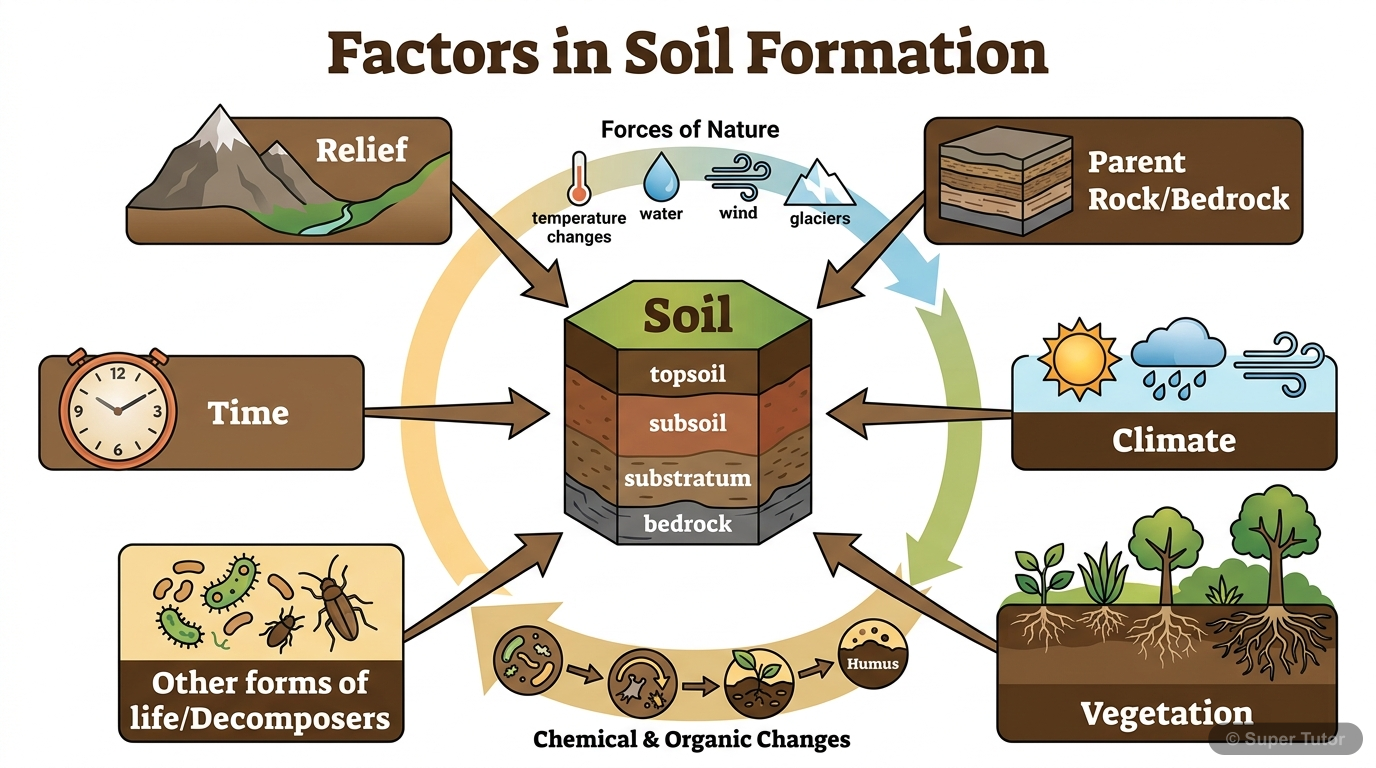
Learn better with visuals Super Tutor pairs illustrations like this with notes and quizzes for Soil Resources in India.
Get startedKey Topics to Revise
1
Importance, Formation and Composition of Soil
- Soil is the loose material forming the thin surface layer of the Earth.
- Soil supports plants, animals and human life because food production depends on fertile soil.
- Soil formation depends on parent rock material, relief, climate, vegetation, animals, insects and human activity.
2
Soil Erosion and Soil Conservation
- Soil erosion is the removal of nutrient-rich topsoil by water, wind and human activities.
- Running water is a major cause of erosion during rainfall and runoff in monsoon season.
- Sheet erosion removes a thin layer of surface soil uniformly across a wide area.
3
Major Soil Groups of India
- Indian soils are broadly divided into two geological groups: soils of Peninsular India and soils of extra peninsular India.
- Soils of Peninsular India are formed in situ from the decomposition of rocks and are sedentary soils.
- Soils of extra peninsular India are formed by transported or residual alluvium brought by rivers or wind.
4
Alluvial Soils
- Alluvial soils are the most important and widespread soil group of India.
- They occupy about 15 lakh sq. km, or about 45.6% of the total land area of India.
- They are formed from transported alluvium brought by rivers, so they are also called river soil.
Get complete notes with diagrams and examples
Full NotesKey Concepts
Soil forms through pedogenesisSoil contains inorganic materials such asSoil erosion is the removalSheet erosion removes a thin layerSoil conservation means preventing soil erosion
Frequently Asked Questions
What are the important topics in Soil Resources in India for ICSE Class 10 Geography?
Key topics in Soil Resources in India include Importance, Formation and Composition of Soil, Soil Erosion and Soil Conservation, Major Soil Groups of India, Alluvial Soils. Study these first, then practise questions on each for the ICSE Class 10 board exam.
How should I revise Soil Resources in India for the ICSE Class 10 board exam?
Learn the core ideas first, then work through the 43 practice questions on Soil Resources in India. Revise definitions regularly and use flashcards for quick recall before the exam.
Sources & Official References
Content is aligned to the official syllabus. Refer to the board website for the latest curriculum.
More resources for Soil Resources in India
For serious students
Get the full Soil Resources in India chapter — start free.
Quizzes, flashcards, an AI doubt solver and a study plan for ICSE Class 10 Geography. Free to start, no card needed.