Soil Resources in India
ICSE · Class 10 · Geography
Summary of Soil Resources in India for ICSE Class 10 Geography. Key concepts, important points, and chapter overview.
Interactive on Super Tutor
Studying Soil Resources in India? Get the full interactive chapter.
Quizzes, flashcards, AI doubt-solver and a step-by-step study plan — built for chapter summary and more.
1,000+ Class 10 students started this chapter today
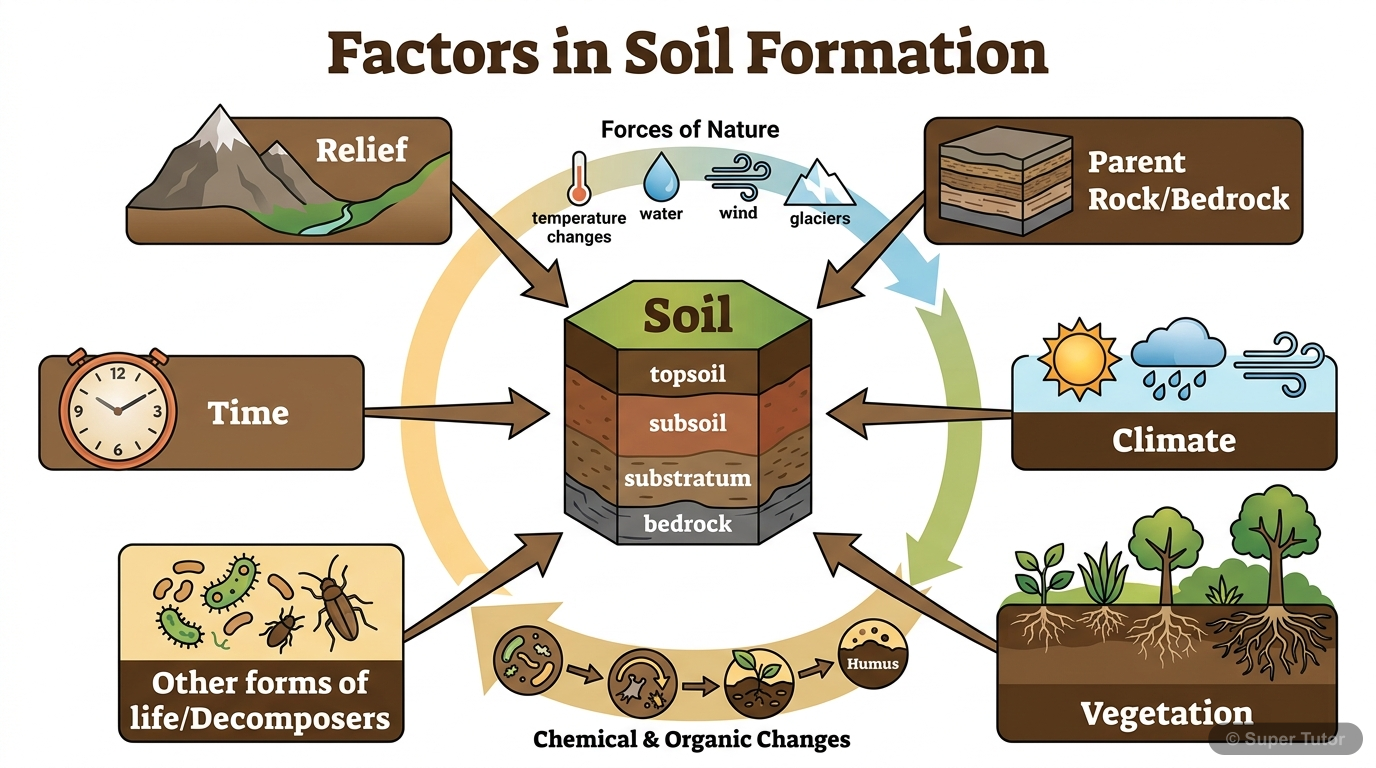
This is just one of 7+ visuals inside Super Tutor's Soil Resources in India chapter
Explore the full setOverview
Soil is the loose material that forms the thin surface layer of the Earth. It is a renewable natural resource, but it takes a long time to form again after it is lost. Soil supports plant growth, livestock, and human life by supplying the food base for agriculture. Soil formation is called pedogenes
Key Concepts
Soil forms through pedogenesis
Soil forms through pedogenesis, the process in which rocks break down and mix with organic matter over a long period. It develops under the influence
Soil contains inorganic materials such as
Soil contains inorganic materials such as silica, clay, and chalk, and organic matter such as humus. Humus is the ultimate form of organic matter and
Soil erosion is the removal
Soil erosion is the removal of fertile topsoil by water, wind, and human activities. It reduces agricultural productivity and damages land resources.
Sheet erosion removes a thin layer
Sheet erosion removes a thin layer of surface soil over a wide area. Rill erosion forms small shallow channels. Gully erosion creates large, deep chan
Soil conservation means preventing soil erosion
Soil conservation means preventing soil erosion and retaining soil fertility. Measures include afforestation, checking overgrazing, building dams and
Learning Objectives
- Understand the meaning and formation of soil
- Learn the main components of soil and their role in fertility
- Explain soil erosion and its major types
- Describe soil conservation methods and government measures
- Identify the major soil groups of India and their features
Frequently Asked Questions
What are the important topics in Soil Resources in India for ICSE Class 10 Geography?
How to score full marks in Soil Resources in India — ICSE Class 10 Geography?
Sources & Official References
Content is aligned to the official syllabus. Refer to the board website for the latest curriculum.
More resources for Soil Resources in India
Practice Quiz
Test yourself with a quick quiz
Important Questions
Practice with board exam-style questions
Revision Notes
Key points for last-minute revision
Formula Sheet
All formulas in one place
Concept Maps
See how topics connect visually
Study Plan
Step-by-step plan to ace this chapter
Flashcards
Quick-fire cards for active recall
Syllabus
What topics to cover
NCERT Solutions
Every textbook question solved step by step
For serious students
Get the full Soil Resources in India chapter — for free.
Quizzes, flashcards, AI doubt-solver and a step-by-step study plan for ICSE Class 10 Geography.