Chapter 3 of 17
Revision Notes
Location, Extent and Physical Features of India — Revision Notes
ICSE · Class 10 · Geography
Location, Extent and Physical Features of India revision notes for ICSE Class 10 Geography: 4 topics in quick points.
42 questions34 flashcards5 concepts
Interactive on Super Tutor
Studying Location, Extent and Physical Features of India? Get the full interactive chapter.
Quizzes, flashcards, AI doubt-solver and a step-by-step study plan — built for revision notes and more.
Free trial, no card needed.
Super Tutor
Learn better with visuals Super Tutor pairs illustrations like this with notes and quizzes for Location, Extent and Physical Features of India.
Get startedKey Topics to Revise
1
Location and Extent of India
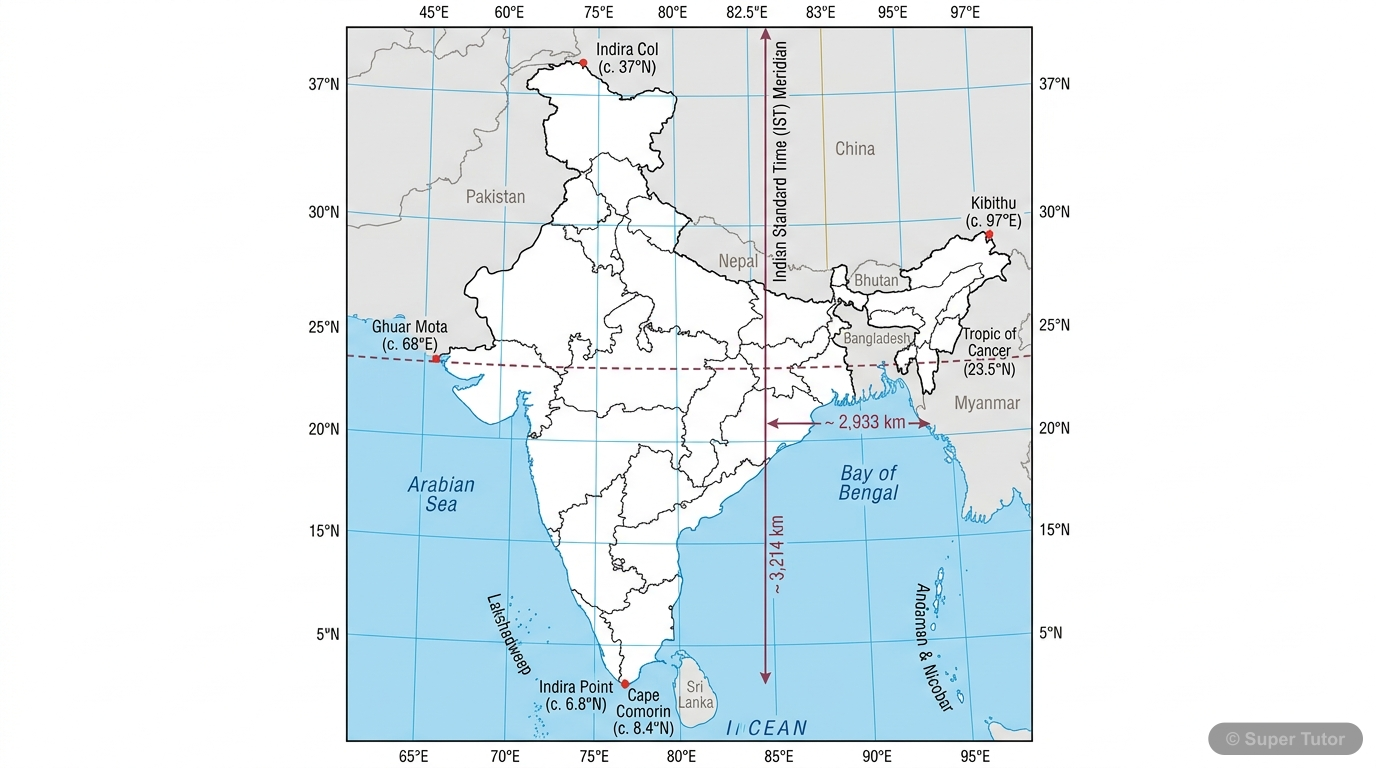
- India extends from 8°N to 37°N latitudes and from 68°E to 97°E longitudes.
- The area of India is 3,287,240 sq km.
- The precise coordinates of India are Lat. 8°4'N to 37°6'N and Long. 68°7'E to 97°25'E.
2
India and Neighbouring Countries
- India is separated from the rest of Asia in the north by the Great Himalayas, forming an insulated compartment.
- In the south, south-west, and south-east, India is washed by the Indian Ocean, Arabian Sea, and Bay of Bengal respectively.
- Immediately across the northern border lies the Tibet plateau, home to Kailash and Mansarovar Lake.
3
Physical Divisions of India
- The physical geography of India is divided into five main parts: the Himalayan Mountains, the Great Plain of North India, the Peninsular Plateau, the Coastal Plains, and the Islands.
- These physical divisions influence climate, settlement, farming, transport, and natural resources.
- The Himalayas form the northern wall of India and include several parallel ranges and offshoots.
4
The Himalayan Mountains
- The north wall of the Himalayas is divided into three parts: the North-West Range, the Northern Himalayan Range or Northern Arc, and the North-East Himalayan Range or Purvanchal.
- The North-West Range is a series of mountain ranges radiating from the Pamir Knot, known as the Roof of the World.
- The North-West Range includes Hindukush, Kunlun, Karakoram, and Ladakh and Zaskar.
Get complete notes with diagrams and examples
Full NotesKey Concepts
India extends from 8°N to 37°NThe Tropic of Cancer passes throughIndia shares land boundaries with countriesIndia has five major physical divisionsThe Himalayas form India’s northern wall
Frequently Asked Questions
What are the important topics in Location, Extent and Physical Features of India for ICSE Class 10 Geography?
Key topics in Location, Extent and Physical Features of India include Location and Extent of India, India and Neighbouring Countries, Physical Divisions of India, The Himalayan Mountains. Study these first, then practise questions on each for the ICSE Class 10 board exam.
How should I revise Location, Extent and Physical Features of India for the ICSE Class 10 board exam?
Learn the core ideas first, then work through the 42 practice questions on Location, Extent and Physical Features of India. Revise definitions regularly and use flashcards for quick recall before the exam.
Sources & Official References
Content is aligned to the official syllabus. Refer to the board website for the latest curriculum.
More resources for Location, Extent and Physical Features of India
For serious students
Get the full Location, Extent and Physical Features of India chapter — start free.
Quizzes, flashcards, an AI doubt solver and a study plan for ICSE Class 10 Geography. Free to start, no card needed.