Mineral and Energy Resources II — Revision Notes
ICSE · Class 10 · Geography
Mineral and Energy Resources II revision notes for ICSE Class 10 Geography: 4 topics in quick points. Part of the ICSE Class 10 Geography syllabus.
Interactive on Super Tutor
Studying Mineral and Energy Resources II? Get the full interactive chapter.
Quizzes, flashcards, AI doubt-solver and a step-by-step study plan — built for revision notes and more.
Free trial, no card needed.
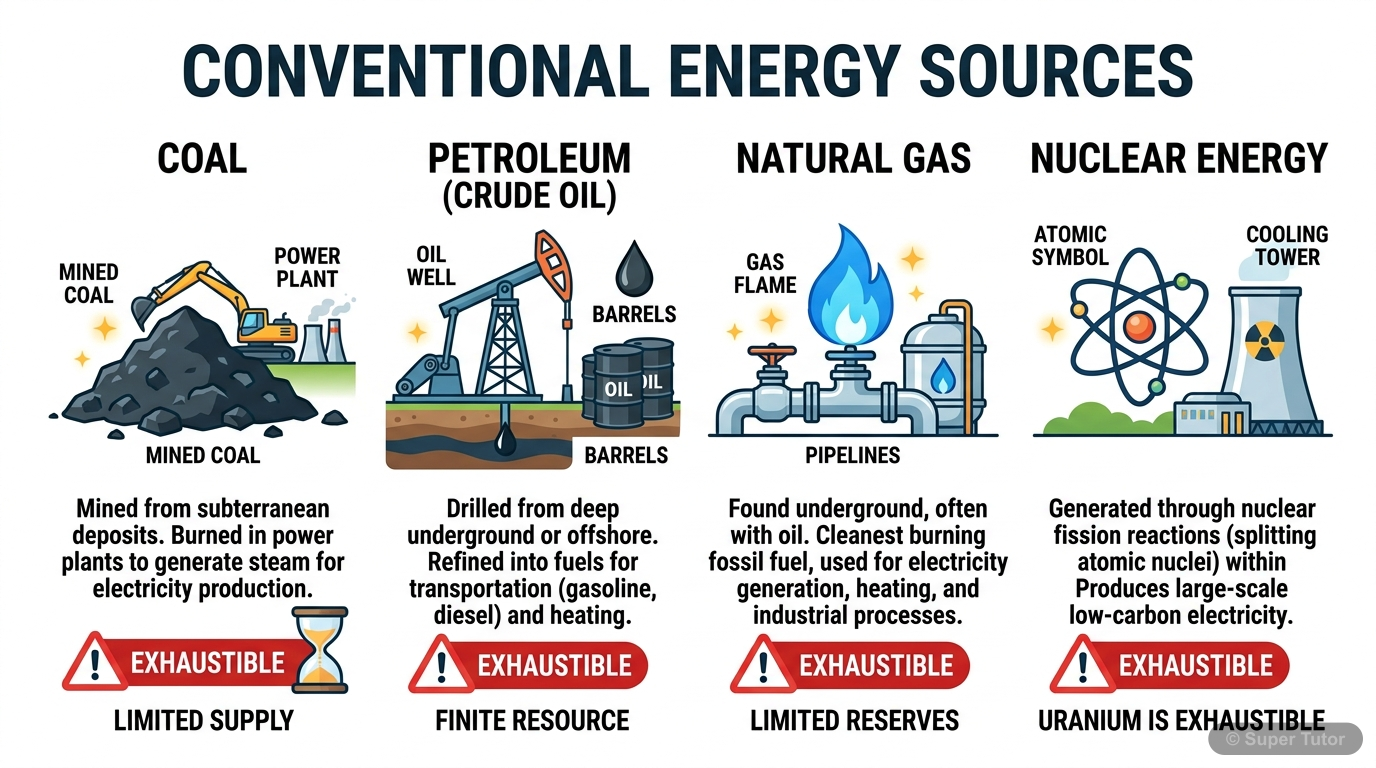
Learn better with visuals Super Tutor pairs illustrations like this with notes and quizzes for Mineral and Energy Resources II.
Get startedKey Topics to Revise
1. Conventional Sources of Energy
- Conventional sources of energy are non-renewable and exhaustible.
- Coal, petroleum, and natural gas are the main conventional energy sources.
- These sources cause pollution when used, and they cannot be replaced quickly once exhausted.
2. Coal
- Coal is a conventional energy source and an inflammable organic substance composed of hydrocarbons found in sedimentary rocks.
- It is the main source of power generation in India.
- India is the third largest producer of coal in the world.
3. Distribution and Types of Coal in India
- Jharkhand has the largest reserves of coal in India, with 33.53%.
- West Bengal produces about 18% of India's coal reserves.
- Jharkhand, Odisha, West Bengal, and Madhya Pradesh account for nearly 90% of India's coal reserves.
4. Petroleum
- Petroleum is a conventional source of energy and an inflammable liquid composed mainly of hydrocarbons.
- The word petroleum comes from the Latin words Petrol and Oleam.
- Hydrocarbons form 90-95% of petroleum.
Get complete notes with diagrams and examples
Full NotesKey Concepts
Frequently Asked Questions
What are the important topics in Mineral and Energy Resources II for ICSE Class 10 Geography?
How should I revise Mineral and Energy Resources II for the ICSE Class 10 board exam?
Sources & Official References
Content is aligned to the official syllabus. Refer to the board website for the latest curriculum.
More resources for Mineral and Energy Resources II
Practice Quiz
Test yourself with a quick quiz
Important Questions
Exam-style questions with answers
Formula Sheet
The chapter's formulas in one place
Chapter Summary
Understand the chapter at a glance
Concept Maps
See how topics connect
Study Plan
Step-by-step plan for this chapter
Flashcards
Quick-fire cards for active recall
Syllabus
What topics to cover
For serious students
Get the full Mineral and Energy Resources II chapter — start free.
Quizzes, flashcards, an AI doubt solver and a study plan for ICSE Class 10 Geography. Free to start, no card needed.