Climate of India — Syllabus
ICSE · Class 10 · Geography
What Climate of India covers in ICSE Class 10 Geography: 4 topics, for the 2026-27 session. Part of the ICSE Class 10 Geography syllabus.
Interactive on Super Tutor
Studying Climate of India? Get the full interactive chapter.
Quizzes, flashcards, AI doubt-solver and a step-by-step study plan — built for syllabus and more.
Free trial, no card needed.
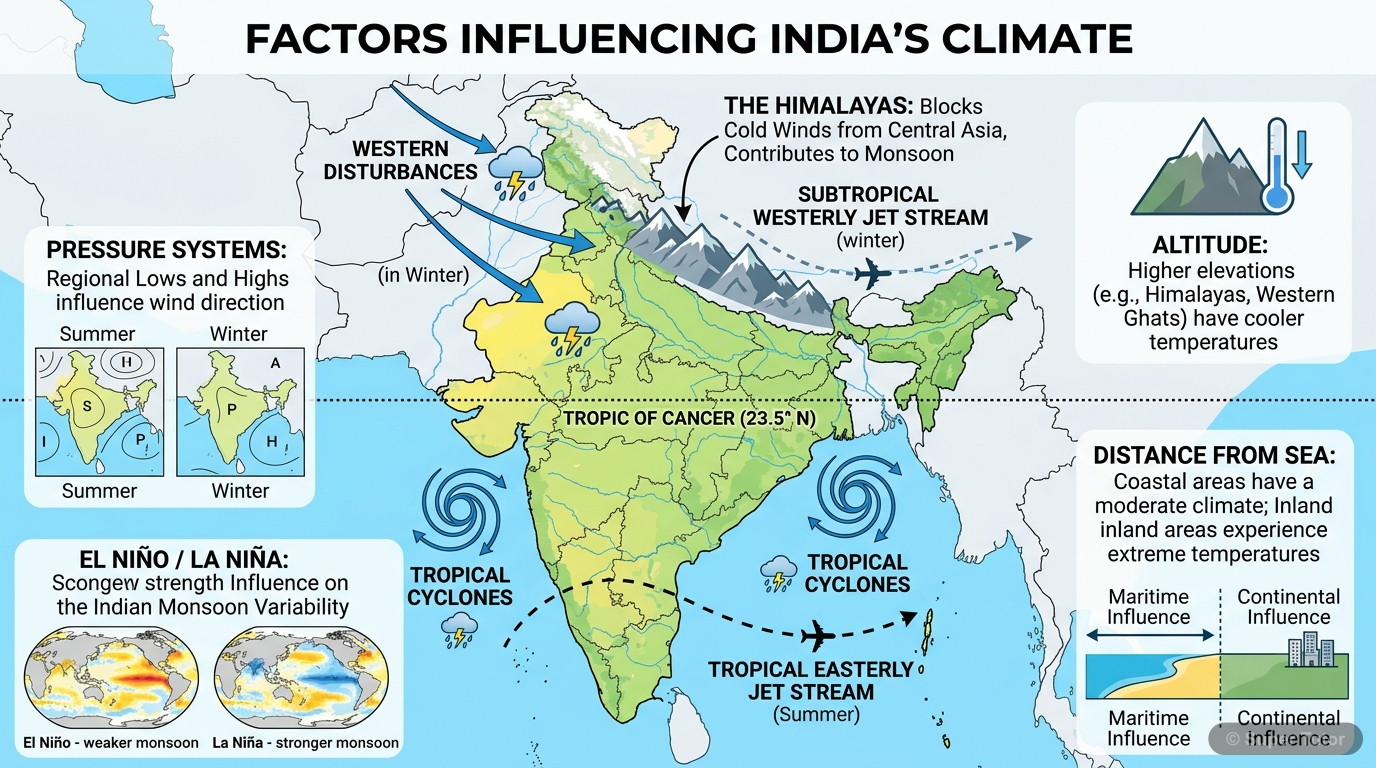
Learn better with visuals Super Tutor pairs illustrations like this with notes and quizzes for Climate of India.
Get startedTopics in Climate of India
1. Major Factors Affecting the Climate of India
- India extends about 3200 km from north to south, from 8°N to 37°6'N.
- The Tropic of Cancer passes through Gujarat, Rajasthan, Madhya Pradesh, Chhattisgarh, Jharkhand, West Bengal, Tripura and Mizoram.
- The Tropic of Cancer divides India into two parts: the North Temperate Zone and the South Tropical Zone.
2. Temperature Conditions in India
- Rajasthan can reach 45-50°C in summer.
- Central India averages about 45°C in May.
- South India averages about 38-40°C in May.
3. Rainfall in India
- The annual rainfall varies from about 1187 cm at Mawsynram to less than 25 cm in the Thar Desert.
- Mawsynram is 16 km west of Cherrapunji in Meghalaya.
- Cherrapunji is a nearby reference point for the world’s highest rainfall region.
4. The South-West Monsoon
- The South-West Monsoon is the rainy season in India and lasts from June to September.
- The advance of the South-West Monsoon can be seen on satellite pictures between 1st and 5th June every year.
- The Arabian Sea branch strikes Kerala on 1st June.
Key Concepts
Central concept: India's climate is Tropical Monsoon Climate shaped by latitude, the Himalayas, altitude, distance from the sea, pressure systems, monsoon winds, and local winds.
Work through every topic in Climate of India with notes and quizzes
Start This ChapterFrequently Asked Questions
What are the important topics in Climate of India for ICSE Class 10 Geography?
How should I revise Climate of India for the ICSE Class 10 board exam?
Sources & Official References
Content is aligned to the official syllabus. Refer to the board website for the latest curriculum.
More resources for Climate of India
Practice Quiz
Test yourself with a quick quiz
Important Questions
Exam-style questions with answers
Revision Notes
Key points for last-minute revision
Formula Sheet
The chapter's formulas in one place
Chapter Summary
Understand the chapter at a glance
Concept Maps
See how topics connect
Study Plan
Step-by-step plan for this chapter
Flashcards
Quick-fire cards for active recall
For serious students
Get the full Climate of India chapter — start free.
Quizzes, flashcards, an AI doubt solver and a study plan for ICSE Class 10 Geography. Free to start, no card needed.