Interpretation of Topographical Maps-II — Syllabus
ICSE · Class 10 · Geography
What Interpretation of Topographical Maps-II covers in ICSE Class 10 Geography: 4 topics, for the 2026-27 session.
Interactive on Super Tutor
Studying Interpretation of Topographical Maps-II? Get the full interactive chapter.
Quizzes, flashcards, AI doubt-solver and a step-by-step study plan — built for syllabus and more.
Free trial, no card needed.
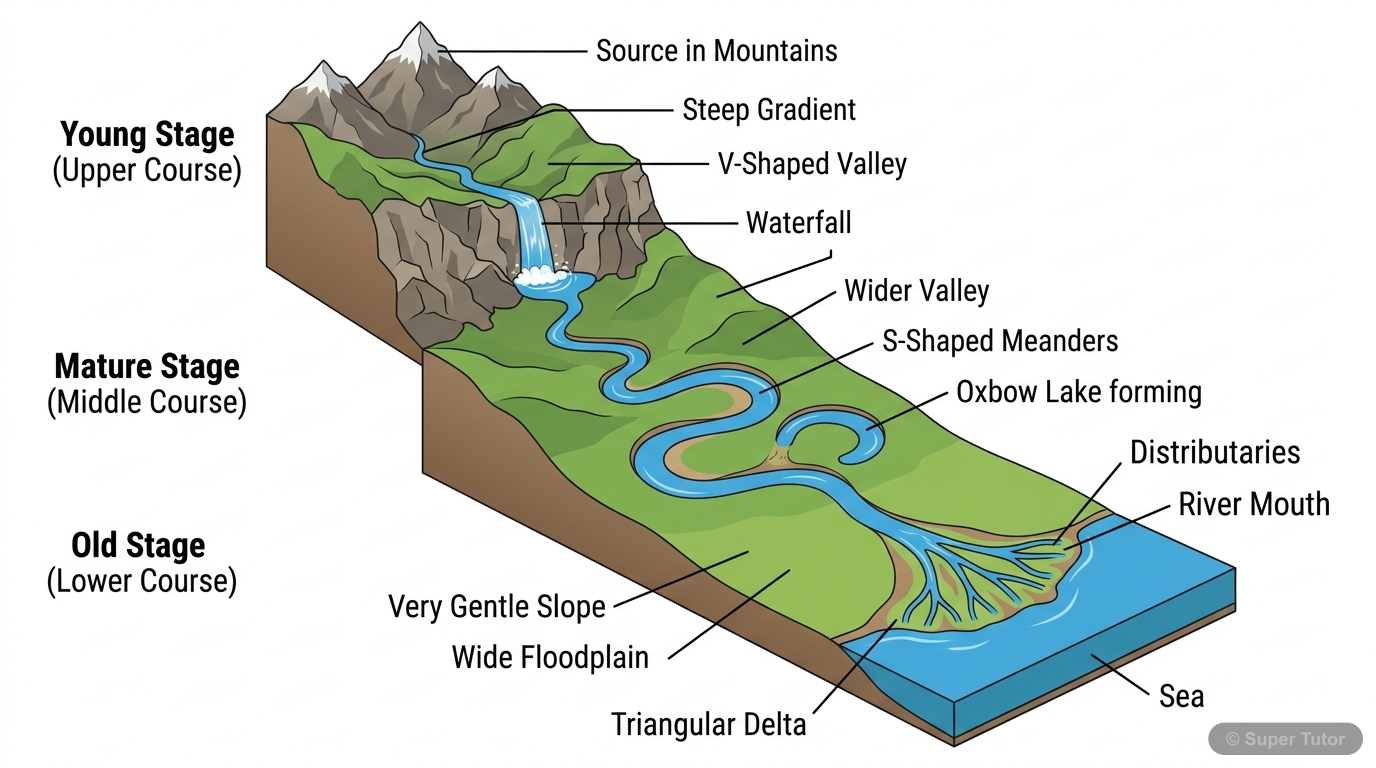
One of 9 illustrations for Interpretation of Topographical Maps-II in Super Tutor — alongside flashcards, concept maps and practice questions.
See them allTopics in Interpretation of Topographical Maps-II
Grid Reference and National Grid
- The National Grid divides surveyed territory into 100 km x 100 km squares designated by two English alphabets.
- Each 100 km x 100 km sheet is divided into 10,000 squares of 1 km x 1 km.
- The network of horizontal and vertical lines on a National Grid map is called the Grid or Grid Reference.
Scale and Distance Measurement
- A map scale shows the relationship between map distance and ground distance.
- Scale can be expressed in three ways: statement, representative fraction, and linear scale.
- Representative Fraction is a ratio between the distance on the map and the corresponding distance on the ground in the same units.
Relief Representation by Contours
- A contour line is an imaginary line joining all places at the same height above mean sea level.
- Contour lines show relief in a three-dimensional way on a two-dimensional map.
- The vertical distance between two contours is 20 m.
Drainage Patterns and River Features
- A drainage basin is an area drained collectively by a river and its tributaries and sub-tributaries.
- A catchment area is an area drained by a single river.
- Three drainage patterns are commonly recognized: dendritic, trellis, and radial.
Key Concepts
Central concept: Interpretation of topographical maps through grid reference, scale, relief, drainage, land use, transport, directions, distances, area, and map-pointing skills
Work through every topic in Interpretation of Topographical Maps-II with notes and quizzes
Start This ChapterFrequently Asked Questions
What are the important topics in Interpretation of Topographical Maps-II for ICSE Class 10 Geography?
How should I revise Interpretation of Topographical Maps-II for the ICSE Class 10 board exam?
Sources & Official References
Content is aligned to the official syllabus. Refer to the board website for the latest curriculum.
More resources for Interpretation of Topographical Maps-II
Practice Quiz
Test yourself with a quick quiz
Important Questions
Exam-style questions with answers
Revision Notes
Key points for last-minute revision
Formula Sheet
The chapter's formulas in one place
Chapter Summary
Understand the chapter at a glance
Concept Maps
See how topics connect
Study Plan
Step-by-step plan for this chapter
Flashcards
Quick-fire cards for active recall
For serious students
Get the full Interpretation of Topographical Maps-II chapter — start free.
Quizzes, flashcards, an AI doubt solver and a study plan for ICSE Class 10 Geography. Free to start, no card needed.