Programme and Achievements of the Early Nationalists (Moderates)
ICSE · Class 10 · History & Civics
Complete topic list for Programme and Achievements of the Early Nationalists (Moderates) in ICSE Class 10 History & Civics. Key concepts, sub-topics, and what to focus on for board exams.
Interactive on Super Tutor
Studying Programme and Achievements of the Early Nationalists (Moderates)? Get the full interactive chapter.
Quizzes, flashcards, AI doubt-solver and a step-by-step study plan — built for syllabus and more.
1,000+ Class 10 students started this chapter today
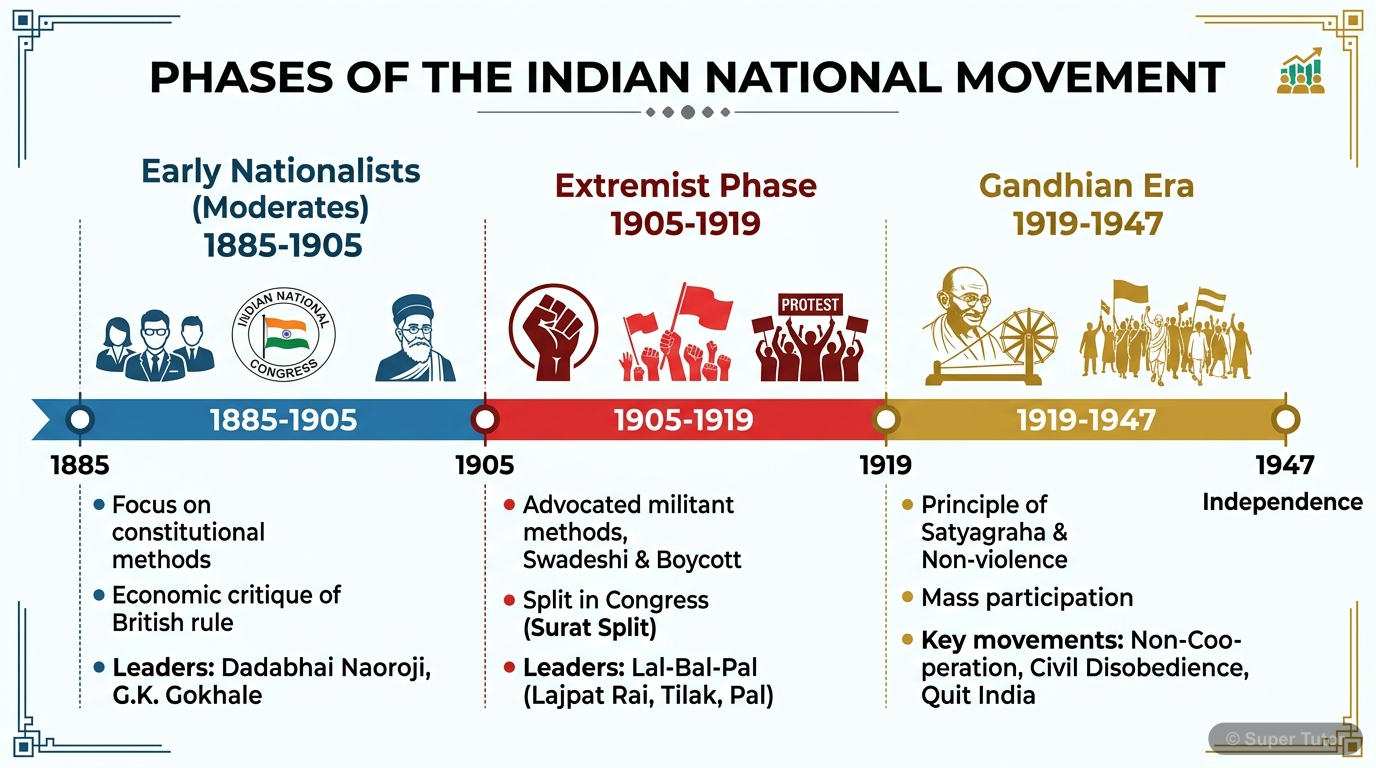
Super Tutor has 5+ illustrations like this for Programme and Achievements of the Early Nationalists (Moderates) alone — flashcards, concept maps, and step-by-step visuals.
See them allTopics in Programme and Achievements of the Early Nationalists (Moderates)
1. Early Nationalists and Their Position in the National Movement
- The history of the National Movement is divided into three phases: 1885-1905, 1905-1919, and 1919-1947.
- The period 1885-1905 is known as the period of the Early Nationalists.
- Important Early Nationalists included Dadabhai Naoroji, Surendranath Banerjea, Pherozeshah Mehta, Gopal Krishna Gokhale, Pt. Madan Mohan Malaviya, Justice Ranade, and Badruddin Tyabji.
2. Programme and Demands of the Early Nationalists
- The Early Nationalists wanted political and economic reforms to unite Indians on a common programme.
- They demanded constitutional reforms and a larger share in the government of their own country.
- They wanted the Legislative Councils to be expanded and reformed.
3. Methods of the Early Nationalists
- The Early Nationalists used moderate methods of struggle.
- They believed in patience and conciliation, not confrontation.
- They used constitutional means to realise their aims.
4. Beliefs of the Early Nationalists
- The Early Nationalists believed in constitutional and peaceful means.
- They were opposed to the use of force and violent methods.
- They were ready to wait for a long time if necessary.
Key Concepts
Central concept: Early Nationalists or Moderates in the first phase of the Indian National Movement from 1885 to 1905
Frequently Asked Questions
What are the important topics in Programme and Achievements of the Early Nationalists (Moderates) for ICSE Class 10 History & Civics?
How to score full marks in Programme and Achievements of the Early Nationalists (Moderates) — ICSE Class 10 History & Civics?
Sources & Official References
Content is aligned to the official syllabus. Refer to the board website for the latest curriculum.
More resources for Programme and Achievements of the Early Nationalists (Moderates)
Practice Quiz
Test yourself with a quick quiz
Important Questions
Practice with board exam-style questions
Revision Notes
Key points for last-minute revision
Formula Sheet
All formulas in one place
Chapter Summary
Understand the chapter at a glance
Concept Maps
See how topics connect visually
Study Plan
Step-by-step plan to ace this chapter
Flashcards
Quick-fire cards for active recall
NCERT Solutions
Every textbook question solved step by step
For serious students
Get the full Programme and Achievements of the Early Nationalists (Moderates) chapter — for free.
Quizzes, flashcards, AI doubt-solver and a step-by-step study plan for ICSE Class 10 History & Civics.