Programme and Achievements of the Early Nationalists (Moderates) — Flashcards
ICSE · Class 10 · History & Civics
34 flashcards for Programme and Achievements of the Early Nationalists (Moderates) (ICSE Class 10 History & Civics) to test yourself on key terms.
Interactive on Super Tutor
Studying Programme and Achievements of the Early Nationalists (Moderates)? Get the full interactive chapter.
Quizzes, flashcards, AI doubt-solver and a step-by-step study plan — built for flashcards and more.
Free trial, no card needed.
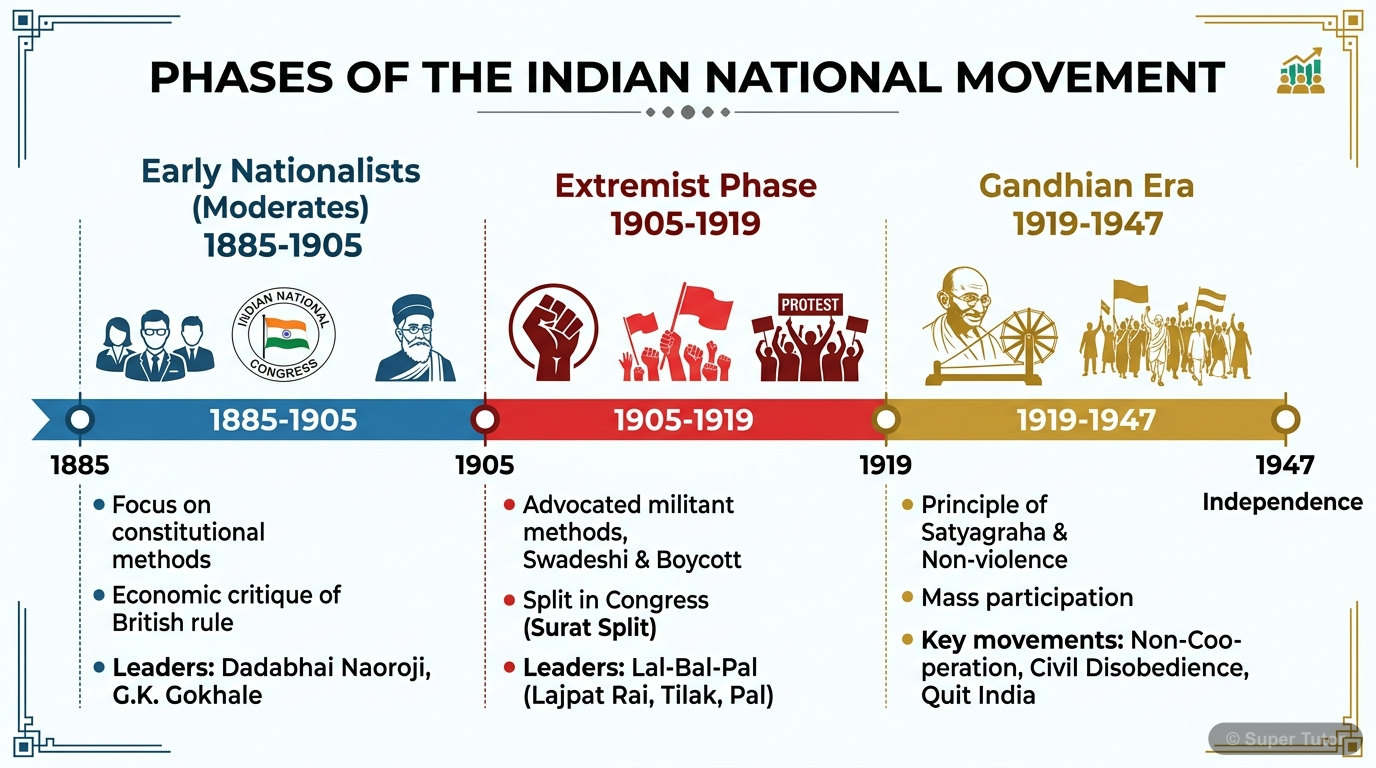
Learn better with visuals Super Tutor pairs illustrations like this with notes and quizzes for Programme and Achievements of the Early Nationalists (Moderates).
Get startedWhat is the first phase of the Indian National Movement, and why is it called the period of the Early Nationalists?
Answer
The first phase of the Indian National Movement lasted from 1885 to 1905. It is called the period of the Early Nationalists because leaders like Dadabhai Naoroji, Surendranath Banerjea, Pherozeshah Me…
Why were the Early Nationalists called Moderates?
Answer
The Early Nationalists were called Moderates for three main reasons: their demands were moderate and not extreme, their methods of struggle were moderate, and they had faith in the British Government.
What was the attitude of the Early Nationalists toward the British Government?
Answer
The Early Nationalists had faith in the British Government. They believed in British justice, fair play, honesty, and integrity. They thought the British would gradually grant reforms if Indians expre…
Explain the demand for constitutional reforms made by the Early Nationalists.
Answer
The Early Nationalists wanted a larger share in the government of India through constitutional reforms. They demanded the expansion and reform of the Legislative Councils, more powers for these counci…
What was Swaraj in the programme of the Early Nationalists?
Answer
Swaraj meant self-government within the British Empire. Gokhale raised this demand from the Congress platform in 1905, and Dadabhai Naoroji made it a key part of his presidential address in 1906. It w…
What economic reforms did the Early Nationalists demand?
Answer
The Early Nationalists blamed British rule for India’s economic backwardness. They demanded reduction in land revenue, rapid development of modern industries, use of Swadeshi goods, abolition of salt …
Why did the Early Nationalists oppose the salt tax?
Answer
They opposed the salt tax because it affected the poor and the lower middle class most severely. Their demand for its abolition was part of their economic reform programme, which aimed to reduce the b…
What did Indianisation of administrative services mean?
Answer
Indianisation of administrative services meant appointing educated Indians to higher government posts. The Early Nationalists demanded this because Europeans occupied most high posts and were paid hig…
+26 more flashcards
Practise AllFrequently Asked Questions
What are the important topics in Programme and Achievements of the Early Nationalists (Moderates) for ICSE Class 10 History & Civics?
How many flashcards are available for Programme and Achievements of the Early Nationalists (Moderates)?
How should I revise Programme and Achievements of the Early Nationalists (Moderates) for the ICSE Class 10 board exam?
Sources & Official References
Content is aligned to the official syllabus. Refer to the board website for the latest curriculum.
More resources for Programme and Achievements of the Early Nationalists (Moderates)
Practice Quiz
Test yourself with a quick quiz
Important Questions
Exam-style questions with answers
Revision Notes
Key points for last-minute revision
Chapter Summary
Understand the chapter at a glance
Concept Maps
See how topics connect
Study Plan
Step-by-step plan for this chapter
Syllabus
What topics to cover
For serious students
Get the full Programme and Achievements of the Early Nationalists (Moderates) chapter — start free.
Quizzes, flashcards, an AI doubt solver and a study plan for ICSE Class 10 History & Civics. Free to start, no card needed.