Programme and Achievements of the Early Nationalists (Moderates)
ICSE · Class 10 · History & Civics
Summary of Programme and Achievements of the Early Nationalists (Moderates) for ICSE Class 10 History & Civics. Key concepts, important points, and chapter overview.
Interactive on Super Tutor
Studying Programme and Achievements of the Early Nationalists (Moderates)? Get the full interactive chapter.
Quizzes, flashcards, AI doubt-solver and a step-by-step study plan — built for chapter summary and more.
1,000+ Class 10 students started this chapter today
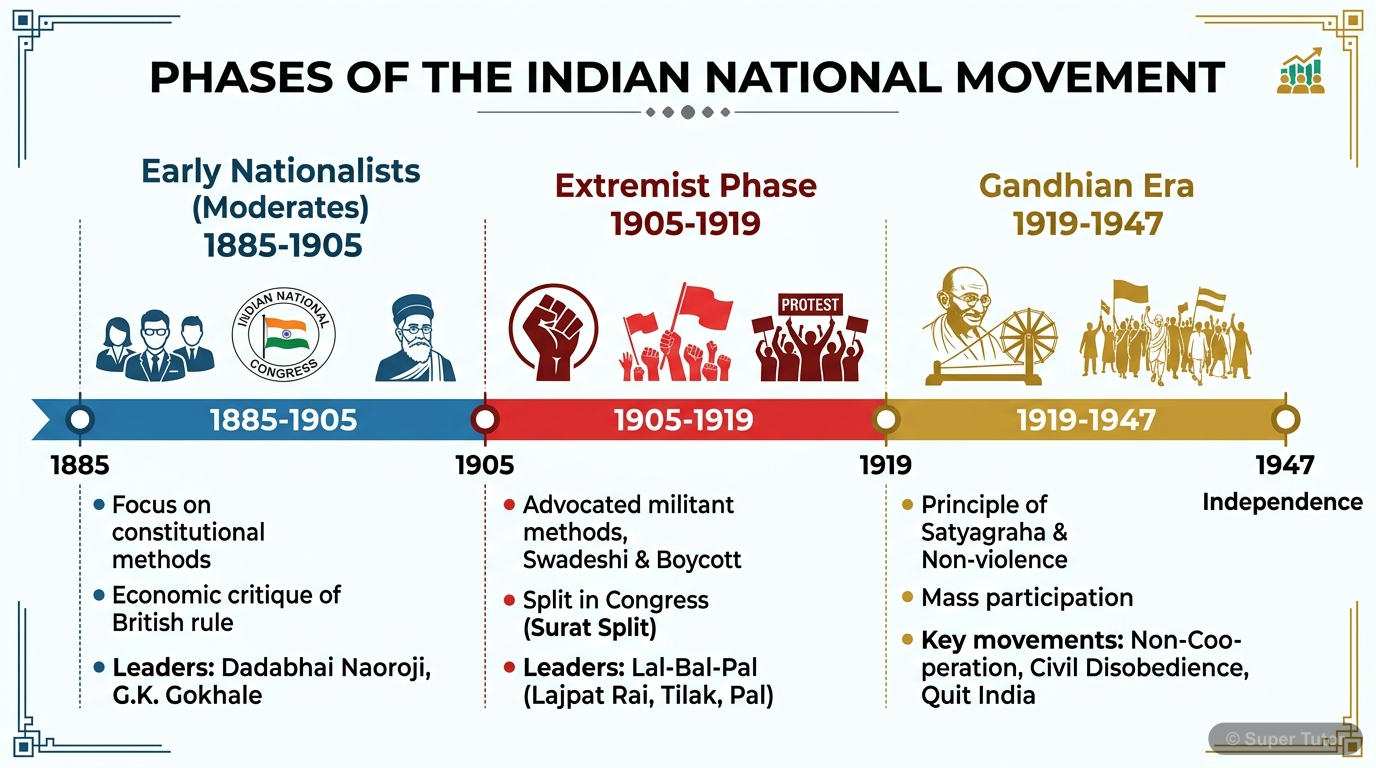
Super Tutor has 5+ illustrations like this for Programme and Achievements of the Early Nationalists (Moderates) alone — flashcards, concept maps, and step-by-step visuals.
See them allOverview
The Early Nationalists formed the first phase of the Indian National Movement from 1885 to 1905. Their leadership included Dadabhai Naoroji, Surendranath Banerjea, Gopal Krishna Gokhale, Pherozeshah Mehta, Pt. Madan Mohan Malaviya, Justice Ranade, and Badruddin Tyabji. They worked for political, eco
Key Concepts
The history of the national movement
The history of the national movement is divided into three phases: 1885-1905, 1905-1919, and 1919-1947. The period 1885-1905 is known as the period of
The Early Nationalists asked for reforms
The Early Nationalists asked for reforms, not sudden revolution. They used petitions, memorandums, meetings, speeches, and annual sessions instead of
They believed in British justice
They believed in British justice, fair play, honesty, and integrity. They hoped that constitutional pressure would bring reforms and Home Rule.
They wanted a larger share
They wanted a larger share in the government, expansion and reform of Legislative Councils, direct election of members, and ultimately Swaraj or self-
They blamed British rule for India’s
They blamed British rule for India’s poverty and economic backwardness. They demanded reduction in land revenue, development of industries, use of swa
Learning Objectives
- Understand the three phases of the Indian National Movement and the place of the Early Nationalists in it.
- Explain why the Early Nationalists were called Moderates.
- Identify the main demands of the Early Nationalists: constitutional, economic, administrative, and civil rights reforms.
- Describe the peaceful and constitutional methods used by the Early Nationalists.
- Recognise the role of important leaders such as Dadabhai Naoroji, Surendranath Banerjea, and Gopal Krishna Gokhale.
Frequently Asked Questions
What are the important topics in Programme and Achievements of the Early Nationalists (Moderates) for ICSE Class 10 History & Civics?
How to score full marks in Programme and Achievements of the Early Nationalists (Moderates) — ICSE Class 10 History & Civics?
Sources & Official References
Content is aligned to the official syllabus. Refer to the board website for the latest curriculum.
More resources for Programme and Achievements of the Early Nationalists (Moderates)
Practice Quiz
Test yourself with a quick quiz
Important Questions
Practice with board exam-style questions
Revision Notes
Key points for last-minute revision
Formula Sheet
All formulas in one place
Concept Maps
See how topics connect visually
Study Plan
Step-by-step plan to ace this chapter
Flashcards
Quick-fire cards for active recall
Syllabus
What topics to cover
NCERT Solutions
Every textbook question solved step by step
For serious students
Get the full Programme and Achievements of the Early Nationalists (Moderates) chapter — for free.
Quizzes, flashcards, AI doubt-solver and a step-by-step study plan for ICSE Class 10 History & Civics.