Subordinate Courts
ICSE · Class 10 · History & Civics
Complete topic list for Subordinate Courts in ICSE Class 10 History & Civics. Key concepts, sub-topics, and what to focus on for board exams.
Interactive on Super Tutor
Studying Subordinate Courts? Get the full interactive chapter.
Quizzes, flashcards, AI doubt-solver and a step-by-step study plan — built for syllabus and more.
1,000+ Class 10 students started this chapter today
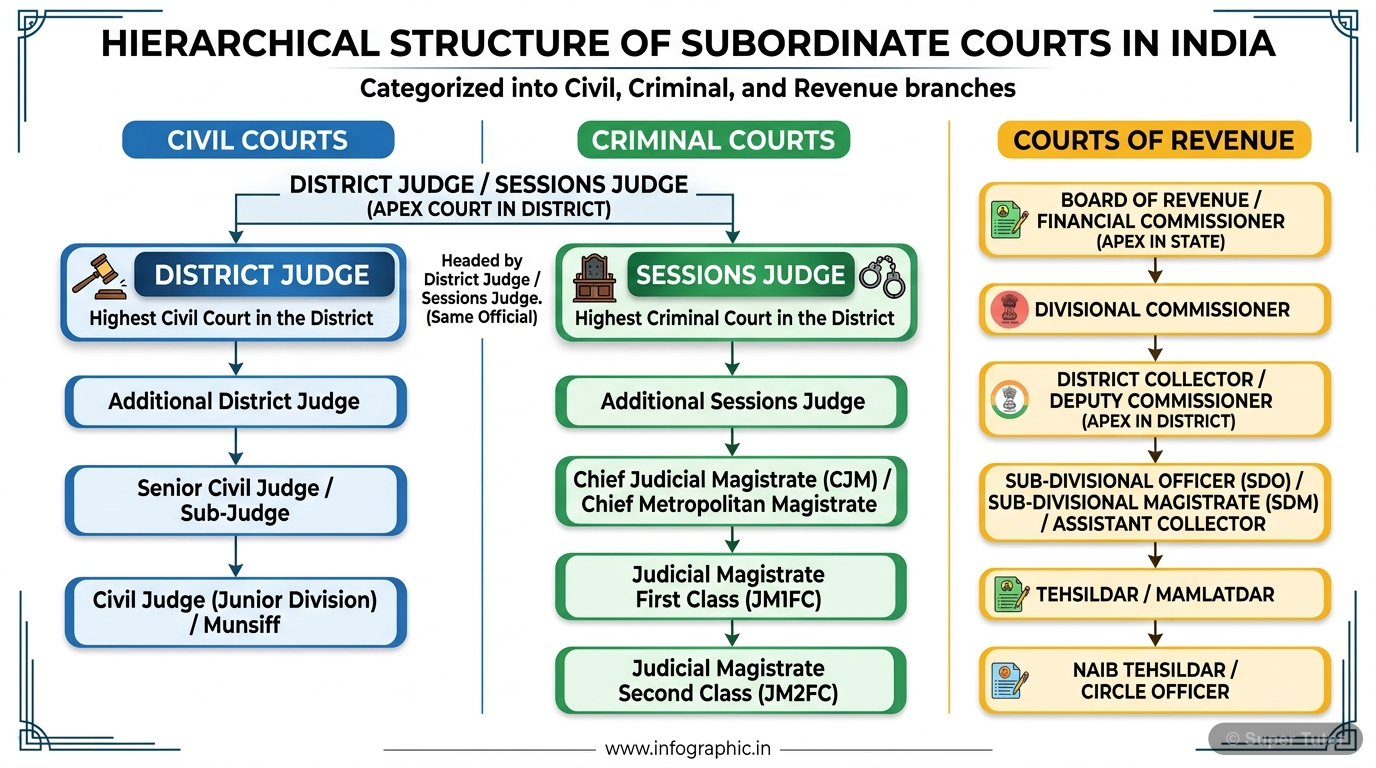
Super Tutor has 5+ illustrations like this for Subordinate Courts alone — flashcards, concept maps, and step-by-step visuals.
See them allTopics in Subordinate Courts
1. Types of Subordinate Courts
- In each district, justice is administered through three types of courts: Civil Courts, Criminal Courts, and Courts of Revenue.
- Civil Courts handle disputes related to land, property, monetary transaction, arbitration, marriage, divorce, guardianship, and will.
- Criminal Courts handle cases such as violence, rioting, physical assault, and murder.
2. Court of the District Judge
- The Court of the District Judge is the highest civil court in a district.
- The District Judge and the Additional District Judge are appointed by the Governor in consultation with the Chief Justice and other judges of the High Court.
- Other judges and magistrates are appointed by the State Public Service Commission from the State Judicial Services through competitive examination.
3. Criminal Courts and Magistrates
- Criminal Courts in the district are divided into four categories from bottom to top: Second Class Judicial Magistrates, First Class Judicial Magistrates, Chief Judicial Magistrate, and Sessions Court.
- Second Class Judicial Magistrates deal with comparatively serious criminal cases and can sentence imprisonment not more than 1 year or fine of ₹5000 or both.
- First Class Judicial Magistrates deal with more serious criminal cases and can award imprisonment up to 3 years or fine up to ₹10,000 or both.
4. Courts of Revenue
- Courts of Revenue deal with assessment and collection of land revenue and property tax.
- The courts are listed in ascending order as: Naib Tehsildar's Court, Tehsildar's Court, Collector's Court, Commissioner's Court, and Board of Revenue.
- Naib Tehsildar's Court is the lowest court among Courts of Revenue.
Key Concepts
Central concept: Subordinate courts administer justice at the district level and below through civil courts, criminal courts, courts of revenue, and Lok Adalats.
Frequently Asked Questions
What are the important topics in Subordinate Courts for ICSE Class 10 History & Civics?
How to score full marks in Subordinate Courts — ICSE Class 10 History & Civics?
Sources & Official References
Content is aligned to the official syllabus. Refer to the board website for the latest curriculum.
More resources for Subordinate Courts
Practice Quiz
Test yourself with a quick quiz
Important Questions
Practice with board exam-style questions
Revision Notes
Key points for last-minute revision
Formula Sheet
All formulas in one place
Chapter Summary
Understand the chapter at a glance
Concept Maps
See how topics connect visually
Study Plan
Step-by-step plan to ace this chapter
Flashcards
Quick-fire cards for active recall
NCERT Solutions
Every textbook question solved step by step
For serious students
Get the full Subordinate Courts chapter — for free.
Quizzes, flashcards, AI doubt-solver and a step-by-step study plan for ICSE Class 10 History & Civics.