The Union Executive
ICSE · Class 10 · History & Civics
Summary of The Union Executive for ICSE Class 10 History & Civics. Key concepts, important points, and chapter overview.
Interactive on Super Tutor
Studying The Union Executive? Get the full interactive chapter.
Quizzes, flashcards, AI doubt-solver and a step-by-step study plan — built for chapter summary and more.
1,000+ Class 10 students started this chapter today
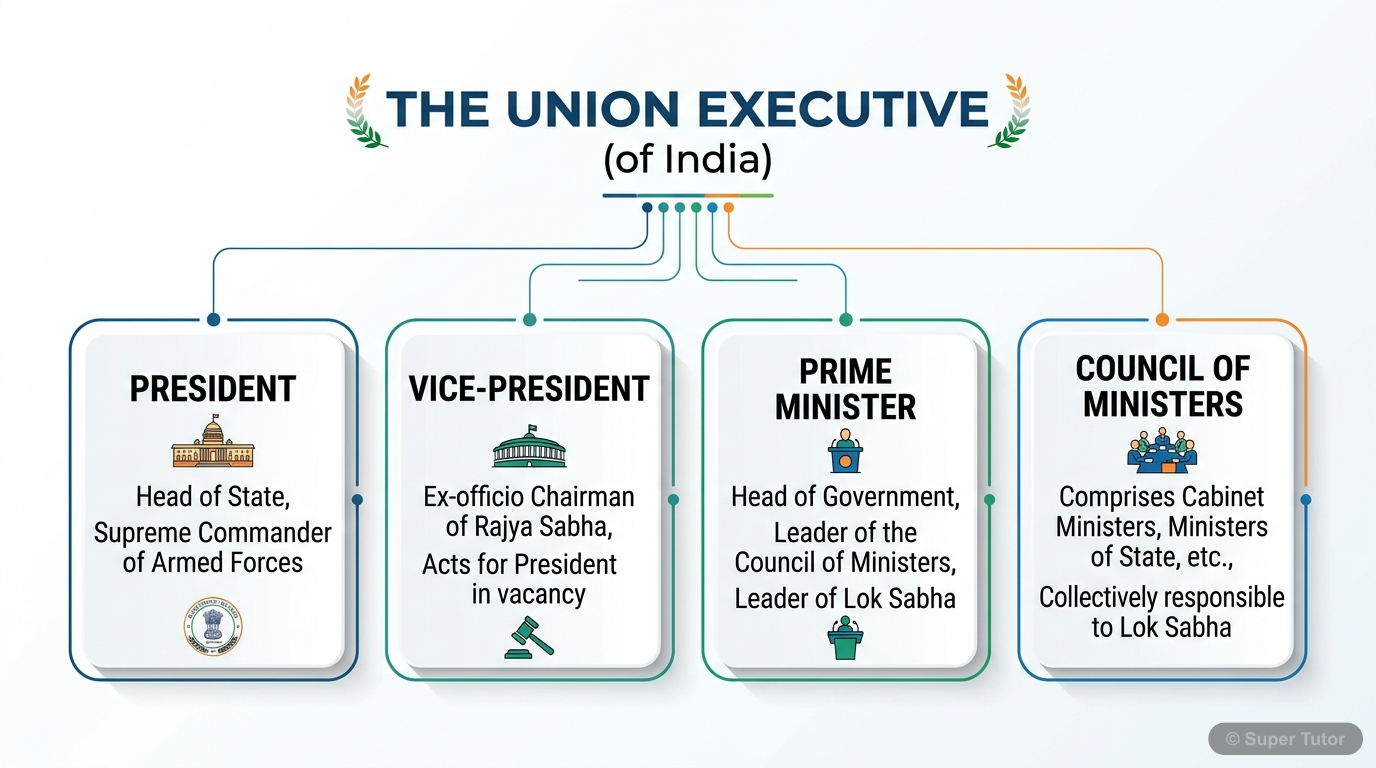
This is just one of 6+ visuals inside Super Tutor's The Union Executive chapter
Explore the full setOverview
The Union Executive is made up of the President, the Vice-President, the Prime Minister, and the Council of Ministers. The President is the head of the State and the first citizen of India, but the real executive power is exercised on the advice of the Council of Ministers headed by the Prime Minist
Key Concepts
The Union Executive consists of
The Union Executive consists of the President, the Vice-President, the Prime Minister, and the Council of Ministers. It is the group responsible for c
The President is the head
The President is the head of the executive, the head of State, and the first citizen of India. The President acts on the advice of the Council of Mini
A presidential candidate must be
A presidential candidate must be a citizen of India, must have completed 35 years of age, must be qualified for election to the Lok Sabha but not be a
The President is elected indirectly by
The President is elected indirectly by an Electoral College made up of elected members of the Legislative Assemblies of States and Union Territories,
The value of an MLA's vote
The value of an MLA's vote is calculated by dividing the total population of the State by the number of elected MLAs, and then dividing the result by
Learning Objectives
- Understand the composition of the Union Executive
- Explain the position and role of the President of India
- Describe the qualifications and method of election of the President
- Learn the term of office, removal, and vacancy of the President's office
- Study the executive, legislative, financial, judicial, military, diplomatic, and emergency powers of the President
Frequently Asked Questions
What are the important topics in The Union Executive for ICSE Class 10 History & Civics?
How to score full marks in The Union Executive — ICSE Class 10 History & Civics?
Sources & Official References
Content is aligned to the official syllabus. Refer to the board website for the latest curriculum.
More resources for The Union Executive
Practice Quiz
Test yourself with a quick quiz
Important Questions
Practice with board exam-style questions
Revision Notes
Key points for last-minute revision
Formula Sheet
All formulas in one place
Concept Maps
See how topics connect visually
Study Plan
Step-by-step plan to ace this chapter
Flashcards
Quick-fire cards for active recall
Syllabus
What topics to cover
NCERT Solutions
Every textbook question solved step by step
For serious students
Get the full The Union Executive chapter — for free.
Quizzes, flashcards, AI doubt-solver and a step-by-step study plan for ICSE Class 10 History & Civics.