The Union Judiciary The Supreme Court
ICSE · Class 10 · History & Civics
Summary of The Union Judiciary The Supreme Court for ICSE Class 10 History & Civics. Key concepts, important points, and chapter overview.
Interactive on Super Tutor
Studying The Union Judiciary The Supreme Court? Get the full interactive chapter.
Quizzes, flashcards, AI doubt-solver and a step-by-step study plan — built for chapter summary and more.
1,000+ Class 10 students started this chapter today
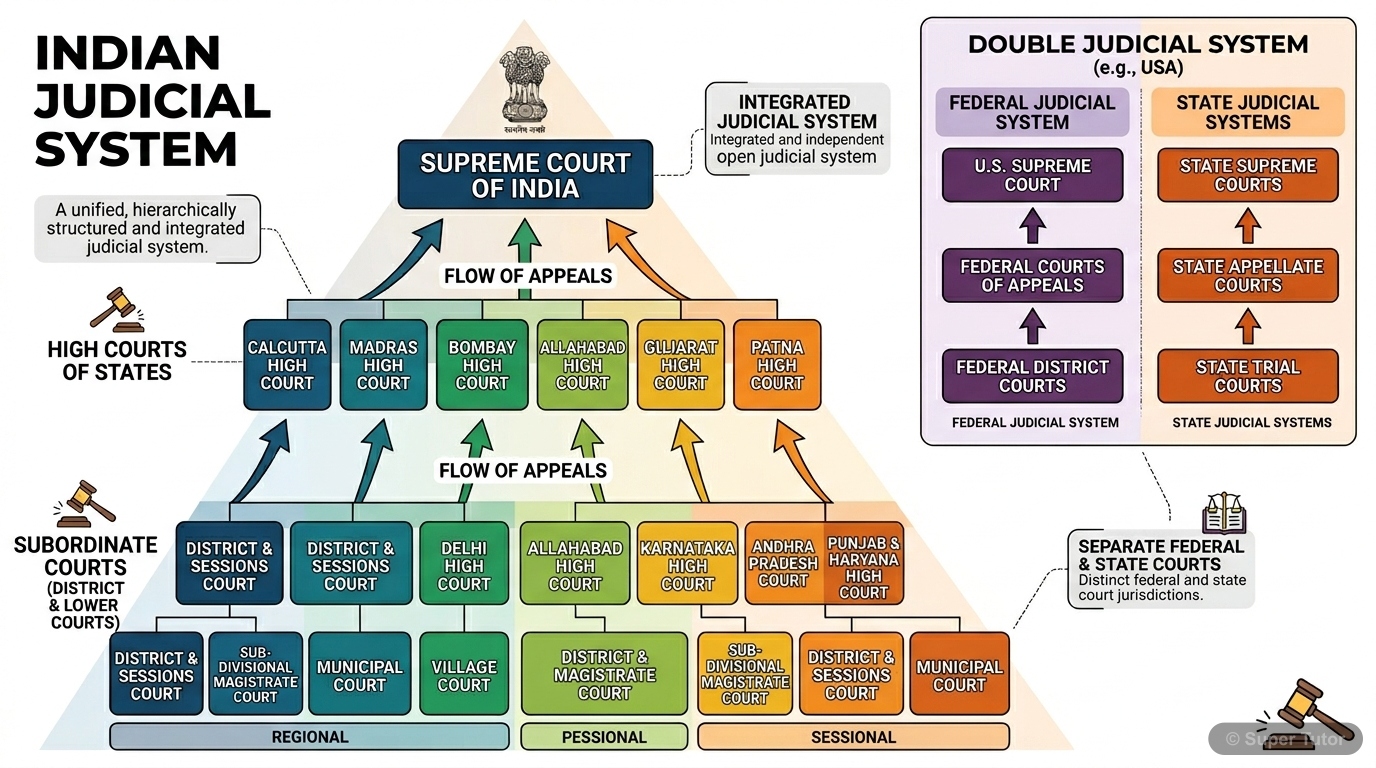
Learn better with visuals Super Tutor has hundreds of illustrations like this across every chapter — all free to try.
Get startedOverview
The Supreme Court of India is the highest court of appeal in the country and the top court in the single integrated judicial system of India. It is the final authority in interpreting the Constitution and its laws are binding on all courts in India. It protects Fundamental Rights, settles important
Key Concepts
India has one unified judicial system
India has one unified judicial system for the whole country. All lower courts are subordinate to higher courts, and the Supreme Court stands at the to
The Supreme Court is the final
The Supreme Court is the final court in India. Its declared laws are binding on all courts within the territory of India.
The Supreme Court consists of
The Supreme Court consists of the Chief Justice and 33 other judges, making 34 judges in all.
Every judge of the Supreme Court
Every judge of the Supreme Court is appointed by the President after consultation with judges of the Supreme Court and High Courts. While appointing j
The Chief Justice of India consults
The Chief Justice of India consults the four seniormost judges before recommending appointments to the President. This is called the collegium system.
Learning Objectives
- Understand why an independent judiciary is necessary in a federation
- Identify the position of the Supreme Court in India’s judicial system
- Explain the composition, appointment, qualifications, and removal of Supreme Court judges
- Describe the original and appellate jurisdiction of the Supreme Court
- Understand judicial review and its role in protecting the Constitution
Frequently Asked Questions
What are the important topics in The Union Judiciary The Supreme Court for ICSE Class 10 History & Civics?
How to score full marks in The Union Judiciary The Supreme Court — ICSE Class 10 History & Civics?
Sources & Official References
Content is aligned to the official syllabus. Refer to the board website for the latest curriculum.
More resources for The Union Judiciary The Supreme Court
Practice Quiz
Test yourself with a quick quiz
Important Questions
Practice with board exam-style questions
Revision Notes
Key points for last-minute revision
Formula Sheet
All formulas in one place
Concept Maps
See how topics connect visually
Study Plan
Step-by-step plan to ace this chapter
Flashcards
Quick-fire cards for active recall
Syllabus
What topics to cover
NCERT Solutions
Every textbook question solved step by step
For serious students
Get the full The Union Judiciary The Supreme Court chapter — for free.
Quizzes, flashcards, AI doubt-solver and a step-by-step study plan for ICSE Class 10 History & Civics.