The Union Judiciary The Supreme Court
ICSE · Class 10 · History & Civics
Flashcards for The Union Judiciary The Supreme Court — ICSE Class 10 History & Civics. Quick Q&A cards covering key concepts, definitions, and formulas.
Interactive on Super Tutor
Studying The Union Judiciary The Supreme Court? Get the full interactive chapter.
Quizzes, flashcards, AI doubt-solver and a step-by-step study plan — built for flashcards and more.
1,000+ Class 10 students started this chapter today
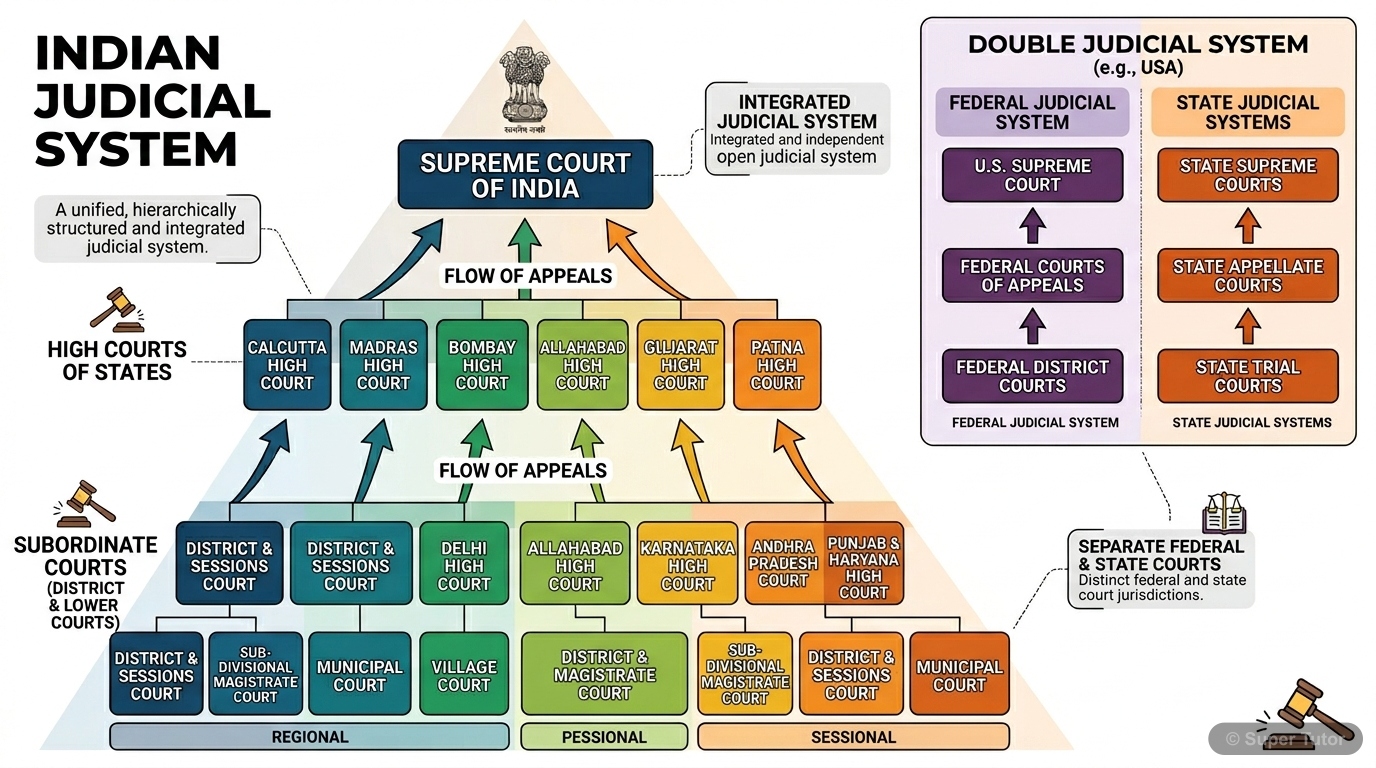
Learn better with visuals Super Tutor has hundreds of illustrations like this across every chapter — all free to try.
Get startedWhy is an independent judiciary necessary in a federation?
Answer
An independent judiciary is necessary because it gives a fair interpretation of the Constitution and settles disputes between the Union and the States. It also helps protect the federal system by chec…
What is meant by India having a single integrated judicial hierarchy?
Answer
It means all courts in India form one unified system, with lower courts subordinate to higher courts and the Supreme Court at the top. This is different from the USA, where separate federal and state …
Why is the Supreme Court called the highest court of appeal in India?
Answer
It is called the highest court of appeal because decisions from lower courts can finally be brought before it, and its declared laws are binding on all courts in India.
Supreme Court of India
Answer
The Supreme Court of India is the highest court in the country and a legacy of the Federal Court of India constituted under the Government of India Act of 1935. Earlier, decisions of the Federal Court…
What does it mean when the laws declared by the Supreme Court are binding on all courts?
Answer
It means every court in India must follow the legal principles laid down by the Supreme Court. This gives uniformity in the justice system and keeps the law consistent across the country.
How many judges does the Supreme Court currently have?
Answer
The Supreme Court currently consists of the Chief Justice and 33 other judges, making 34 judges in total.
How did the number of Supreme Court judges change over time?
Answer
In 1950, the number of judges was 12. In 1977, it was raised to 18 including the Chief Justice. Later it was raised to 26 and then to 31. The current total is 34 including the Chief Justice.
What are the qualifications for becoming a Judge of the Supreme Court?
Answer
A person must be a citizen of India. A person may also qualify by serving as a High Court Judge for at least five years, or as an advocate of a High Court for at least ten years, or by being a disting…
+32 more flashcards available
Practice AllFrequently Asked Questions
What are the important topics in The Union Judiciary The Supreme Court for ICSE Class 10 History & Civics?
How to score full marks in The Union Judiciary The Supreme Court — ICSE Class 10 History & Civics?
How many flashcards are available for The Union Judiciary The Supreme Court?
Sources & Official References
Content is aligned to the official syllabus. Refer to the board website for the latest curriculum.
More resources for The Union Judiciary The Supreme Court
Practice Quiz
Test yourself with a quick quiz
Important Questions
Practice with board exam-style questions
Revision Notes
Key points for last-minute revision
Formula Sheet
All formulas in one place
Chapter Summary
Understand the chapter at a glance
Concept Maps
See how topics connect visually
Study Plan
Step-by-step plan to ace this chapter
Syllabus
What topics to cover
NCERT Solutions
Every textbook question solved step by step
For serious students
Get the full The Union Judiciary The Supreme Court chapter — for free.
Quizzes, flashcards, AI doubt-solver and a step-by-step study plan for ICSE Class 10 History & Civics.