Plant Kingdom — Flashcards
ICSE · Class 11 · Biology
46 flashcards for Plant Kingdom (ICSE Class 11 Biology) to test yourself on key terms and facts. Sample: "What organisms are included in the plant"
Interactive on Super Tutor
Studying Plant Kingdom? Get the full interactive chapter.
Quizzes, flashcards, AI doubt-solver and a step-by-step study plan — built for flashcards and more.
Free trial, no card needed.
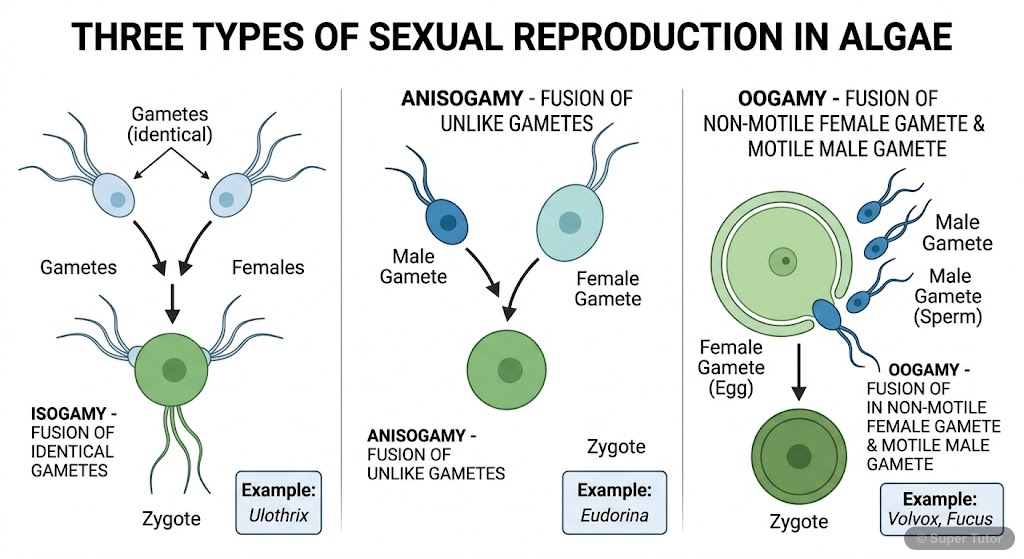
One of 6 illustrations for Plant Kingdom in Super Tutor — alongside flashcards, concept maps and practice questions.
What organisms are included in the plant kingdom?
Answer
Plant kingdom comprises multicellular, autotrophic organisms. It includes major groups such as algae, bryophytes, pteridophytes, gymnosperms, and angiosperms.
From which algal group did land plants probably arise?
Answer
Plants probably arose from the algal division Chlorophyta. Green algae are especially close to land plants in their pigments, food storage, and cell wall composition.
Why are blue-green algae not treated as algae anymore?
Answer
Cyanobacteria, also called blue-green algae, are not algae any more. They are placed in Monera because they are prokaryotic, unlike true algae which are eukaryotic.
What are algae?
Answer
Algae are chlorophyll-containing thalloid autotrophic plants of the simplest type. They lack true roots, stems, leaves, or leaf-like organs and commonly live in aquatic habitats.
What are the three major divisions of algae?
Answer
Algae are divided into three major divisions: Rhodophyceae, Phaeophyceae, and Chlorophyceae. These groups are mainly distinguished by their pigments, storage food, and other structural features.
Why are red algae called red algae?
Answer
Red algae contain the water-soluble red pigment r-phycoerythrin, which masks the green colour of chlorophyll a. This pigment also helps them live at greater depths in the ocean than other algal groups…
What are the main features of Rhodophyceae?
Answer
Rhodophyceae are mostly marine algae with no flagellated cells at any stage of the life cycle. Their reserve food is floridean starch, and their pigments include chlorophyll a and d, carotenes, xantho…
Give examples of red algae and their uses.
Answer
Common examples include Batrachospermum, Polysiphonia, Porphyra, Gracilaria, and Gelidium. Porphyra and Rhodymenia are used as food, agar is obtained from Gelidium, Gracilaria, Chondrus, and Gigartina…
+38 more flashcards
Practise AllFrequently Asked Questions
What are the important topics in Plant Kingdom for ICSE Class 11 Biology?
How many flashcards are available for Plant Kingdom?
How should I revise Plant Kingdom for Class 11 exams?
Sources & Official References
Content is aligned to the official syllabus. Refer to the board website for the latest curriculum.
More resources for Plant Kingdom
Practice Quiz
Test yourself with a quick quiz
Important Questions
Exam-style questions with answers
Revision Notes
Key points for last-minute revision
Chapter Summary
Understand the chapter at a glance
Concept Maps
See how topics connect
Study Plan
Step-by-step plan for this chapter
Syllabus
What topics to cover
For serious students
Get the full Plant Kingdom chapter — start free.
Quizzes, flashcards, an AI doubt solver and a study plan for ICSE Class 11 Biology. Free to start, no card needed.