Morphology of Flowering Plants — Flashcards
ICSE · Class 11 · Biology
45 flashcards for Morphology of Flowering Plants (ICSE Class 11 Biology) to test yourself on key terms and facts.
Interactive on Super Tutor
Studying Morphology of Flowering Plants? Get the full interactive chapter.
Quizzes, flashcards, AI doubt-solver and a step-by-step study plan — built for flashcards and more.
Free trial, no card needed.
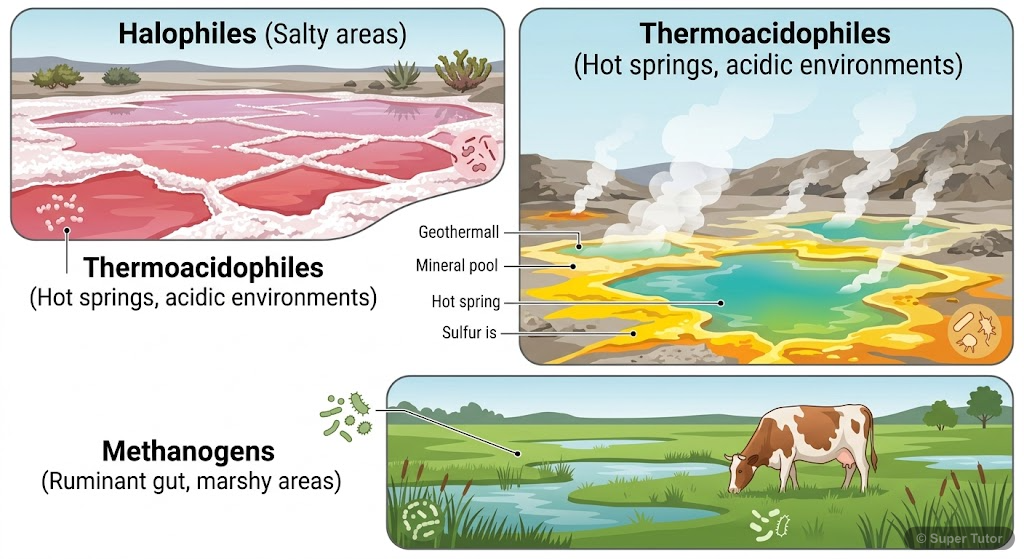
One of 19 illustrations for Morphology of Flowering Plants in Super Tutor — alongside flashcards, concept maps and practice questions.
What are the two fundamental parts of a flowering plant body?
Answer
A flowering plant body has two fundamental parts: the underground root system and the aboveground shoot system. The root system anchors the plant and absorbs water and minerals, while the shoot system…
Define root.
Answer
The root is a non-green, cylindrical, descending axis of the plant that normally grows downwards into the soil. It develops from the radicle and usually lacks nodes, internodes, leaves, and buds.
How does a tap root system form?
Answer
When the primary root persists and continues to grow, it becomes the tap root. It is the main root, grows vertically downward, and produces secondary and tertiary roots. This root system is more commo…
What is a fibrous root system?
Answer
A fibrous root system forms when the primary root is short-lived and is replaced by many thin, thread-like roots arising from the base of the stem. These roots are nearly equal in size and are prevale…
What are adventitious roots?
Answer
Adventitious roots arise from any part of the plant body other than the radicle. They may develop underground or aerially, and they occur in both dicots and monocots. Examples include ivy, mangroves, …
Why are root hairs important?
Answer
Root hairs are unicellular outgrowths from the young region of the root. They greatly increase the surface area of the root and help in absorption of water and dissolved minerals from the soil.
What are the main regions of a typical root?
Answer
A typical root has four main regions: root cap, meristematic zone, zone of elongation, and zone of maturation. The meristematic zone is about 1 mm long, the zone of elongation is about 4-8 mm long, an…
What is special about the root cap in some plants?
Answer
Most plants have a simple root cap, but Pandanus has a multiple root cap. In hydrophytes like Pistia and Lemna, a root pocket replaces the root cap.
+37 more flashcards
Practise AllFrequently Asked Questions
What are the important topics in Morphology of Flowering Plants for ICSE Class 11 Biology?
How many flashcards are available for Morphology of Flowering Plants?
How should I revise Morphology of Flowering Plants for Class 11 exams?
Sources & Official References
Content is aligned to the official syllabus. Refer to the board website for the latest curriculum.
More resources for Morphology of Flowering Plants
Practice Quiz
Test yourself with a quick quiz
Important Questions
Exam-style questions with answers
Revision Notes
Key points for last-minute revision
Chapter Summary
Understand the chapter at a glance
Concept Maps
See how topics connect
Study Plan
Step-by-step plan for this chapter
Syllabus
What topics to cover
For serious students
Get the full Morphology of Flowering Plants chapter — start free.
Quizzes, flashcards, an AI doubt solver and a study plan for ICSE Class 11 Biology. Free to start, no card needed.