Respiration in Plants — Flashcards
ICSE · Class 11 · Biology
42 flashcards for Respiration in Plants (ICSE Class 11 Biology) to test yourself on key terms and facts. Sample: "What is cellular respiration?"
Interactive on Super Tutor
Studying Respiration in Plants? Get the full interactive chapter.
Quizzes, flashcards, AI doubt-solver and a step-by-step study plan — built for flashcards and more.
Free trial, no card needed.
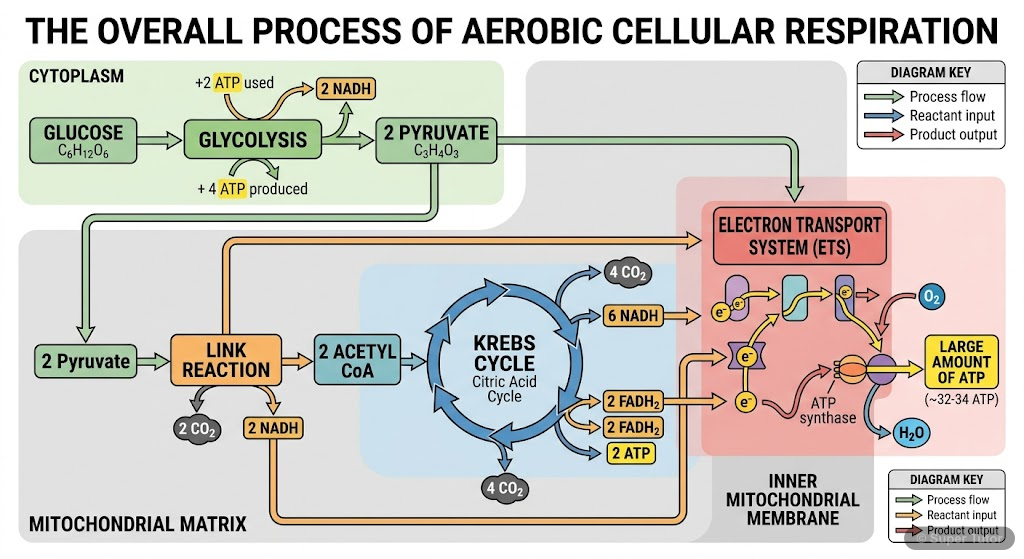
One of 10 illustrations for Respiration in Plants in Super Tutor — alongside flashcards, concept maps and practice questions.
What is cellular respiration?
Answer
Cellular respiration is an exothermic oxidative process in which the chemical energy of organic substances is converted into metabolically usable energy within living cells. It is a controlled breakdo…
Why is ATP called the energy currency of the cell?
Answer
ATP stores energy in a usable form and releases it when needed for cell activities. It powers processes such as biosynthesis, active transport, movement, secretion, and activation of reactants.
What are the two main types of cellular respiration?
Answer
Aerobic respiration requires molecular oxygen and occurs in mitochondria. Anaerobic respiration does not require oxygen and is catalyzed by enzymes present in the cytoplasm.
What is glycolysis?
Answer
Glycolysis is a series of closely integrated reactions in which hexose sugar, usually glucose, is converted into pyruvic acid. It occurs in the cytoplasm and does not require oxygen. It is also called…
Why is glycolysis called the EMP pathway?
Answer
The glycolytic pathway is called the Embden-Meyerhof-Parnas pathway after Gustav Embden, Otto Meyerhof, and J. Parnas, the three scientists who traced these reactions.
What happens in the first phosphorylation step of glycolysis?
Answer
Glucose is phosphorylated using ATP in the presence of hexokinase and Mg++. The product is glucose-6-phosphate and ADP is formed. This is one of the two ATP-consuming steps that prime glycolysis.
What happens in the second phosphorylation step of glycolysis?
Answer
Fructose-6-phosphate is phosphorylated using ATP in the presence of phosphofructokinase and Mg++. The product is fructose-1,6-diphosphate and ADP is formed.
How much ATP is consumed and how much is formed during glycolysis?
Answer
Two ATP molecules are consumed in the first phase of glycolysis. Four ATP molecules are formed in the second phase, two for each triose split off from fructose-1,6-diphosphate. The net gain is two ATP…
+34 more flashcards
Practise AllFrequently Asked Questions
What are the important topics in Respiration in Plants for ICSE Class 11 Biology?
How many flashcards are available for Respiration in Plants?
How should I revise Respiration in Plants for Class 11 exams?
Sources & Official References
Content is aligned to the official syllabus. Refer to the board website for the latest curriculum.
More resources for Respiration in Plants
Practice Quiz
Test yourself with a quick quiz
Important Questions
Exam-style questions with answers
Revision Notes
Key points for last-minute revision
Formula Sheet
The chapter's formulas in one place
Chapter Summary
Understand the chapter at a glance
Concept Maps
See how topics connect
Study Plan
Step-by-step plan for this chapter
Syllabus
What topics to cover
For serious students
Get the full Respiration in Plants chapter — start free.
Quizzes, flashcards, an AI doubt solver and a study plan for ICSE Class 11 Biology. Free to start, no card needed.