Motion in a Plane
ICSE · Class 11 · Physics
Most important questions from Motion in a Plane for ICSE Class 11 Physics board exam 2026. MCQs, short answer, and long answer questions with marks.
Interactive on Super Tutor
Studying Motion in a Plane? Get the full interactive chapter.
Quizzes, flashcards, AI doubt-solver and a step-by-step study plan — built for important questions and more.
1,000+ Class 11 students started this chapter today
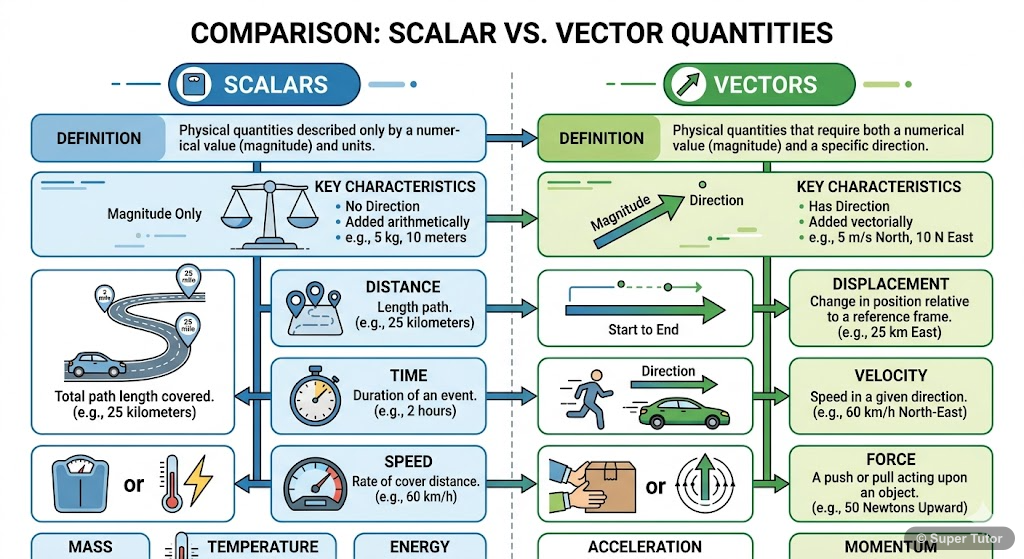
Super Tutor has 7+ illustrations like this for Motion in a Plane alone — flashcards, concept maps, and step-by-step visuals.
See them allSample Questions
Two vectors A⃗ and B⃗ are equal if and only if they have:
Show answer
Same magnitude AND same direction
Step 1: Two vectors are said to be equal if they satisfy two conditions simultaneously. Step 2: Condition 1 — they must have the same magnitude. Step 3: Condition 2 — they must have the same direction. Step 4: The starting point (initial point) does NOT matter — vectors can be translated freely. Step 5: If only magnitudes are equal but directions differ, the vectors are not equal (they could be negative of each other if directions are exactly opposite).
What is the resultant magnitude of two vectors A and B when they act in the SAME direction (θ = 0°)?
Show answer
A + B
Step 1: The formula for resultant of two vectors is R = √(A² + B² + 2AB cosθ). Step 2: When θ = 0°, cos 0° = 1. Step 3: R = √(A² + B² + 2AB × 1) = √(A + B)² = A + B. Step 4: This makes physical sense — when both vectors point the same way, their effects add up fully. Step 5: The minimum resultant (A – B) occurs when θ = 180° (opposite directions). The formula √(A² + B²) is for θ = 90°.
The scalar product (dot product) of two vectors A⃗ and B⃗ is defined as:
Show answer
AB cos θ
Step 1: There are two types of products of two vectors — scalar (dot) product and vector (cross) product. Step 2: The scalar product is defined as A⃗ · B⃗ = AB cos θ, where θ is the angle between them. Step 3: The result is a scalar quantity (no direction). Step 4: Example: Work = F⃗ · s⃗ = Fs cos θ. Step 5: Common confusion — AB sin θ is the magnitude of the cross (vector) product, not the dot product. Remember: Dot → cos, Cross → sin.
The scalar product of two mutually perpendicular vectors is:
Show answer
Zero
Step 1: Use the dot product formula: A⃗ · B⃗ = AB cos θ. Step 2: For perpendicular vectors, θ = 90°. Step 3: cos 90° = 0. Step 4: Therefore A⃗ · B⃗ = AB × 0 = 0. Step 5: Physical meaning — if force is perpendicular to displacement, work done = 0. This is why the normal force does no work on a horizontally moving object. Common mistake: students write 1 thinking of parallel vectors — that is when θ = 0°, cos 0° = 1.
+40 more questions available
Practice AllFrequently Asked Questions
What are the important topics in Motion in a Plane for ICSE Class 11 Physics?
How to score full marks in Motion in a Plane — ICSE Class 11 Physics?
How many important questions are there in Motion in a Plane?
Sources & Official References
Content is aligned to the official syllabus. Refer to the board website for the latest curriculum.
More resources for Motion in a Plane
Practice Quiz
Test yourself with a quick quiz
Revision Notes
Key points for last-minute revision
Formula Sheet
All formulas in one place
Chapter Summary
Understand the chapter at a glance
Concept Maps
See how topics connect visually
Study Plan
Step-by-step plan to ace this chapter
Flashcards
Quick-fire cards for active recall
Syllabus
What topics to cover
NCERT Solutions
Every textbook question solved step by step
For serious students
Get the full Motion in a Plane chapter — for free.
Quizzes, flashcards, AI doubt-solver and a step-by-step study plan for ICSE Class 11 Physics.