Motion in a Plane — Chapter Summary
ICSE · Class 11 · Physics
Summary of Motion in a Plane for ICSE Class 11 Physics. Part of the ICSE Class 11 Physics syllabus. Motion in a plane deals with quantities that need both.
Interactive on Super Tutor
Studying Motion in a Plane? Get the full interactive chapter.
Quizzes, flashcards, AI doubt-solver and a step-by-step study plan — built for chapter summary and more.
Free trial, no card needed.
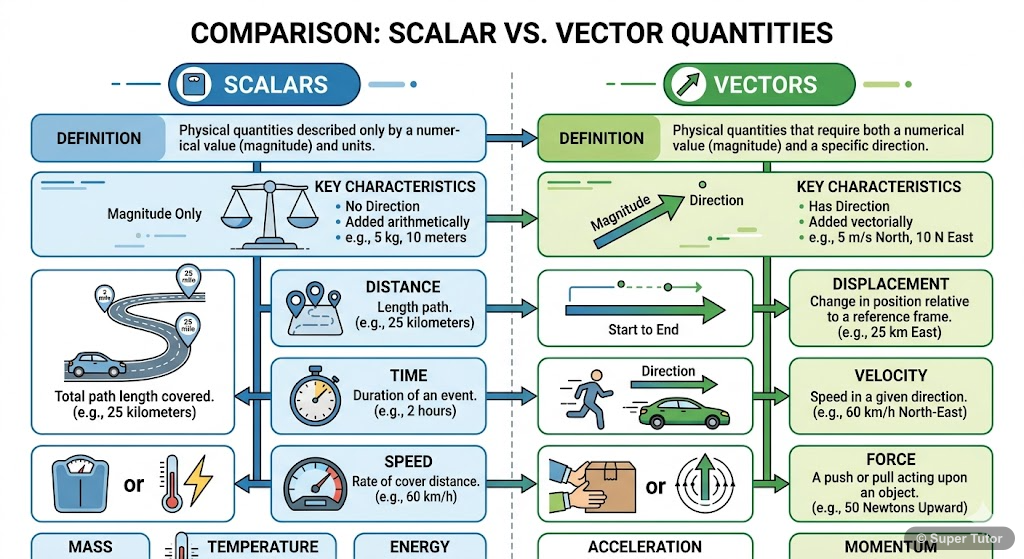
Learn better with visuals Super Tutor pairs illustrations like this with notes and quizzes for Motion in a Plane.
Overview
Motion in a plane deals with quantities that need both magnitude and direction, so vectors become essential. Scalars such as mass, distance, time, speed, work, energy, power, charge, current, temperature, potential, specific heat and frequency are fully described by magnitude alone. Vectors such as
Key Concepts
These are physical quantities having only
These are physical quantities having only magnitude and no direction. They obey ordinary algebra for addition, subtraction, multiplication and divisio
These are physical quantities having both
These are physical quantities having both magnitude and direction and obey the triangle law or parallelogram law of vector addition.
A vector quantity with a well
A vector quantity with a well-defined starting point. Its sign reverses when coordinate axes are reversed. Examples include displacement, velocity, ra
A vector quantity described by
A vector quantity described by a plane at least, such as rotation. It is also called a pseudo vector, and its direction is given by the screw rule. Ex
A position vector is drawn from
A position vector is drawn from the origin to the object’s position. Displacement vector is the vector from initial position to final position and equ
Learning Objectives
- Distinguish between scalar and vector quantities with correct examples.
- Explain polar vectors and axial vectors.
- Define position vector, displacement vector, zero vector and unit vector.
- Add and subtract vectors using geometric laws.
- Resolve a vector into rectangular components in two and three dimensions.
Frequently Asked Questions
What are the important topics in Motion in a Plane for ICSE Class 11 Physics?
How should I revise Motion in a Plane for Class 11 exams?
Sources & Official References
Content is aligned to the official syllabus. Refer to the board website for the latest curriculum.
More resources for Motion in a Plane
Practice Quiz
Test yourself with a quick quiz
Important Questions
Exam-style questions with answers
Revision Notes
Key points for last-minute revision
Formula Sheet
The chapter's formulas in one place
Concept Maps
See how topics connect
Study Plan
Step-by-step plan for this chapter
Flashcards
Quick-fire cards for active recall
Syllabus
What topics to cover
For serious students
Get the full Motion in a Plane chapter — start free.
Quizzes, flashcards, an AI doubt solver and a study plan for ICSE Class 11 Physics. Free to start, no card needed.