Superposition of Waves-2 : Stationary (Standing) Waves : Vibration of Air Columns — Chapter Summary
ICSE · Class 11 · Physics
Summary of Superposition of Waves-2 : Stationary (Standing) Waves : Vibration of Air Columns for ICSE Class 11 Physics.
Interactive on Super Tutor
Studying Superposition of Waves-2 : Stationary (Standing) Waves : Vibration of Air Columns? Get the full interactive chapter.
Quizzes, flashcards, AI doubt-solver and a step-by-step study plan — built for chapter summary and more.
Free trial, no card needed.
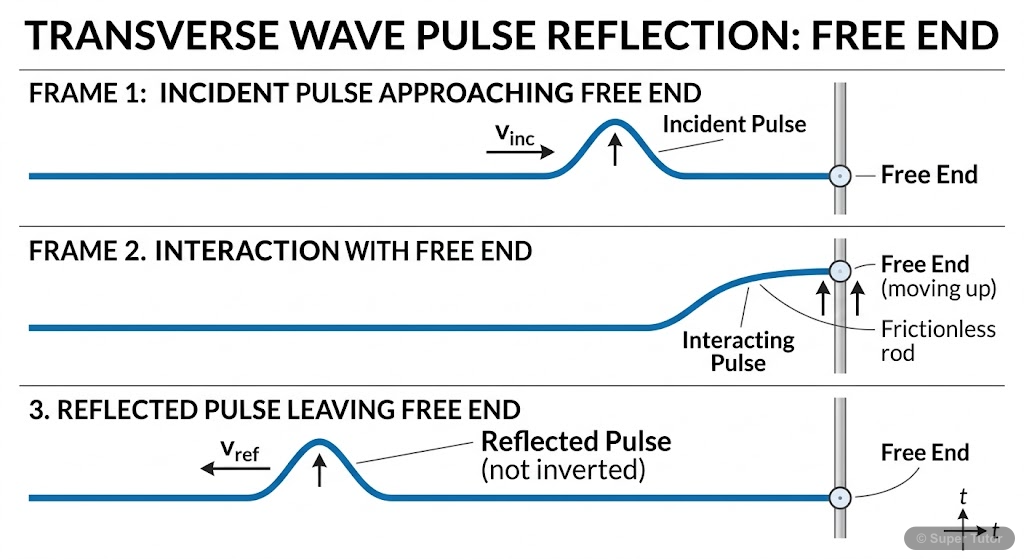
An illustration from Super Tutor's Superposition of Waves-2 : Stationary (Standing) Waves : Vibration of Air Columns chapter — alongside flashcards, concept maps and practice questions.
Overview
Stationary waves are formed when two identical progressive waves travel in opposite directions in a bounded medium. In such waves, some points remain at rest as nodes, while some points vibrate with maximum displacement as antinodes. In air columns, stationary waves explain the sound of organ pipes,
Key Concepts
A bounded medium has definite boundaries
A bounded medium has definite boundaries separated from other media by distinct surfaces. Such a medium vibrates only with certain definite frequencie
A progressive wave reflected from
A progressive wave reflected from a free or open end suffers no phase change. The reflected wave keeps the same displacement pattern as the incident w
A progressive wave reflected from
A progressive wave reflected from a rigid or closed end undergoes a phase change of π or 180 degrees. The displacement is inverted after reflection.
When two identical progressive waves travel
When two identical progressive waves travel in opposite directions with the same speed in a bounded medium, their superposition produces a wave that a
Nodes are points of zero displacement
Nodes are points of zero displacement, while antinodes are points of maximum displacement. In longitudinal stationary waves, pressure and density chan
Learning Objectives
- Understand how reflection of waves at free and rigid boundaries differs
- Explain the formation of stationary waves by superposition of two opposite progressive waves
- Identify nodes and antinodes in stationary waves and state their properties
- Describe stationary waves in longitudinal media, including pressure and density variations
- Derive and use the frequency relations for closed and open organ pipes
Frequently Asked Questions
What are the important topics in Superposition of Waves-2 : Stationary (Standing) Waves : Vibration of Air Columns for ICSE Class 11 Physics?
How should I revise Superposition of Waves-2 : Stationary (Standing) Waves : Vibration of Air Columns for Class 11 exams?
Sources & Official References
Content is aligned to the official syllabus. Refer to the board website for the latest curriculum.
More resources for Superposition of Waves-2 : Stationary (Standing) Waves : Vibration of Air Columns
Practice Quiz
Test yourself with a quick quiz
Important Questions
Exam-style questions with answers
Revision Notes
Key points for last-minute revision
Formula Sheet
The chapter's formulas in one place
Concept Maps
See how topics connect
Study Plan
Step-by-step plan for this chapter
Flashcards
Quick-fire cards for active recall
Syllabus
What topics to cover
For serious students
Get the full Superposition of Waves-2 : Stationary (Standing) Waves : Vibration of Air Columns chapter — start free.
Quizzes, flashcards, an AI doubt solver and a study plan for ICSE Class 11 Physics. Free to start, no card needed.