Superposition of Waves-2 : Stationary (Standing) Waves : Vibration of Air Columns — Flashcards
ICSE · Class 11 · Physics
34 flashcards for Superposition of Waves-2 : Stationary (Standing) Waves : Vibration of Air Columns (ICSE Class 11 Physics) to test yourself on key terms.
Interactive on Super Tutor
Studying Superposition of Waves-2 : Stationary (Standing) Waves : Vibration of Air Columns? Get the full interactive chapter.
Quizzes, flashcards, AI doubt-solver and a step-by-step study plan — built for flashcards and more.
Free trial, no card needed.
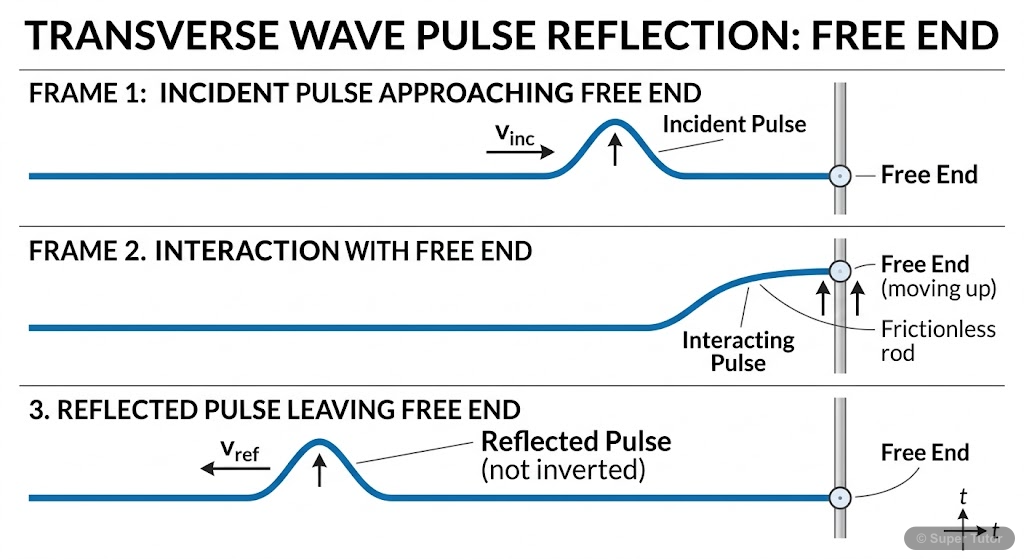
An illustration from Super Tutor's Superposition of Waves-2 : Stationary (Standing) Waves : Vibration of Air Columns chapter — alongside flashcards, concept maps and practice questions.
State the definition of a bounded medium.
Answer
A bounded medium is one which has definite boundaries and whose boundaries are separated from other media by distinct surfaces. It vibrates with only certain definite frequencies called characteristic…
Why is a bounded medium essential for stationary wave formation?
Answer
Stationary waves are formed when a wave reflects from a boundary and superposes with an identical wave moving in the opposite direction. Without boundaries, reflection does not occur, so stationary wa…
State the result of reflection from a free or open end.
Answer
A wave reflected from a free or open end does not suffer any phase change. The reflected wave is y=a sin ((2 pi)/(lambda) (v t+x)).
State the result of reflection from a rigid or closed end.
Answer
A wave reflected from a rigid or closed end suffers a phase change of pi or 180 degrees. The reflected wave is y=-a sin ((2 pi)/(lambda) (v t+x)).
A progressive wave has amplitude 2 cm. What is the reflected wave from a free end?
Answer
Given: amplitude a = 2 cm. Rule for free end reflection: y = a sin ((2 pi)/(lambda) (v t+x)). The amplitude remains the same, so the reflected wave amplitude is 2 cm. No phase change occurs at the fre…
A wave of amplitude 3 cm is reflected from a rigid end. What is the reflected wave amplitude and phase change?
Answer
Given: amplitude a = 3 cm. Rule for rigid end reflection: y = -a sin ((2 pi)/(lambda) (v t+x)). Amplitude = 3 cm. Phase change = pi radians = 180 degrees. The negative sign shows the inversion on refl…
State the stationary wave equation formed by reflection from a rigid boundary.
Answer
The stationary wave equation is y=-2 a sin ((2 pi x)/(lambda)) cos ((2 pi t)/(T)). Here T = lambda/v. The displacement is zero at nodes and maximum at antinodes.
State the stationary wave equation formed by reflection from a free boundary.
Answer
The stationary wave equation is y=2 a cos ((2 pi x)/(lambda)) sin ((2 pi t)/(T)). Here T is the period. This form shows nodes and antinodes fixed in space.
+26 more flashcards
Practise AllFrequently Asked Questions
What are the important topics in Superposition of Waves-2 : Stationary (Standing) Waves : Vibration of Air Columns for ICSE Class 11 Physics?
How many flashcards are available for Superposition of Waves-2 : Stationary (Standing) Waves : Vibration of Air Columns?
How should I revise Superposition of Waves-2 : Stationary (Standing) Waves : Vibration of Air Columns for Class 11 exams?
Sources & Official References
Content is aligned to the official syllabus. Refer to the board website for the latest curriculum.
More resources for Superposition of Waves-2 : Stationary (Standing) Waves : Vibration of Air Columns
Practice Quiz
Test yourself with a quick quiz
Important Questions
Exam-style questions with answers
Revision Notes
Key points for last-minute revision
Formula Sheet
The chapter's formulas in one place
Chapter Summary
Understand the chapter at a glance
Concept Maps
See how topics connect
Study Plan
Step-by-step plan for this chapter
Syllabus
What topics to cover
For serious students
Get the full Superposition of Waves-2 : Stationary (Standing) Waves : Vibration of Air Columns chapter — start free.
Quizzes, flashcards, an AI doubt solver and a study plan for ICSE Class 11 Physics. Free to start, no card needed.