Superposition of Waves-2 : Stationary (Standing) Waves : Vibration of Air Columns
ICSE · Class 11 · Physics
Most important questions from Superposition of Waves-2 : Stationary (Standing) Waves : Vibration of Air Columns for ICSE Class 11 Physics board exam 2026. MCQs, short answer, and long answer questions with marks.
Interactive on Super Tutor
Studying Superposition of Waves-2 : Stationary (Standing) Waves : Vibration of Air Columns? Get the full interactive chapter.
Quizzes, flashcards, AI doubt-solver and a step-by-step study plan — built for important questions and more.
1,000+ Class 11 students started this chapter today
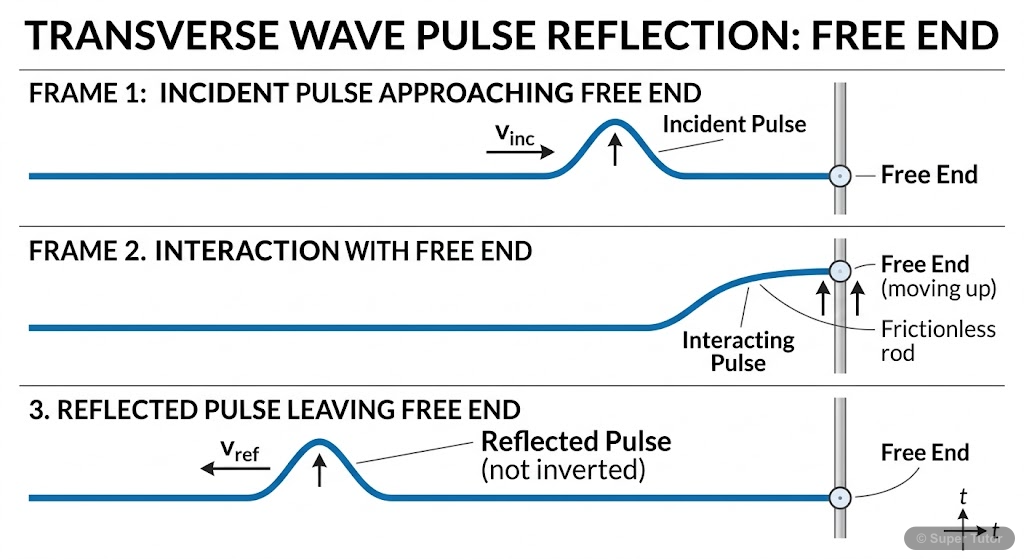
This is just one of 5+ visuals inside Super Tutor's Superposition of Waves-2 : Stationary (Standing) Waves : Vibration of Air Columns chapter
Explore the full setSample Questions
A closed pipe has length 0.60 m and radius 0.05 m. If the speed of sound is 340 m/s, what is its fundamental frequency using end correction?
Show answer
132.8 Hz
For a closed pipe with end correction, n1 = v / 4(l + 0.6r). Here 0.6r = 0.6 × 0.05 = 0.03 m. Effective length = 0.60 + 0.03 = 0.63 m. So n1 = 340 / (4 × 0.63) = 340 / 2.52 ≈ 132.8 Hz.
A closed pipe has length 0.50 m and speed of sound 340 m/s. What is the difference between its first and second harmonic frequencies?
Show answer
340 Hz
For a closed pipe, consecutive harmonics differ by Δn = 2n1 = 2v / 4l. So Δn = 2 × 340 / (4 × 0.50) = 680 / 2 = 340 Hz.
A tuning fork of frequency 256 Hz is used in a resonance tube. If the first resonance length is 0.30 m, what is the second resonance length neglecting end correction?
Show answer
0.90 m
For a resonance tube, l1 = λ/4 and l2 = 3λ/4. So l2 = 3l1. If l1 = 0.30 m, then l2 = 0.90 m.
A tuning fork of frequency 400 Hz produces first and second resonance lengths of 0.21 m and 0.63 m in a resonance tube. What is the wavelength of sound?
Show answer
0.84 m
Use λ = 2(l2 - l1). Here l2 - l1 = 0.63 - 0.21 = 0.42 m. So λ = 2 × 0.42 = 0.84 m.
+48 more questions available
Practice AllFrequently Asked Questions
What are the important topics in Superposition of Waves-2 : Stationary (Standing) Waves : Vibration of Air Columns for ICSE Class 11 Physics?
How to score full marks in Superposition of Waves-2 : Stationary (Standing) Waves : Vibration of Air Columns — ICSE Class 11 Physics?
How many important questions are there in Superposition of Waves-2 : Stationary (Standing) Waves : Vibration of Air Columns?
Sources & Official References
Content is aligned to the official syllabus. Refer to the board website for the latest curriculum.
More resources for Superposition of Waves-2 : Stationary (Standing) Waves : Vibration of Air Columns
Practice Quiz
Test yourself with a quick quiz
Revision Notes
Key points for last-minute revision
Formula Sheet
All formulas in one place
Chapter Summary
Understand the chapter at a glance
Concept Maps
See how topics connect visually
Study Plan
Step-by-step plan to ace this chapter
Flashcards
Quick-fire cards for active recall
Syllabus
What topics to cover
NCERT Solutions
Every textbook question solved step by step
For serious students
Get the full Superposition of Waves-2 : Stationary (Standing) Waves : Vibration of Air Columns chapter — for free.
Quizzes, flashcards, AI doubt-solver and a step-by-step study plan for ICSE Class 11 Physics.