The Modern Age in Europe (A) Renaissance — Syllabus
ICSE · Class 9 · History & Civics
What The Modern Age in Europe (A) Renaissance covers in ICSE Class 9 History & Civics: 4 topics, for the 2026-27 session.
Interactive on Super Tutor
Studying The Modern Age in Europe (A) Renaissance? Get the full interactive chapter.
Quizzes, flashcards, AI doubt-solver and a step-by-step study plan — built for syllabus and more.
Free trial, no card needed.
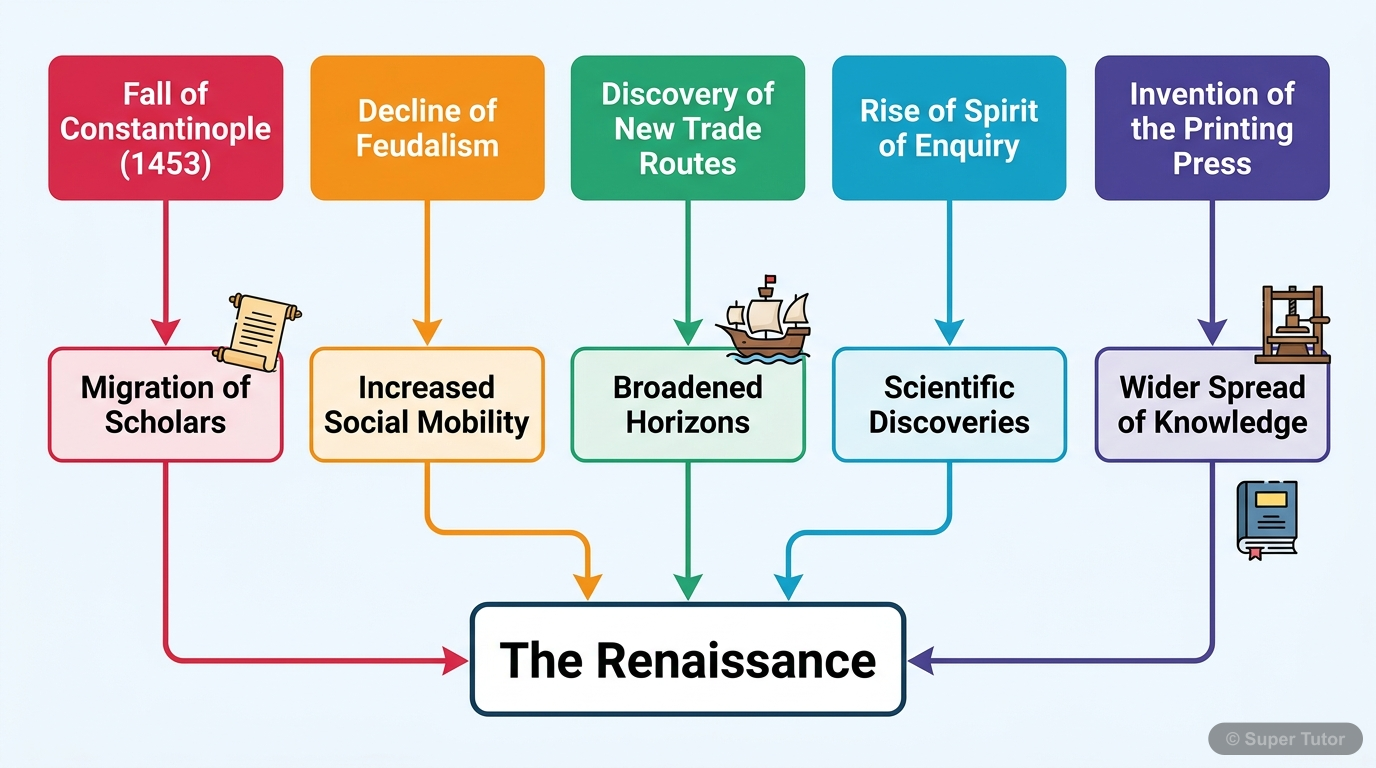
Learn better with visuals Super Tutor pairs illustrations like this with notes and quizzes for The Modern Age in Europe (A) Renaissance.
Topics in The Modern Age in Europe (A) Renaissance
Meaning and Features of the Renaissance
- Renaissance means rebirth or revival.
- It was a transitional movement between medieval and modern Europe.
- It revived the study of ancient Greek and Roman classics.
Causes of the Renaissance
- Capture of Constantinople in 1453 forced Greek and Roman scholars to move to Rome and other parts of Europe with their manuscripts.
- Constantinople was the capital of the Eastern Roman Empire and a centre of Greek and Roman cultures.
- Decline of feudalism created more freedom and helped new ideas grow.
New Trade Routes and Exploration
- Prince Henry the Navigator of Portugal discovered a sea route to Africa.
- Bartholomew Diaz reached the Cape of Good Hope, the southernmost point of Africa.
- Columbus discovered America in 1492.
Spirit of Enquiry and Development of Science
- During the Middle Ages, the Church controlled thought and people depended heavily on faith.
- Renaissance thinkers encouraged reason, observation and experimentation.
- Roger Bacon, Abelard and Thomas Aquinas are called forerunners of Renaissance.
Key Concepts
Central concept: Renaissance: rebirth of learning, art, literature, science, and human thought in Europe
Work through every topic in The Modern Age in Europe (A) Renaissance with notes and quizzes
Start This ChapterFrequently Asked Questions
What are the important topics in The Modern Age in Europe (A) Renaissance for ICSE Class 9 History & Civics?
How should I revise The Modern Age in Europe (A) Renaissance for Class 9 exams?
Sources & Official References
Content is aligned to the official syllabus. Refer to the board website for the latest curriculum.
More resources for The Modern Age in Europe (A) Renaissance
Practice Quiz
Test yourself with a quick quiz
Important Questions
Exam-style questions with answers
Revision Notes
Key points for last-minute revision
Chapter Summary
Understand the chapter at a glance
Concept Maps
See how topics connect
Study Plan
Step-by-step plan for this chapter
Flashcards
Quick-fire cards for active recall
For serious students
Get the full The Modern Age in Europe (A) Renaissance chapter — start free.
Quizzes, flashcards, an AI doubt solver and a study plan for ICSE Class 9 History & Civics. Free to start, no card needed.