An Imperial Capital: Vijaynagara — NCERT Solutions
Madhya Pradesh Board · Class 12 · History
NCERT Solutions for An Imperial Capital: Vijaynagara, Madhya Pradesh Board Class 12 History: 12 textbook questions solved step by step.
Interactive on Super Tutor
Studying An Imperial Capital: Vijaynagara? Get the full interactive chapter.
Quizzes, flashcards, AI doubt-solver and a step-by-step study plan — built for NCERT solutions and more.
Free trial, no card needed.
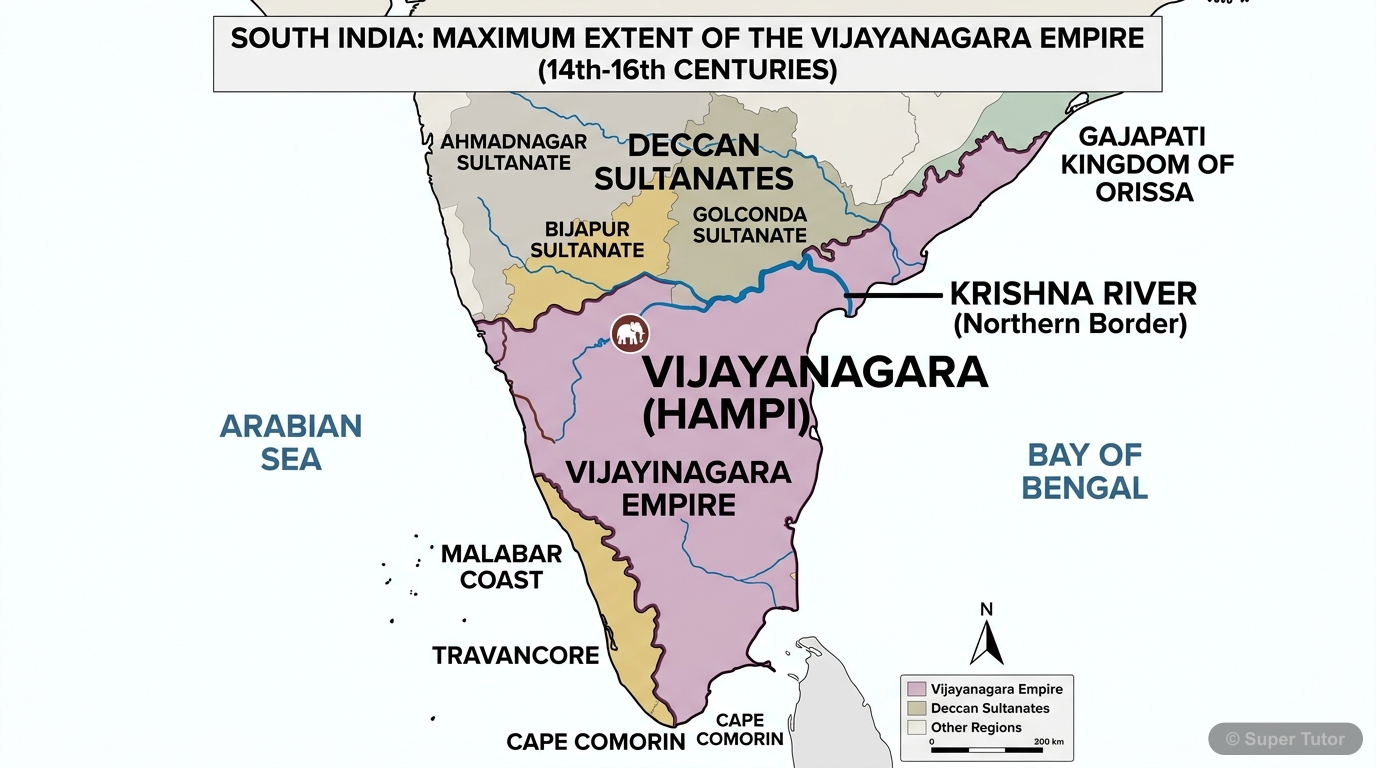
Learn better with visuals Super Tutor pairs illustrations like this with notes and quizzes for An Imperial Capital: Vijaynagara.
The first 6 solutions are open to read. The other 6 are free with a Super Tutor account.
Answer in 100-150 Words
1What have been the methods used to study the ruins of Hampi over the last two centuries? In what way do you think they would have complemented the information provided by the priests of the Virupaksha temple?Show solution
Methods used to study the ruins of Hampi:
Given: The ruins of Vijayanagara (Hampi) have been studied since the early nineteenth century.
Methods employed:
- Survey and Mapping: Colin Mackenzie conducted the first survey of the site in 1800. He collected local histories, surveyed historic sites, and made detailed maps. Later, the Vijayanagara Metropolitan Survey (led by John M. Fritz, George Michell and M.S. Nagaraja Rao) divided the entire area into 25 lettered squares, each further subdivided, to document thousands of structures systematically.
- Archaeological Excavation: Archaeologists excavated the site and found evidence of roads, pavements, pillar bases, platforms, Chinese porcelain shards, agricultural tracts, and canal systems.
- Study of Inscriptions (Epigraphy): A large number of inscriptions recording donations to temples and important events were recovered and studied.
- Analysis of Travellers' Accounts: Accounts of foreign visitors such as Nicolo de Conti, Abdur Razzaq, Afanasii Nikitin, Duarte Barbosa, Domingo Paes, and Fernao Nuniz provided vivid descriptions of the city's layout, buildings, and life.
Complementing the priests' information:
The priests of the Virupaksha temple preserved oral traditions, rituals, and local histories associated with the temple and the city. While the priests provided continuity of religious memory and knowledge of the sacred significance of structures, the archaeological and textual methods provided physical evidence, chronology, and broader historical context. Together, they offered a more complete picture — the priests filling in the living traditions and the scholars providing material and documentary evidence.
2How were the water requirements of Vijayanagara met?Show solution
Given: Vijayanagara was a large imperial capital that required a substantial and reliable water supply.
Water supply system of Vijayanagara:
- Rivers: The city was situated near the Tungabhadra river, which was the primary source of water. An elaborate canal system drew water from the Tungabhadra to service the agricultural tracts within the fortified area and the urban core.
- Lakes and Tanks: The city had several lakes and rainwater tanks. Domingo Paes noted 'conduits of water which flow into the midst of it, and in places there are lakes.' These stored rainwater for use during dry seasons.
- Wells: Field surveys indicate that wells served as sources of water for ordinary town dwellers.
- Temple Tanks: Temple tanks within the sacred complex also served as water sources for the local population.
- Canals: An elaborate canal system connected the river to the agricultural belt between the sacred centre and the urban core, ensuring irrigation of crops grown within the fortified area.
Conclusion: The rulers of Vijayanagara invested heavily in water management infrastructure, combining rivers, canals, tanks, wells, and lakes to meet the needs of a large urban and agricultural population.
3What do you think were the advantages and disadvantages of enclosing agricultural land within the fortified area of the city?Show solution
Given: The rulers of Vijayanagara enclosed agricultural tracts within the fortified area of the city, serviced by an elaborate canal system drawing water from the Tungabhadra.
Advantages:
- Defence against sieges: Medieval sieges aimed to starve defenders into submission. By enclosing agricultural land, the city could produce its own food supply during prolonged sieges, making it far more difficult for enemies to force a surrender through starvation.
- Food security: A steady supply of food (especially rice) was available to the large urban population, reducing dependence on external supply chains.
- Self-sufficiency: The city could sustain itself economically and nutritionally even when trade routes were disrupted during wars.
Disadvantages:
- Enormous cost: Protecting a large agricultural belt required building extensive and expensive fortification walls — a far more costly strategy than simply storing grain in granaries.
- Larger area to defend: A bigger fortified perimeter required more soldiers and resources to guard, stretching military capacity.
- Vulnerability of crops: During a siege, crops within the walls could be destroyed by fire or flooding, negating the advantage.
- Land use conflict: Agricultural land within the city reduced space available for urban development and population settlement.
Conclusion: While the strategy was expensive and complex, it gave Vijayanagara a significant strategic advantage in withstanding long sieges.
4What do you think was the significance of the rituals associated with the mahanavami dibba?Show solution
Given: The mahanavami dibba was a massive platform located at one of the highest points in the city. Rituals associated with it coincided with the festival of Mahanavami (part of the ten-day autumn festival known as Dussehra/Navaratri).
Significance of the rituals:
- Display of royal power and prestige: The ceremonies — including processions of caparisoned horses, elephants, chariots, and soldiers — were a grand public demonstration of the king's military strength and imperial authority.
- Assertion of suzerainty: On the last day, the king inspected his own army and the armies of the nayakas. The nayakas brought rich gifts and tribute, publicly reaffirming their loyalty and subordination to the king.
- Religious legitimacy: The worship of the state image and the state horse, and the sacrifice of buffaloes and other animals, connected the king to divine power, reinforcing his sacred authority as a ruler.
- Political integration: The ritual presentations by chief nayakas and subordinate kings before the king and his guests served to integrate the diverse political units of the empire under the symbolic umbrella of royal authority.
- Cultural expression: Dances, wrestling matches, and processions were also cultural events that celebrated the empire's prosperity and cultural vitality.
Conclusion: The rituals of the mahanavami dibba were deeply political and religious in nature, serving to legitimise royal authority, consolidate imperial power, and publicly demonstrate the king's dominance over his subordinates.
5Fig. 7.33 is an illustration of another pillar from the Virupaksha temple. Do you notice any floral motifs? What are the animals shown? Why do you think they are depicted? Describe the human figures shown.Show solution
Note: The actual figure (Fig. 7.33) cannot be seen in the OCR text. The following answer is based on the general description of pillars from the Virupaksha temple as discussed in the chapter, and is representative of what such pillars typically depict.
Floral Motifs:
Yes, the pillar likely features intricate floral and foliate motifs — stylised lotus flowers, creepers, and decorative borders are common on Vijayanagara temple pillars. These represent fertility, auspiciousness, and the abundance of nature.
Animals depicted:
The pillar probably shows horses and elephants, which are commonly depicted on Vijayanagara temple panels. Mythical creatures such as the yali (a composite leonine beast) are also frequently carved on pillars. These animals symbolise royal power, military strength, and divine protection.
Why animals are depicted:
Horses and elephants were the backbone of the Vijayanagara military and were symbols of royal prestige and power. Their depiction on temple pillars linked the king's military might with divine sanction. Mythical creatures like the yali were believed to ward off evil.
Human figures:
The human figures on such pillars typically include celestial beings (apsaras or devadasis) in graceful dancing poses, warriors in armour, and devotees in postures of worship. They are finely carved with detailed ornamentation — jewellery, headdresses, and garments — reflecting the artistic sophistication of Vijayanagara craftsmen.
Conclusion: The pillar as a whole is a rich artistic composition combining religious symbolism, royal imagery, and decorative beauty, reflecting the close relationship between royal patronage and temple art in Vijayanagara.
Write a Short Essay (About 250-300 Words)
6Discuss whether the term 'royal centre' is an appropriate description for the part of the city for which it is used.Show solution
Introduction:
The term 'royal centre' is used to describe the south-western part of the Vijayanagara settlement. While the name suggests an exclusively royal and administrative zone, a closer examination reveals that the area was far more complex and multifunctional.
Arguments in favour of the term:
- Palaces and administrative structures: About thirty building complexes have been identified as palaces. These are large structures, and the 'king's palace' is the largest enclosure in the area. The presence of an audience hall — a high platform with slots for wooden pillars — suggests that the king held court and conducted administrative functions here.
- Mahanavami dibba: This massive platform was the site of grand royal ceremonies during the Mahanavami festival, where the king displayed his power, received tribute from nayakas, and inspected his armies. This is quintessentially a royal function.
- Exclusive structures: The Hazara Rama temple within this zone was probably meant to be used only by the king and his family, reinforcing the royal character of the area.
Arguments against the term being fully appropriate:
- Over 60 temples: The royal centre included more than sixty temples. This suggests that the area was not exclusively royal but was also a major religious zone. The patronage of temples was important for rulers seeking to legitimise their authority, but the temples themselves served broader religious purposes.
- Ambiguity of structures: The 'king's palace' has not yielded definitive evidence of being a royal residence. The function of the audience hall itself remains unclear to historians.
- Lotus Mahal: The purpose of the Lotus Mahal is uncertain — it may have been a council chamber or a pleasure pavilion, not strictly a royal residence.
Conclusion:
The term 'royal centre' is partially appropriate. The area was certainly associated with royal power, ritual, and administration. However, the large number of temples and the uncertainty about the functions of many structures suggest that it was also a sacred and ceremonial zone. A more accurate description might be 'royal and sacred centre,' reflecting its dual character as a space of both political authority and religious legitimacy.
Free with a Super Tutor account
Free with a Super Tutor account
Free with a Super Tutor account
Map Work
Free with a Super Tutor account
Project
Free with a Super Tutor account
Free with a Super Tutor account
6 more solved questions in An Imperial Capital: Vijaynagara
They are free with a Super Tutor account, along with practice quizzes and flashcards for this chapter. Free to start, no card needed.
Frequently Asked Questions
What are the important topics in An Imperial Capital: Vijaynagara for Madhya Pradesh Board Class 12 History?
Are these NCERT Solutions for An Imperial Capital: Vijaynagara free?
How should I revise An Imperial Capital: Vijaynagara for the Madhya Pradesh Board Class 12 board exam?
Sources & Official References
Content is aligned to the official syllabus. Refer to the board website for the latest curriculum.
More resources for An Imperial Capital: Vijaynagara
Practice Quiz
Test yourself with a quick quiz
Important Questions
Exam-style questions with answers
Revision Notes
Key points for last-minute revision
Chapter Summary
Understand the chapter at a glance
Concept Maps
See how topics connect
Study Plan
Step-by-step plan for this chapter
Flashcards
Quick-fire cards for active recall
Syllabus
What topics to cover
For serious students
Get the full An Imperial Capital: Vijaynagara chapter — start free.
Quizzes, flashcards, an AI doubt solver and a study plan for Madhya Pradesh Board Class 12 History. Free to start, no card needed.