Kinship, Caste and Class (Early Societies) (c. 600 BCE-600 CE) — NCERT Solutions
Madhya Pradesh Board · Class 12 · History
NCERT Solutions for Kinship, Caste and Class (Early Societies) (c. 600 BCE-600 CE), Madhya Pradesh Board Class 12 History: 28 textbook questions solved.
Interactive on Super Tutor
Studying Kinship, Caste and Class (Early Societies) (c. 600 BCE-600 CE)? Get the full interactive chapter.
Quizzes, flashcards, AI doubt-solver and a step-by-step study plan — built for NCERT solutions and more.
Free trial, no card needed.
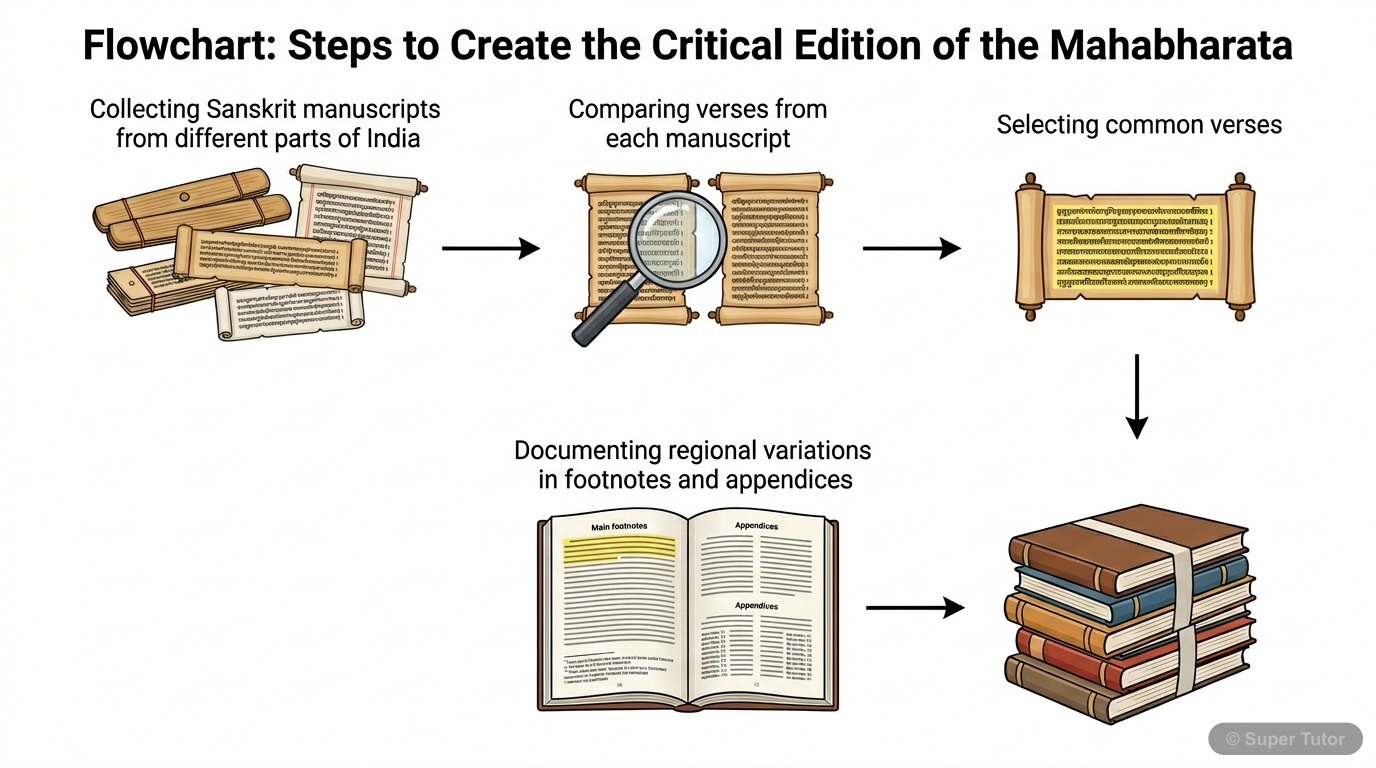
One of 16 illustrations for Kinship, Caste and Class (Early Societies) (c. 600 BCE-600 CE) in Super Tutor — alongside flashcards, concept maps and practice questions.
The first 14 solutions are open to read. The other 14 are free with a Super Tutor account.
Source-Based Intext Questions
Source 1In the context of the mantra from the Rigveda, discuss the implications of marriage from the point of view of the bride and groom. Are the implications identical, or are there differences?Show solution
Given: The mantra reads – 'I free her from here, but not from there. I have bound her firmly there, so that through the grace of Indra she will have fine sons and be fortunate in her husband's love.' 'Here' refers to the father's house and 'there' to the husband's house.
Implications for the Bride:
- Marriage meant a complete transfer of the woman from her father's household to her husband's household. She was 'freed' from one place only to be 'bound' in another.
- Her primary purpose, as stated in the mantra, was to produce 'fine sons' – i.e., male heirs – indicating that her reproductive role was central to the institution of marriage.
- She had no independent identity; her worth was measured by her ability to bear sons and by her husband's love.
- The mantra suggests she had no agency or choice in the matter – the priest, acting on behalf of the father, 'bound' her to the husband's house.
Implications for the Groom:
- The mantra does not place any obligations or restrictions on the groom. He is not 'bound' anywhere.
- He receives a wife whose purpose is to serve him and bear his children.
- His identity, property, and freedom remain unchanged.
Conclusion: The implications are NOT identical. Marriage was a deeply asymmetrical institution. For the bride, it meant a loss of her natal home, loss of freedom, and a new set of obligations (bearing sons, being devoted to the husband). For the groom, it meant gaining a wife and heirs, with no corresponding loss of freedom or identity. This reflects the patrilineal and patriarchal nature of early Indian society where women were transferred from one male authority (father) to another (husband).
Source 2Read the passage from the Adi Parvan of the Mahabharata and list the different criteria suggested for becoming king. Of these, how important was birth in a particular family? Which of these criteria seem justified? Are there any that strike you as unjust?Show solution
Given: The passage describes the conflict between Kauravas and Pandavas over succession to the throne of Hastinapura.
Criteria suggested for becoming king (as evident from the passage):
- Birth in the royal family (patrilineal descent) – Pandu's sons (Pandavas) were seen as natural heirs because Pandu had held the throne.
- Physical and mental capability – The citizens preferred the Pandavas because they were 'more capable and virtuous.'
- Virtue/moral character – The Pandavas were described as more virtuous.
- Seniority/age – Dhritarashtra was the elder brother but was passed over due to his blindness.
- Physical fitness/absence of disability – Dhritarashtra was denied the throne because of his blindness (his 'defect').
Importance of birth:
Birth in a particular family was the most fundamental criterion. The entire conflict arose because both the Kauravas and Pandavas were born into the royal lineage. Duryodhana's argument was entirely based on patrilineal succession – that if the Pandavas inherited, their sons and grandsons would continue to rule, excluding the Kauravas. This shows that birth was the primary determinant of eligibility.
Justified criteria:
- Capability and virtue seem the most justified criteria, as a capable and virtuous ruler would govern better and serve the people's interests.
- The citizens' preference for the Pandavas on grounds of capability reflects a merit-based view.
Unjust criteria:
- Excluding Dhritarashtra solely on the basis of physical disability (blindness) appears unjust, as disability does not necessarily affect one's wisdom or ability to rule.
- The idea that birth alone should determine kingship, regardless of merit, also seems unjust, as it could lead to incompetent rulers.
- Duryodhana's concern was purely self-interest (fear of exclusion), not the welfare of the kingdom or its people.
Source 3 (Eight forms of marriage)For each of the forms of marriage described in the Manusmriti, discuss whether the decision about the marriage was taken by (a) the bride, (b) the bridegroom, (c) the father of the bride, (d) the father of the bridegroom, (e) any other person.Show solution
Given: The Manusmriti describes eight forms of marriage. The first, fourth, fifth and sixth are given.
First Form (Brahma marriage):
- The father selects a learned Vedic scholar and gifts his daughter to him with costly clothes and jewels.
- Decision taken by: (c) the father of the bride. The bride and groom have no say. The father chooses the groom and initiates the marriage.
Fourth Form (Prajapatya marriage):
- The father addresses the couple with the text 'May both of you perform your duties together' and honours the bridegroom.
- Decision taken by: (c) the father of the bride, primarily. He selects the groom and performs the ceremony. The couple is addressed together, suggesting a slight acknowledgement of both parties, but the father retains control.
Fifth Form (Asura marriage):
- The bridegroom gives wealth to the kinsmen and to the bride herself according to his own will, and receives the maiden.
- Decision taken by: (b) the bridegroom. He decides how much wealth to give and takes the bride. The bride's kinsmen also play a role in accepting the wealth. The bride herself receives gifts but does not appear to have a decisive voice.
Sixth Form (Gandharva marriage):
- The voluntary union of a maiden and her lover, which springs from desire.
- Decision taken by: (a) the bride and (b) the bridegroom jointly. This is the only form where both parties exercise free will and mutual consent. It is based on love and desire.
Overall observation: In most forms, the father of the bride or the bridegroom held decision-making power. Only the sixth (Gandharva) form gave agency to both the bride and groom. The Brahmanical texts considered the first four forms 'good' and the remaining (including the Gandharva) as less desirable, which reflects the patriarchal control over women's lives.
Source 4How many Gotami-putas and how many Vasithi (alternative spelling Vasathi)-putas are there in the list of Satavahana kings?Show solution
Given: The list of Satavahana rulers from inscriptions is:
- raja Gotami-puta Siri-Satakani
- raja Vasithi-puta (sami-) Siri-Pulumayi
- raja Gotami-puta sami-Siri-Yana-Satakani
- raja Madhari-puta svami-Sakasena
- raja Vasathi-puta Chatarapana-Satakani
- raja Hariti-puta Vinhukada Chutukulanamda-Satakamni
- raja Gotami-puta Siri-Vijaya-Satakani
Counting:
- Gotami-putas: Rulers 1, 3, and 7 → Total = 3 Gotami-putas
- Vasithi/Vasathi-putas: Rulers 2 and 5 → Total = 2 Vasithi/Vasathi-putas
Significance: The use of metronymics (names derived from the mother's name) among Satavahana rulers is notable. The gotra names Gotami and Vasithi are feminine forms of the Vedic seers Gotama and Vasistha. This shows that Satavahana women retained their father's gotra names even after marriage, which was contrary to Brahmanical rules that required women to adopt their husband's gotra upon marriage.
Source 5Does the passage about Gandhari's advice to Duryodhana give you an idea about the way in which mothers were viewed in early Indian societies?Show solution
Given: Gandhari appeals to Duryodhana to make peace with the Pandavas, citing dharma, wisdom, self-control, and the futility of war. Duryodhana ignores her advice.
What the passage reveals about the status of mothers:
- Moral authority: Gandhari's appeal shows that mothers were regarded as moral guides and voices of wisdom. She invokes dharma, artha, and the welfare of the kingdom – suggesting that mothers were expected to uphold ethical values.
- Emotional bond: Duryodhana is expected to honour his mother's wishes ('By making peace you honour your father and me'). This indicates that a mother's approval was considered important and that sons were expected to respect their mothers.
- Limited political power: Despite her wisdom and moral authority, Gandhari's advice was ignored by Duryodhana. This suggests that while mothers were respected, they did not hold real political or decision-making power. Their role was advisory, not authoritative.
- Metronymics and symbolic importance: The use of metronymics among Satavahana rulers (as discussed in the chapter) suggests that mothers were symbolically important, even if succession was patrilineal.
Conclusion: Mothers in early Indian societies were viewed with great respect as moral authorities and emotional anchors of the family. However, their actual power was limited – they could advise but not command. The episode of Gandhari illustrates both the reverence accorded to mothers and the limits of their influence in a patriarchal society.
Source 6Why do you think the Brahmanas quoted the verse from the Purusha sukta (Rigveda) frequently?Show solution
Given: The Purusha sukta verse states that the Brahmana was born from the mouth of Purusha (the primeval man), the Kshatriya from his arms, the Vaishya from his thighs, and the Shudra from his feet.
Reasons why Brahmanas quoted this verse frequently:
- Divine sanction for social hierarchy: By claiming that the varna system originated from the sacrifice of a cosmic being (Purusha), Brahmanas gave the social order a divine and sacred origin. This made it difficult to question or challenge the hierarchy.
- Justification of Brahmanical supremacy: The verse placed Brahmanas at the top (born from the mouth – the most sacred part, associated with speech, knowledge, and the Vedas). Frequent citation reinforced their claim to the highest social position.
- Legitimising the subordination of Shudras: The Shudra's birth from the feet (the lowest part of the body) was used to justify their servile status and restricted occupations.
- Resistance to challenges: As political power shifted and non-Kshatriya kings emerged, and as Buddhist and other traditions challenged the varna order, Brahmanas needed a powerful counter-argument. A verse from the sacred Rigveda provided unquestionable authority.
- Universal applicability: By rooting the varna system in a cosmic event, Brahmanas claimed that it was not a human invention but a universal, eternal truth that everyone was obliged to follow.
Conclusion: The frequent citation of the Purusha sukta was a deliberate ideological strategy to naturalise and sacralise social inequality, making the varna hierarchy appear divinely ordained and therefore beyond human questioning.
Source 7(a) What message do you think the story of Ekalavya was meant to convey to the nishadas? (b) What message would it convey to Kshatriyas? (c) Do you think that Drona, as a Brahmana, was acting according to the Dharmasutras when he was teaching archery?Show solution
Given: The story describes how Ekalavya, a nishada (forest-dwelling hunting community), was refused as a pupil by Drona (a Brahmana archery teacher). Ekalavya taught himself using a clay image of Drona, became supremely skilled, but was asked to give his right thumb as guru-dakshina (teacher's fee), which he did, thereby losing his superior skill.
(a) Message to the nishadas:
- The story conveyed that people from 'lower' or 'outside' communities should not aspire to skills and occupations reserved for higher varnas (in this case, archery, which was a Kshatriya skill).
- Even if a nishada acquired such skills through hard work, the social order would find a way to neutralise the threat he posed to the established hierarchy.
- The message was one of resignation and acceptance of one's assigned social role – nishadas were hunters, not warriors or archers.
- It also warned that challenging the social order, even indirectly, would result in loss and punishment.
(b) Message to Kshatriyas:
- The story reassured Kshatriyas that their monopoly over martial skills (like archery) would be protected.
- It showed that Brahmanas (like Drona) would act as guardians of the varna order, ensuring that lower-born individuals did not surpass Kshatriya warriors.
- It also reinforced the bond between Brahmanas and Kshatriyas – Drona protected Arjuna's supremacy, and by extension, Kshatriya dominance in warfare.
(c) Was Drona acting according to the Dharmasutras?
- According to the Dharmasutras, Brahmanas were supposed to study and teach the Vedas, perform sacrifices, and give/receive gifts. Teaching archery was not listed as a Brahmanical occupation.
- Archery and warfare were prescribed for Kshatriyas.
- Therefore, strictly speaking, Drona was NOT acting according to the Dharmasutras when he taught archery. He was performing a Kshatriya function.
- However, the Dharmasutras also allowed Brahmanas to take up other occupations in times of distress (apad-dharma). Drona may have been justified under this provision.
- This also illustrates that in practice, the rigid varna-based occupational rules were not always followed, even by those who upheld the system.
Source 8Do you think the silk weavers were following the occupation laid down for them in the Shastras?Show solution
Given: The inscription from Mandasor describes silk weavers who had migrated from Lata (Gujarat) to Dashapura (Mandasor). The excerpt describes members of the guild as being engaged in music, writing biographies, religious discourses, Vedic astronomy, and even warfare – activities far beyond weaving.
Answer:
No, the silk weavers were clearly NOT following only the occupation laid down for them in the Shastras.
- According to the Shastras, occupations were determined by varna. Weavers would likely have been classified as Vaishyas or Shudras, whose prescribed occupations were trade, agriculture, pastoralism (Vaishyas) or service (Shudras). Weaving as a craft was a specific occupational identity.
- However, the inscription reveals that members of the weavers' guild had diversified into:
- Music (a cultural/artistic pursuit)
- Writing biographies (a literary/scholarly activity, closer to Brahmanical learning)
- Religious discourses (again, a Brahmanical domain)
- Vedic astronomy (explicitly a Brahmanical/scholarly field)
- Warfare (a Kshatriya occupation)
- This shows that in practice, people did not confine themselves to the occupations prescribed by the Shastras. Economic prosperity, urbanisation, and social mobility allowed craft communities to pursue diverse activities.
- The guild also collectively decided to build a temple – an act of religious patronage that transcended their assigned social role.
Conclusion: The evidence from the Mandasor inscription clearly demonstrates that Brahmanical prescriptions about occupational roles were not universally followed. Real social life was far more complex and fluid than the ideal varna order suggested.
Source 9Identify the practices described in the story of Hidimba which seem non-Brahmanical.Show solution
Given: The story describes how Hidimba, a rakshasa woman, fell in love with Bhima, proposed to him, and eventually married him. Their son Ghatotkacha was born and later rejoined the Pandavas when needed.
Non-Brahmanical practices identified in the story:
- A woman proposing marriage: Hidimba herself proposed to Bhima. In Brahmanical norms, marriage was arranged by the father (kanyadana), and women had no agency in choosing their husbands. A woman taking the initiative to propose was contrary to Brahmanical ideals.
- Inter-community/inter-varna marriage: The marriage between a Kshatriya (Bhima, a Pandava prince) and a rakshasa woman was a cross-community union. Brahmanical texts generally discouraged such unions and prescribed marriage within one's own varna.
- The nature of the union: The marriage was based on love and desire (similar to the Gandharva form), which was considered the sixth and less desirable form of marriage in the Manusmriti. It was not arranged by a father or conducted with Vedic rituals.
- Living arrangement: The couple spent days together but Bhima returned every night – an unconventional arrangement not prescribed in Brahmanical texts.
- The rakshasa's way of life: Rakshasas were associated with eating flesh, living in forests, shape-shifting, and other practices considered impure or uncivilised by Brahmanical standards.
- Abandonment of kin and dharma: Hidimba declared that she had 'forsaken her friends, her dharma and her kin' for Bhima – suggesting that she was consciously stepping outside her community's norms.
Conclusion: The story reflects the integration of non-Brahmanical communities and practices into the Mahabharata narrative, suggesting that the text recorded a diversity of social practices that existed beyond the Brahmanical framework.
Source 10Identify elements in the story of Matanga from the Matanga Jataka that suggest that it was written from the perspective of Matanga.Show solution
Given: The story from the Matanga Jataka describes how Matanga, a chandala (considered 'untouchable'), attained spiritual powers, married a merchant's daughter, and was later rejected by his own son Mandavya (who had become a Brahmanical scholar) when he came begging.
Elements suggesting the story is written from Matanga's perspective:
- Matanga is the hero and the Bodhisattva: The story identifies Matanga as the Bodhisattva (the Buddha in a previous birth). This immediately elevates him to the highest spiritual status, directly challenging the Brahmanical notion that chandalas were spiritually inferior.
- Matanga's spiritual superiority: Despite being born a chandala, Matanga attains great spiritual powers through renunciation. This suggests that birth does not determine spiritual worth – a central Buddhist argument against the varna system.
- Critique of Brahmanical pride: Matanga's statement – 'Those who are proud of their birth and are ignorant do not deserve gifts. On the contrary, those who are free from vices are worthy of offerings' – is a direct critique of Brahmanical claims to superiority based on birth. This is clearly Matanga's (and the Buddhist) viewpoint.
- Mandavya's rejection is shown as wrong: The story portrays Mandavya's refusal to give food to his own father (because he looked like an outcaste) as morally reprehensible. The narrative condemns the son's behaviour, siding with Matanga.
- Dittha Mangalika's repentance: The merchant's daughter, who had initially insulted Matanga, later begs his forgiveness. This vindicates Matanga and shows that those who discriminated against him were ultimately in the wrong.
- The power of Matanga's leftover food: The story ends with Matanga's leftover food being given to Mandavya and the Brahmanas – suggesting that a chandala's spiritual merit was greater than that of the Brahmanas he fed.
Conclusion: The story is clearly written from a Buddhist perspective that champions Matanga's cause, critiques caste-based discrimination, and argues that virtue and spiritual attainment, not birth, determine a person's worth.
Source 11Do you think that the episode of Draupadi being staked in the dice game suggests that wives could be treated as the property of their husbands?Show solution
Given: Yudhisthira staked Draupadi in a game of dice after losing everything else, including himself. Two contrary opinions were expressed: (1) even if Yudhisthira had lost himself, his wife remained under his control; (2) an unfree man could not stake another person. The matter remained unresolved.
Analysis:
Arguments suggesting wives were treated as property:
- The very act of staking Draupadi in a dice game implies that Yudhisthira considered her his possession, like gold, elephants, or his kingdom.
- The first opinion expressed in the text explicitly states that 'his wife remained under his control' even after he had lost himself – treating her as an object that could be owned and transferred.
- The Manusmriti and other Dharmashastra texts gave husbands significant control over their wives' movements and property, reinforcing the idea of wives as dependents under male authority.
- Women could not claim a share of the paternal estate, and their stridhana (personal wealth) was also subject to the husband's permission – indicating limited economic autonomy.
Arguments against this interpretation:
- The second opinion in the text challenges Yudhisthira's right to stake Draupadi, suggesting that even in early Indian society, there were voices that questioned the treatment of women as property.
- Draupadi herself challenged the assembly, asking whether Yudhisthira had the right to stake her. Her protest shows that women were not entirely passive.
- Dhritarashtra ultimately restored freedom to both the Pandavas and Draupadi, suggesting that her enslavement was not considered fully legitimate.
Conclusion: Yes, the episode does suggest that in the social context of the time, wives could be (and were) treated as property by their husbands. However, the text itself presents this as a contested and morally ambiguous act, indicating that there were dissenting voices even within early Indian society. The episode reflects the patriarchal nature of the society while also hinting at its contradictions.
Source 12Compare and contrast the ways in which men and women could acquire wealth according to the Manusmriti.Show solution
Given: According to the Manusmriti:
- Men's seven means of acquiring wealth: inheritance, finding, purchase, conquest, investment, work, and acceptance of gifts from good people.
- Women's six means: gifts received at marriage (in front of the fire), gifts during the bridal procession, tokens of affection, gifts from brother/mother/father, subsequent gifts, and gifts from an 'affectionate' husband.
Comparison:
Similarities:
- Both men and women could receive gifts as a means of acquiring wealth.
- Both could inherit wealth (though the conditions differed significantly).
Differences:
| Aspect | Men | Women |
|---|---|---|
| Number of means | 7 | 6 |
| Nature of means | Active and independent (work, purchase, conquest, investment) | Passive and dependent (gifts from family members, husband) |
| Economic agency | High – men could earn through work, trade, investment | Low – women depended almost entirely on gifts from others |
| Conquest | Men could acquire wealth through conquest (warfare) | No such provision for women |
| Investment | Men could invest and earn returns | No such provision for women |
| Work | Men could earn through their own labour | No independent earning through work mentioned |
| Source of wealth | Self-generated as well as received | Almost entirely received from others (father, brother, husband) |
Conclusion: The contrast is stark. Men had multiple active, independent means of acquiring wealth through their own efforts (work, investment, conquest, purchase). Women's means were almost entirely passive and dependent on the goodwill of male relatives (father, brother, husband). This reflects the deeply patriarchal nature of early Indian society, where women had limited economic autonomy and were financially dependent on men throughout their lives – first on their father, then on their husband.
Source 13What does the dialogue between Avantiputta and Kachchana (from the Majjhima Nikaya) reveal about Buddhist attitudes towards varna?Show solution
Given: Kachchana (a disciple of the Buddha) asks King Avantiputta whether a wealthy Shudra could command the service of Brahmanas, Kshatriyas, and Vaishyas. Avantiputta agrees that wealth, not birth, determines social relations. Kachchana then asks whether the four varnas are not exactly the same, and Avantiputta concedes.
Buddhist attitudes towards varna as revealed by this passage:
- Rejection of birth-based hierarchy: The dialogue directly challenges the Brahmanical claim that varna is determined by birth and is divinely ordained. By showing that a wealthy Shudra can command the service of Brahmanas, the text argues that birth is irrelevant to actual social power.
- Wealth as the real determinant of status: The Buddhist text suggests that in practice, economic power (wealth) determines social relationships, not ritual purity or birth. This is a materialist critique of the varna system.
- Equality of all varnas: Kachchana's conclusion – 'are not these four varnas exactly the same?' – reflects the Buddhist belief in the fundamental equality of all human beings, regardless of their birth.
- Critique of Brahmanical claims: The passage directly addresses and refutes Brahmanical claims of being 'sons of Brahma,' 'born of his mouth,' and being the 'best caste.' The Buddhist text treats these as unfounded assertions.
- Social differences are not natural or inflexible: Unlike the Brahmanical view that the varna order was eternal and divinely created, Buddhists recognised social differences but argued they were human constructs that could change with circumstances (like the acquisition of wealth).
Conclusion: The Buddhist tradition offered a powerful critique of the Brahmanical varna system by arguing that social status was determined by wealth and conduct, not by birth. This made Buddhism attractive to many who were marginalised by the Brahmanical order.
Source 14(a) What are the strategies which the bard uses to try and persuade the chief to be generous? (b) What is the chief expected to do to acquire wealth in order to give some to the bards?Show solution
Given: A poem from the Puranaruru (Tamil Sangam literature) in which a bard describes his patron to other poets, inviting them to seek his generosity.
(a) Strategies used by the bard to persuade the chief:
- Honest acknowledgement of the chief's limited wealth: The bard does not flatter the chief falsely. He admits 'He doesn't have the wealth to lavish on others everyday' – this honesty builds credibility and makes the appeal more genuine.
- Praising the chief's generous spirit: Despite limited wealth, the bard emphasises that the chief does not refuse with the excuse of having nothing. He highlights the chief's willingness to give, which is his defining virtue.
- Appealing to the chief's identity as a patron: The bard calls the chief 'an enemy to the hunger of bards' – a vivid metaphor that defines the chief's social role as a protector and provider for poets.
- Appealing to the self-interest of other bards: The bard invites other bards to come along ('come along with me, bards whose lips are so skilled'), promising that the chief will help cure their poverty.
- Evoking sympathy through physical imagery: The bard describes the bards' 'ribs thin with hunger' – a powerful visual image designed to evoke the chief's compassion and sense of duty.
- Implicit social pressure: By publicly praising the chief's generosity, the bard creates a social expectation. The chief's reputation depends on living up to this praise.
(b) What the chief is expected to do to acquire wealth:
- The chief is expected to go to the village blacksmith and commission a 'long spear for war, one that has a straight blade.'
- This means the chief is expected to engage in warfare and raiding to acquire wealth (plunder/booty), which he can then distribute to the bards.
- This reflects the chieftain economy of ancient Tamilakam, where chiefs derived wealth through warfare and were expected to redistribute it generously to their followers, bards, and dependants.
- Generosity was a key marker of status and honour for chiefs in this society.
Free with a Super Tutor account
Free with a Super Tutor account
Answer in 100-150 Words (Short Answer Questions)
Free with a Super Tutor account
Free with a Super Tutor account
Free with a Super Tutor account
Free with a Super Tutor account
Free with a Super Tutor account
Write a Short Essay (About 500 Words)
Free with a Super Tutor account
Free with a Super Tutor account
Free with a Super Tutor account
Free with a Super Tutor account
Map Work
Free with a Super Tutor account
Project Questions
Free with a Super Tutor account
Free with a Super Tutor account
14 more solved questions in Kinship, Caste and Class (Early Societies) (c. 600 BCE-600 CE)
They are free with a Super Tutor account, along with practice quizzes and flashcards for this chapter. Free to start, no card needed.
Frequently Asked Questions
What are the important topics in Kinship, Caste and Class (Early Societies) (c. 600 BCE-600 CE) for Madhya Pradesh Board Class 12 History?
Are these NCERT Solutions for Kinship, Caste and Class (Early Societies) (c. 600 BCE-600 CE) free?
How should I revise Kinship, Caste and Class (Early Societies) (c. 600 BCE-600 CE) for the Madhya Pradesh Board Class 12 board exam?
Sources & Official References
Content is aligned to the official syllabus. Refer to the board website for the latest curriculum.
More resources for Kinship, Caste and Class (Early Societies) (c. 600 BCE-600 CE)
Practice Quiz
Test yourself with a quick quiz
Important Questions
Exam-style questions with answers
Revision Notes
Key points for last-minute revision
Chapter Summary
Understand the chapter at a glance
Concept Maps
See how topics connect
Study Plan
Step-by-step plan for this chapter
Flashcards
Quick-fire cards for active recall
Syllabus
What topics to cover
For serious students
Get the full Kinship, Caste and Class (Early Societies) (c. 600 BCE-600 CE) chapter — start free.
Quizzes, flashcards, an AI doubt solver and a study plan for Madhya Pradesh Board Class 12 History. Free to start, no card needed.