Data And Their Representations — Revision Notes
NIOS · Class 10 · Maths
Data And Their Representations revision notes for NIOS Class 10 Maths: 4 topics in quick points. Part of the NIOS Class 10 Maths syllabus.
Interactive on Super Tutor
Studying Data And Their Representations? Get the full interactive chapter.
Quizzes, flashcards, AI doubt-solver and a step-by-step study plan — built for revision notes and more.
Free trial, no card needed.
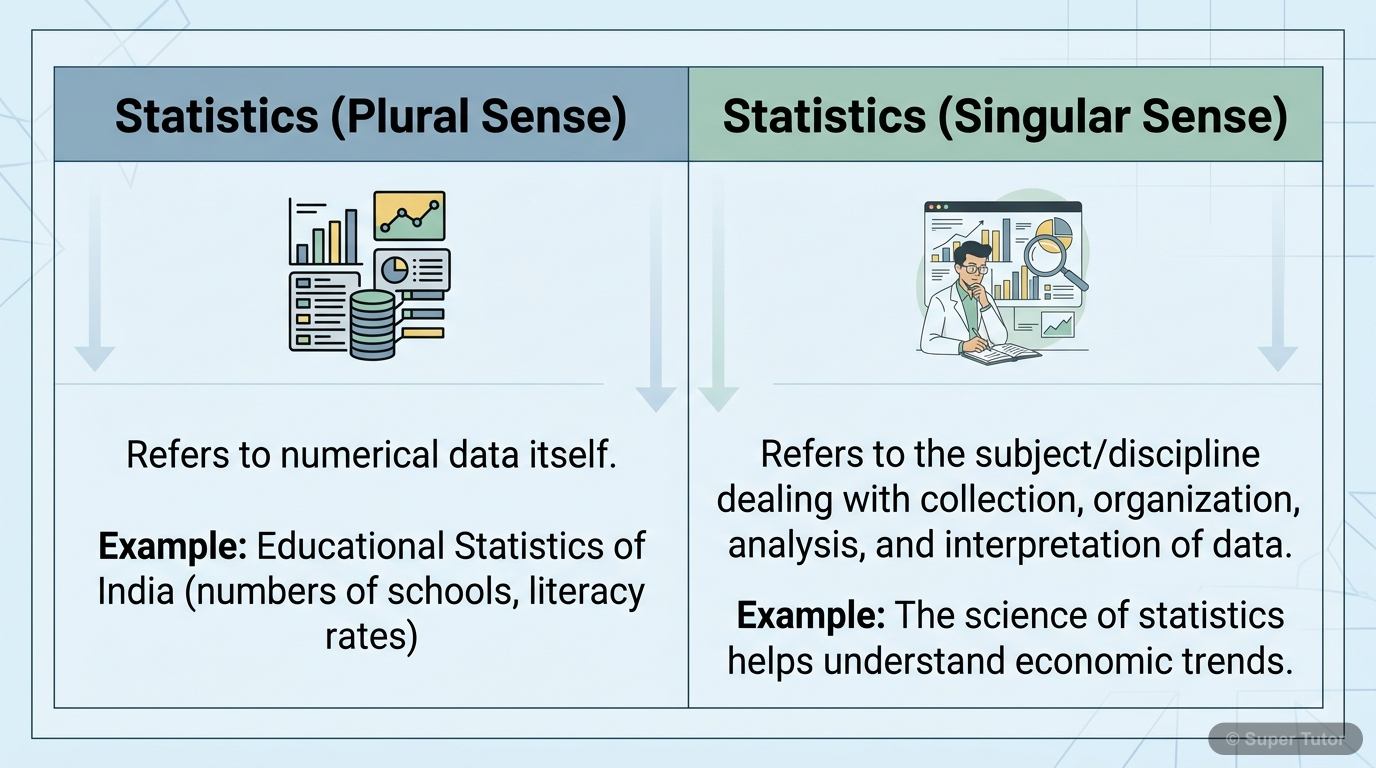
One of 11 illustrations for Data And Their Representations in Super Tutor — alongside flashcards, concept maps and practice questions.
Key Topics to Revise
1. Statistics and Data Collection
- Statistics has two meanings: plural sense means numerical data, and singular sense means the subject that studies data.
- Data may be primary for one individual or agency but becomes secondary for others using the same data.
- Primary data are collected directly by the investigator.
2. Raw Data, Arrayed Data and Frequency Tables
- Raw data is data in the form in which it is originally collected.
- Arrayed data is raw data arranged in ascending or descending order.
- Arraying data makes it easy to find the minimum, maximum and repeated values.
3. Class Limits, True Class Limits and Class Mark
- A class interval has a lower class limit and an upper class limit.
- True class limits are adjusted boundaries that make classes continuous.
- True class limits are found by taking half the difference between the upper limit of one class and the lower limit of the next class and adjusting the boundaries.
4. Cumulative Frequency
- Cumulative frequency of a class is the total of the frequency of that class and the frequencies of all classes preceding it.
- The cumulative frequency of the last class equals the total number of observations.
- Cumulative frequency tables help find how many observations are less than a given upper boundary.
Get complete notes with diagrams and examples
Full NotesKey Concepts
Frequently Asked Questions
What are the important topics in Data And Their Representations for NIOS Class 10 Maths?
How should I revise Data And Their Representations for the NIOS Class 10 board exam?
Sources & Official References
Content is aligned to the official syllabus. Refer to the board website for the latest curriculum.
More resources for Data And Their Representations
Practice Quiz
Test yourself with a quick quiz
Important Questions
Exam-style questions with answers
Formula Sheet
The chapter's formulas in one place
Chapter Summary
Understand the chapter at a glance
Concept Maps
See how topics connect
Study Plan
Step-by-step plan for this chapter
Flashcards
Quick-fire cards for active recall
Syllabus
What topics to cover
For serious students
Get the full Data And Their Representations chapter — start free.
Quizzes, flashcards, an AI doubt solver and a study plan for NIOS Class 10 Maths. Free to start, no card needed.