Electrical Energy — Revision Notes
NIOS · Class 10 · Science & Tech
Electrical Energy revision notes for NIOS Class 10 Science & Tech: 4 topics in quick points. Part of the NIOS Class 10 Science & Tech syllabus.
Interactive on Super Tutor
Studying Electrical Energy? Get the full interactive chapter.
Quizzes, flashcards, AI doubt-solver and a step-by-step study plan — built for revision notes and more.
Free trial, no card needed.
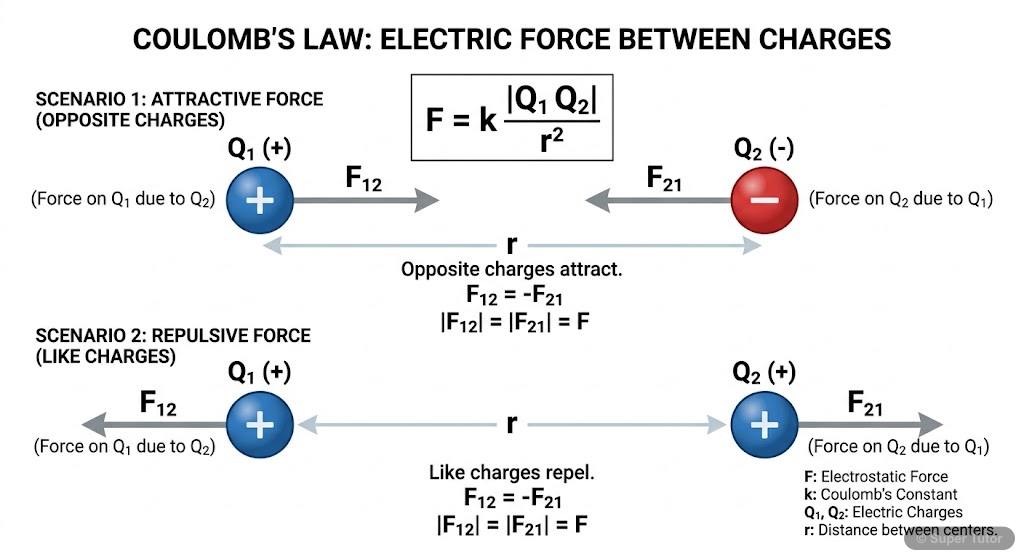
One of 18 illustrations for Electrical Energy in Super Tutor — alongside flashcards, concept maps and practice questions.
Key Topics to Revise
1. Electrostatics and Electric Charge
- Frictional electricity or static electricity is the charge developed on a body when rubbed with another body.
- Thales of Miletus observed that amber rubbed with wool attracts light materials like feathers, dust, lint, and leaves.
- The Greek name for amber, electrum, gave the words electricity, electric charge, electric force, and electron.
2. Coulomb's Law and Electrostatic Potential
- Coulomb's law gives the force between two point charges.
- The force increases when either charge increases.
- The force decreases when the distance between charges increases.
3. Electric Current, Cell, and Charge Flow
- Electric current is the charge flowing through a conductor per unit time.
- A current-carrying conductor contains free electrons.
- Free electrons move randomly at high speed, but this random motion is not current.
4. Resistance, Ohm's Law, and Resistors
- Resistance is the opposition offered to the flow of electric current.
- Ohm's law states that current through a conductor is directly proportional to the potential difference across it if temperature remains constant.
- Resistance depends on length, thickness, width, and material.
Get complete notes with diagrams and examples
Full NotesKey Concepts
Frequently Asked Questions
What are the important topics in Electrical Energy for NIOS Class 10 Science & Tech?
How should I revise Electrical Energy for the NIOS Class 10 board exam?
Sources & Official References
Content is aligned to the official syllabus. Refer to the board website for the latest curriculum.
More resources for Electrical Energy
Practice Quiz
Test yourself with a quick quiz
Important Questions
Exam-style questions with answers
Formula Sheet
The chapter's formulas in one place
Chapter Summary
Understand the chapter at a glance
Concept Maps
See how topics connect
Study Plan
Step-by-step plan for this chapter
Flashcards
Quick-fire cards for active recall
Syllabus
What topics to cover
For serious students
Get the full Electrical Energy chapter — start free.
Quizzes, flashcards, an AI doubt solver and a study plan for NIOS Class 10 Science & Tech. Free to start, no card needed.