Electrical Energy
NIOS · Class 10 · Science & Tech
Most important questions from Electrical Energy for NIOS Class 10 Science & Tech board exam 2026. MCQs, short answer, and long answer questions with marks.
Interactive on Super Tutor
Studying Electrical Energy? Get the full interactive chapter.
Quizzes, flashcards, AI doubt-solver and a step-by-step study plan — built for important questions and more.
1,000+ Class 10 students started this chapter today
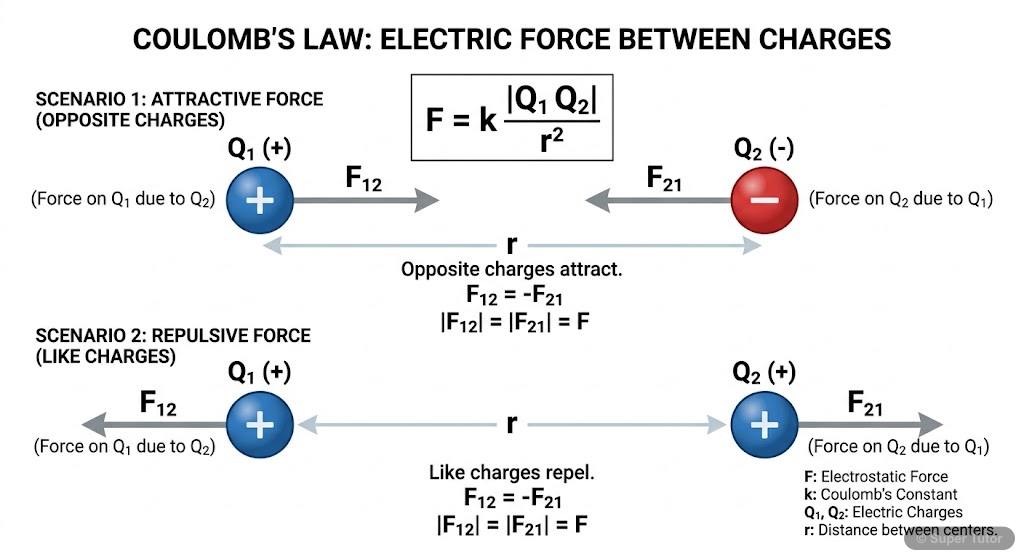
Super Tutor has 18+ illustrations like this for Electrical Energy alone — flashcards, concept maps, and step-by-step visuals.
See them allSample Questions
What type of materials allow electric current to flow through them easily?
Show answer
Conductors
Conductors are materials that allow electric current to flow through them easily because they have free electrons that can move freely. Metals like copper, aluminum, and silver are excellent conductors. These materials have low electrical resistance. Insulators like rubber, glass, and plastic resist the flow of current. Semiconductors have properties between conductors and insulators. Resistors are components that provide specific resistance in circuits. Good conductors are used in electrical wires, while insulators are used for safety and protection in electrical systems.
The heating effect of electric current is used in which of the following appliances?
Show answer
Electric iron
The heating effect of electric current (Joule's heating) occurs when electrical energy is converted to heat energy due to resistance in conductors. Electric iron uses this principle - current flows through a heating element with high resistance, generating heat for ironing clothes. The heat produced follows H = I²Rt formula. Electric fan uses magnetic effect for rotation, electric bell uses electromagnetic effect for sound, and electric motor uses magnetic effect for mechanical motion. Other heating appliances include electric heater, toaster, kettle, and room heaters.
In a series circuit with three resistors, the equivalent resistance is:
Show answer
Sum of all individual resistances
In a series circuit, resistors are connected end-to-end, forming a single path for current flow. The same current flows through all resistors. The equivalent resistance Rs = R₁ + R₂ + R₃. This happens because each resistor adds to the total opposition to current flow. The total voltage across the combination equals the sum of individual voltages (V = V₁ + V₂ + V₃). This makes the total resistance higher than any individual resistance. Series circuits are used in applications where we want the same current through all components, like decorative lights.
The commercial unit of electrical energy is:
Show answer
Kilowatt hour (kWh)
The commercial unit of electrical energy is kilowatt hour (kWh), also called 'unit' of electricity. It represents the energy consumed when 1 kilowatt power is used for 1 hour. 1 kWh = 1000 W × 3600 s = 3.6 × 10⁶ J. Electricity boards use this unit for billing because joule is too small for practical energy measurements. Watt is the unit of power, not energy. Ampere hour is used for battery capacity. Your electricity bill shows consumption in kWh units, and you pay per unit consumed.
+98 more questions available
Practice AllFrequently Asked Questions
What are the important topics in Electrical Energy for NIOS Class 10 Science & Tech?
How to score full marks in Electrical Energy — NIOS Class 10 Science & Tech?
How many important questions are there in Electrical Energy?
Sources & Official References
Content is aligned to the official syllabus. Refer to the board website for the latest curriculum.
More resources for Electrical Energy
Practice Quiz
Test yourself with a quick quiz
Revision Notes
Key points for last-minute revision
Formula Sheet
All formulas in one place
Chapter Summary
Understand the chapter at a glance
Concept Maps
See how topics connect visually
Study Plan
Step-by-step plan to ace this chapter
Flashcards
Quick-fire cards for active recall
Syllabus
What topics to cover
NCERT Solutions
Every textbook question solved step by step
For serious students
Get the full Electrical Energy chapter — for free.
Quizzes, flashcards, AI doubt-solver and a step-by-step study plan for NIOS Class 10 Science & Tech.