Electrical Energy — Chapter Summary
NIOS · Class 10 · Science & Tech
Summary of Electrical Energy for NIOS Class 10 Science & Tech. Part of the NIOS Class 10 Science & Tech syllabus.
Interactive on Super Tutor
Studying Electrical Energy? Get the full interactive chapter.
Quizzes, flashcards, AI doubt-solver and a step-by-step study plan — built for chapter summary and more.
Free trial, no card needed.
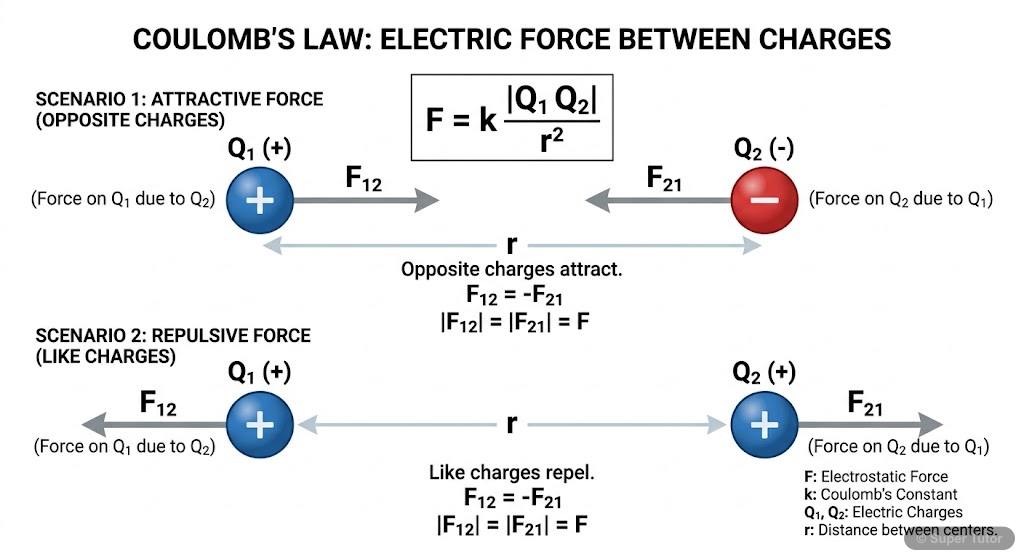
One of 18 illustrations for Electrical Energy in Super Tutor — alongside flashcards, concept maps and practice questions.
Overview
Electrical energy is closely connected with electric charge, electric potential, current, resistance, and power. Charge can be transferred by rubbing, and that transfer explains static electricity. When charge moves through a conductor, electric current is produced. A cell supplies the potential dif
Key Concepts
The electricity or charge developed on
The electricity or charge developed on a body on rubbing with another body is called frictional electricity or static electricity. Rubbing does not cr
Two types of charge are produced
Two types of charge are produced on rubbing: positive and negative. A glass rod rubbed with silk acquires positive charge, while an ebonite rod rubbed
Conservation of charge states that
Conservation of charge states that the total amount of electric charge in an isolated system does not change with time.
According to Coulomb's law
According to Coulomb's law, the magnitude of the force between two point charges is directly proportional to the product of the charges and inversely
Electrostatic potential is the work done
Electrostatic potential is the work done in bringing a unit positive charge from infinity to a point. Potential difference is the work done in moving
Learning Objectives
- Understand static electricity and the transfer of charge by rubbing
- Distinguish between positive and negative charges and explain attraction and repulsion
- Apply Coulomb's law for force between charges
- Define electrostatic potential and potential difference
- Understand electric current, conventional current, and the role of a cell
Frequently Asked Questions
What are the important topics in Electrical Energy for NIOS Class 10 Science & Tech?
How should I revise Electrical Energy for the NIOS Class 10 board exam?
Sources & Official References
Content is aligned to the official syllabus. Refer to the board website for the latest curriculum.
More resources for Electrical Energy
Practice Quiz
Test yourself with a quick quiz
Important Questions
Exam-style questions with answers
Revision Notes
Key points for last-minute revision
Formula Sheet
The chapter's formulas in one place
Concept Maps
See how topics connect
Study Plan
Step-by-step plan for this chapter
Flashcards
Quick-fire cards for active recall
Syllabus
What topics to cover
For serious students
Get the full Electrical Energy chapter — start free.
Quizzes, flashcards, an AI doubt solver and a study plan for NIOS Class 10 Science & Tech. Free to start, no card needed.