Chapter 21 of 32
Revision Notes
Building Blocks of Life Cell and Tissues — Revision Notes
NIOS · Class 10 · Science & Tech
Building Blocks of Life Cell and Tissues revision notes for NIOS Class 10 Science & Tech: 4 topics in quick points.
41 questions40 flashcards5 concepts
Interactive on Super Tutor
Studying Building Blocks of Life Cell and Tissues? Get the full interactive chapter.
Quizzes, flashcards, AI doubt-solver and a step-by-step study plan — built for revision notes and more.
Free trial, no card needed.
Super Tutor
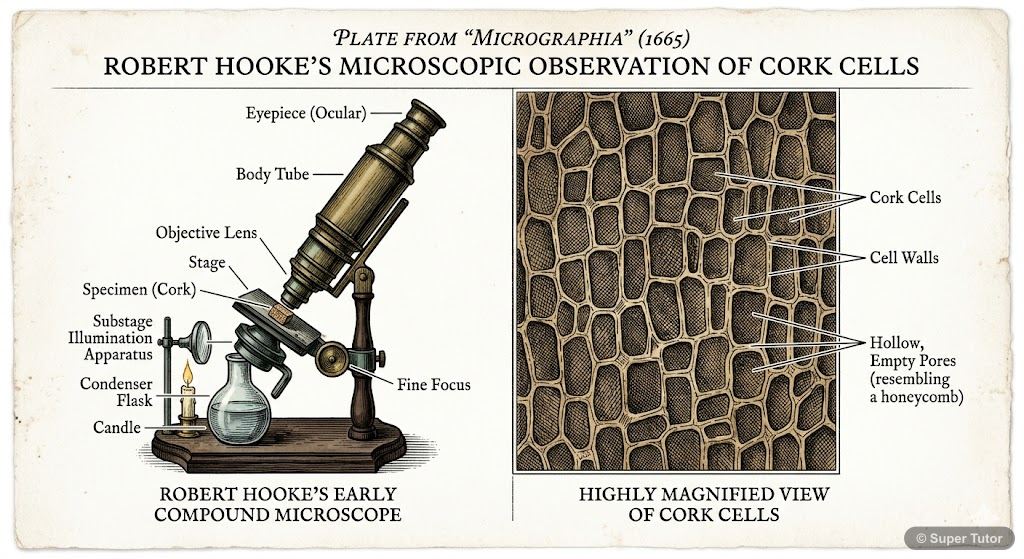
Learn better with visuals Super Tutor pairs illustrations like this with notes and quizzes for Building Blocks of Life Cell and Tissues.
Key Topics to Revise
1
1. Cell as the Basic Unit of Life
- Robert Hooke discovered the cell in 1665 by observing cork under a simple microscope.
- He named the small compartments cells.
- The cell theory was formulated by M J Schleiden in 1838 and T Schwann in 1839.
2
2. Types of Cells: Prokaryotic and Eukaryotic
- All cells have cell membrane, cytoplasm, and DNA.
- Prokaryotic cells do not have a well-organized nucleus.
- In prokaryotic cells, nuclear membrane is absent.
3
3. Parts of a Typical Eukaryotic Cell
- The three basic parts of a cell are cell membrane, cytoplasm, and nucleus.
- The cell membrane is thin, delicate, and selectively permeable.
- The cell membrane protects the cell, maintains shape, and allows only selected substances to pass in and out.
4
4. Plant Cell and Animal Cell
- Plant cells are larger and rectangular.
- Animal cells are smaller and oval.
- Cell wall is present only in plant cells and is made of cellulose.
Get complete notes with diagrams and examples
Full NotesKey Concepts
Robert Hooke discovered the cellProkaryotic cells do not haveThe cell membrane is thinEndoplasmic reticulum helps in intracellular transportPlant cells have a cell wall
Frequently Asked Questions
What are the important topics in Building Blocks of Life Cell and Tissues for NIOS Class 10 Science & Tech?
Key topics in Building Blocks of Life Cell and Tissues include Cell as the Basic Unit of Life, Types of Cells: Prokaryotic and Eukaryotic, Parts of a Typical Eukaryotic Cell, Plant Cell and Animal Cell. Study these first, then practise questions on each for the NIOS Class 10 board exam.
How should I revise Building Blocks of Life Cell and Tissues for the NIOS Class 10 board exam?
Learn the core ideas first, then work through the 41 practice questions on Building Blocks of Life Cell and Tissues. Revise definitions regularly and use flashcards for quick recall before the exam.
Sources & Official References
Content is aligned to the official syllabus. Refer to the board website for the latest curriculum.
More resources for Building Blocks of Life Cell and Tissues
For serious students
Get the full Building Blocks of Life Cell and Tissues chapter — start free.
Quizzes, flashcards, an AI doubt solver and a study plan for NIOS Class 10 Science & Tech. Free to start, no card needed.