Metals and Non-Metals — Revision Notes
NIOS · Class 10 · Science & Tech
Metals and Non-Metals revision notes for NIOS Class 10 Science & Tech: 4 topics in quick points. Part of the NIOS Class 10 Science & Tech syllabus.
Interactive on Super Tutor
Studying Metals and Non-Metals? Get the full interactive chapter.
Quizzes, flashcards, AI doubt-solver and a step-by-step study plan — built for revision notes and more.
Free trial, no card needed.
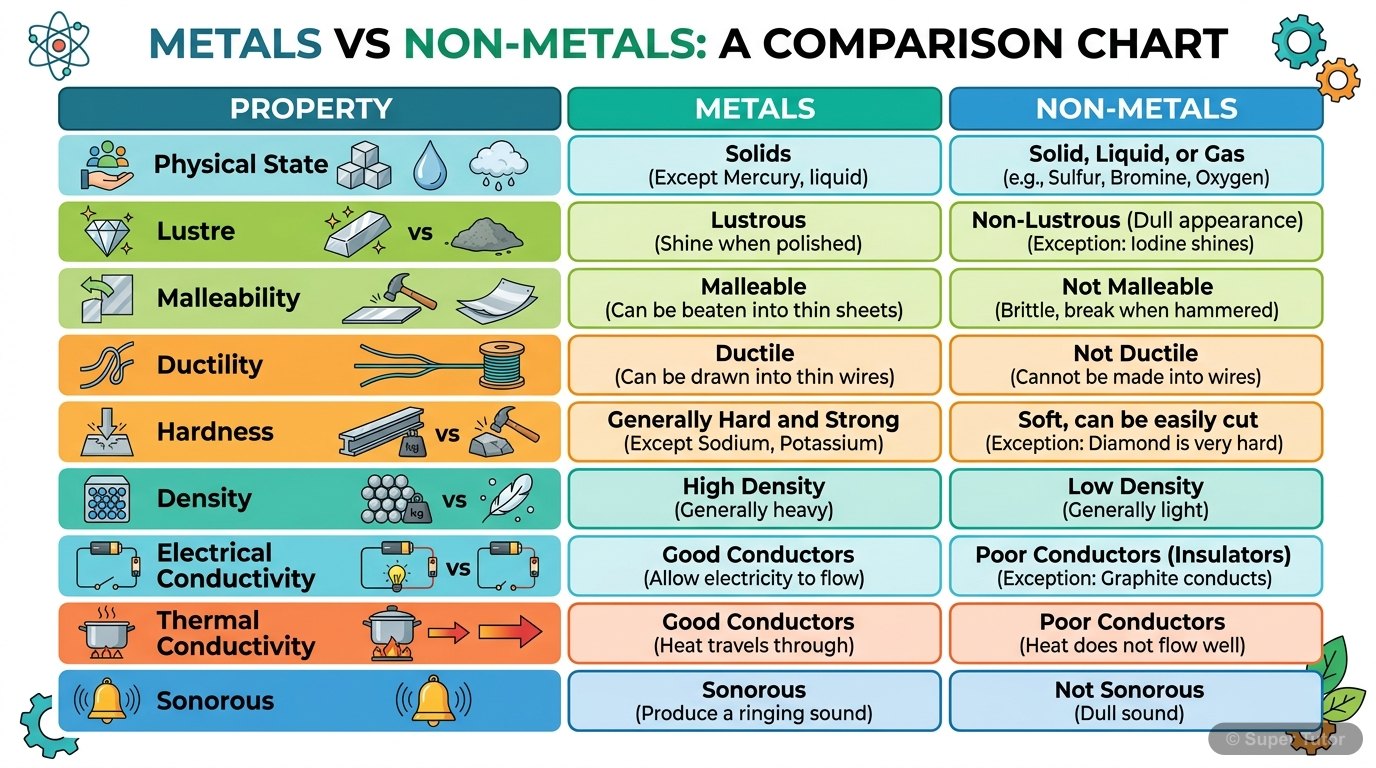
Learn better with visuals Super Tutor pairs illustrations like this with notes and quizzes for Metals and Non-Metals.
Key Topics to Revise
1. Physical Properties of Metals and Non-Metals
- Metals are generally malleable, so they can be beaten into thin sheets.
- Metals are generally ductile, so they can be drawn into wires.
- Metals show metallic lustre and are usually shiny.
2. Chemical Properties of Metals and Non-Metals
- Metals are electropositive and usually have 1, 2, or 3 valence electrons.
- Metals lose electrons to form positive ions called cations.
- Non-metals are electronegative and usually have 5, 6, or 7 valence electrons.
3. Reactions of Metals with Oxygen, Water, Acids, and Bases
- Sodium, calcium, and potassium react with oxygen without heating.
- Metals like magnesium, aluminium, and iron react on heating to form oxides.
- Metal oxides react with water to form bases in some cases.
4. Corrosion, Rusting, and Prevention
- Corrosion is the destruction of a metal surface by air and moisture.
- Rusting is the corrosion of iron.
- Rust is hydrated ferric oxide and appears as a brown powder.
Get complete notes with diagrams and examples
Full NotesKey Concepts
Frequently Asked Questions
What are the important topics in Metals and Non-Metals for NIOS Class 10 Science & Tech?
How should I revise Metals and Non-Metals for the NIOS Class 10 board exam?
Sources & Official References
Content is aligned to the official syllabus. Refer to the board website for the latest curriculum.
More resources for Metals and Non-Metals
Practice Quiz
Test yourself with a quick quiz
Important Questions
Exam-style questions with answers
Formula Sheet
The chapter's formulas in one place
Chapter Summary
Understand the chapter at a glance
Concept Maps
See how topics connect
Study Plan
Step-by-step plan for this chapter
Flashcards
Quick-fire cards for active recall
Syllabus
What topics to cover
For serious students
Get the full Metals and Non-Metals chapter — start free.
Quizzes, flashcards, an AI doubt solver and a study plan for NIOS Class 10 Science & Tech. Free to start, no card needed.