Electrical Energy — Flashcards
NIOS · Class 10 · Science & Tech
50 flashcards for Electrical Energy (NIOS Class 10 Science & Tech) to test yourself on key terms and facts. Sample: "What is frictional electricity.
Interactive on Super Tutor
Studying Electrical Energy? Get the full interactive chapter.
Quizzes, flashcards, AI doubt-solver and a step-by-step study plan — built for flashcards and more.
Free trial, no card needed.
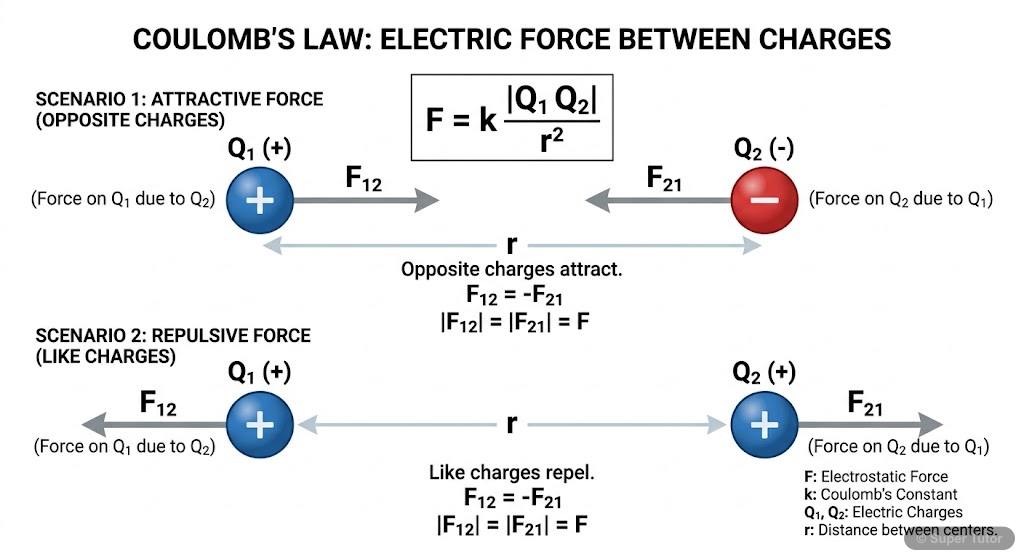
One of 18 illustrations for Electrical Energy in Super Tutor — alongside flashcards, concept maps and practice questions.
What is frictional electricity or static electricity?
Answer
The electricity or charge developed on a body on rubbing with another body is called frictional electricity or static electricity. It often shows up when small bits of paper are attracted to a rubbed …
Why does a rubbed comb attract small bits of paper?
Answer
Rubbing transfers electrons from one material to another, so the comb becomes charged. The charged comb then attracts light paper bits by electrostatic force.
What did Thales of Miletus observe about amber?
Answer
He observed that amber rubbed with wool attracts light feathers, dust, lint, and pieces of leaves. This was one of the earliest observations related to electric charge.
Why can metals be charged by rubbing only when held with an insulating handle?
Answer
If a metal is held directly by hand, charge leaks through the body to earth. When it is held with an insulating handle like glass or amber, the charge stays on the metal and charging is possible.
What happened in the paper-bit experiment with the rubbed pen and balloon?
Answer
Before rubbing, the pen or balloon did not attract the paper bits. After rubbing, they attracted the paper bits. When the pen was rolled between the palms, it lost the charge and could not attract the…
Why do two uncharged straws not affect each other?
Answer
Uncharged objects do not have an electric charge imbalance, so there is no electrostatic force between them strong enough to cause attraction or repulsion.
Why do two charged straws repel each other, but a charged straw and a charged glass bottle attract each other?
Answer
Like charges repel each other while unlike charges attract each other. A straw rubbed with paper and a glass bottle rubbed with silk acquire different kinds of charge.
What is the conclusion from the straw and glass bottle experiment?
Answer
Two different types of charges are produced. Like charges repel each other while unlike charges attract each other.
+42 more flashcards
Practise AllFrequently Asked Questions
What are the important topics in Electrical Energy for NIOS Class 10 Science & Tech?
How many flashcards are available for Electrical Energy?
How should I revise Electrical Energy for the NIOS Class 10 board exam?
Sources & Official References
Content is aligned to the official syllabus. Refer to the board website for the latest curriculum.
More resources for Electrical Energy
Practice Quiz
Test yourself with a quick quiz
Important Questions
Exam-style questions with answers
Revision Notes
Key points for last-minute revision
Formula Sheet
The chapter's formulas in one place
Chapter Summary
Understand the chapter at a glance
Concept Maps
See how topics connect
Study Plan
Step-by-step plan for this chapter
Syllabus
What topics to cover
For serious students
Get the full Electrical Energy chapter — start free.
Quizzes, flashcards, an AI doubt solver and a study plan for NIOS Class 10 Science & Tech. Free to start, no card needed.