Religious And Social Awakening In Colonial India — Syllabus
NIOS · Class 10 · Social Studies
What Religious And Social Awakening In Colonial India covers in NIOS Class 10 Social Studies: 4 topics, for the 2026-27 session.
Interactive on Super Tutor
Studying Religious And Social Awakening In Colonial India? Get the full interactive chapter.
Quizzes, flashcards, AI doubt-solver and a step-by-step study plan — built for syllabus and more.
Free trial, no card needed.
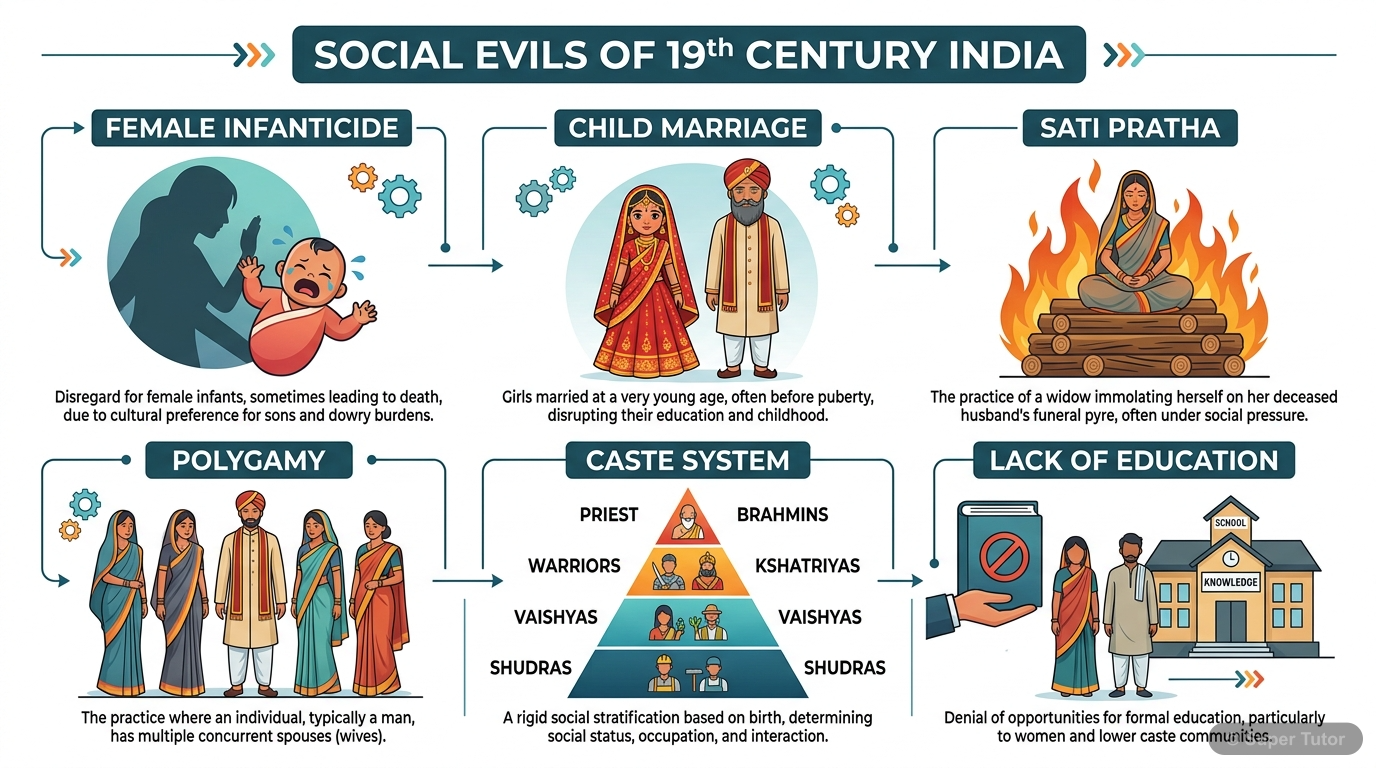
One of 4 illustrations for Religious And Social Awakening In Colonial India in Super Tutor — alongside flashcards, concept maps and practice questions.
Topics in Religious And Social Awakening In Colonial India
1. Society in the Early 19th Century
- Indian society in the first half of the 19th century was marked by lack of education and the subordinate position of women.
- Most people were illiterate. Education was limited to a small group, mainly upper-caste men.
- Religious knowledge was controlled by the priestly class, which interpreted texts in ways that supported its own position.
2. Causes of Socio-Religious Awakening
- Reformers believed that ignorance and backwardness were stopping social progress.
- Contact with Europeans exposed Indian thinkers to different ideas and ways of life.
- Christian missionaries criticized some Indian social and religious practices, which also encouraged self-examination.
3. Reform of the Caste System
- The caste system was originally based on occupation but became hereditary over time.
- Varna categories were Brahmin, Kshatriya, Vaishya, and Shudra.
- Hereditary caste division caused inequality and exploitation of lower castes.
4. Important Reformers and Their Contributions
- Raja Ram Mohan Roy founded Brahmo Samaj in 1828.
- He campaigned against sati after his brother's widow was forced to commit it.
- He was supported by Governor General Sir William Bentinck in the anti-sati effort.
Key Concepts
Central concept: Religious and social reform movements in colonial India changed society, challenged harmful practices, promoted modern education, and helped build social awareness and national consciousness.
Work through every topic in Religious And Social Awakening In Colonial India with notes and quizzes
Start This ChapterFrequently Asked Questions
What are the important topics in Religious And Social Awakening In Colonial India for NIOS Class 10 Social Studies?
How should I revise Religious And Social Awakening In Colonial India for the NIOS Class 10 board exam?
Sources & Official References
Content is aligned to the official syllabus. Refer to the board website for the latest curriculum.
More resources for Religious And Social Awakening In Colonial India
Practice Quiz
Test yourself with a quick quiz
Important Questions
Exam-style questions with answers
Revision Notes
Key points for last-minute revision
Chapter Summary
Understand the chapter at a glance
Concept Maps
See how topics connect
Study Plan
Step-by-step plan for this chapter
Flashcards
Quick-fire cards for active recall
For serious students
Get the full Religious And Social Awakening In Colonial India chapter — start free.
Quizzes, flashcards, an AI doubt solver and a study plan for NIOS Class 10 Social Studies. Free to start, no card needed.