Religious And Social Awakening In Colonial India — Chapter Summary
NIOS · Class 10 · Social Studies
Summary of Religious And Social Awakening In Colonial India for NIOS Class 10 Social Studies. Part of the NIOS Class 10 Social Studies syllabus.
Interactive on Super Tutor
Studying Religious And Social Awakening In Colonial India? Get the full interactive chapter.
Quizzes, flashcards, AI doubt-solver and a step-by-step study plan — built for chapter summary and more.
Free trial, no card needed.
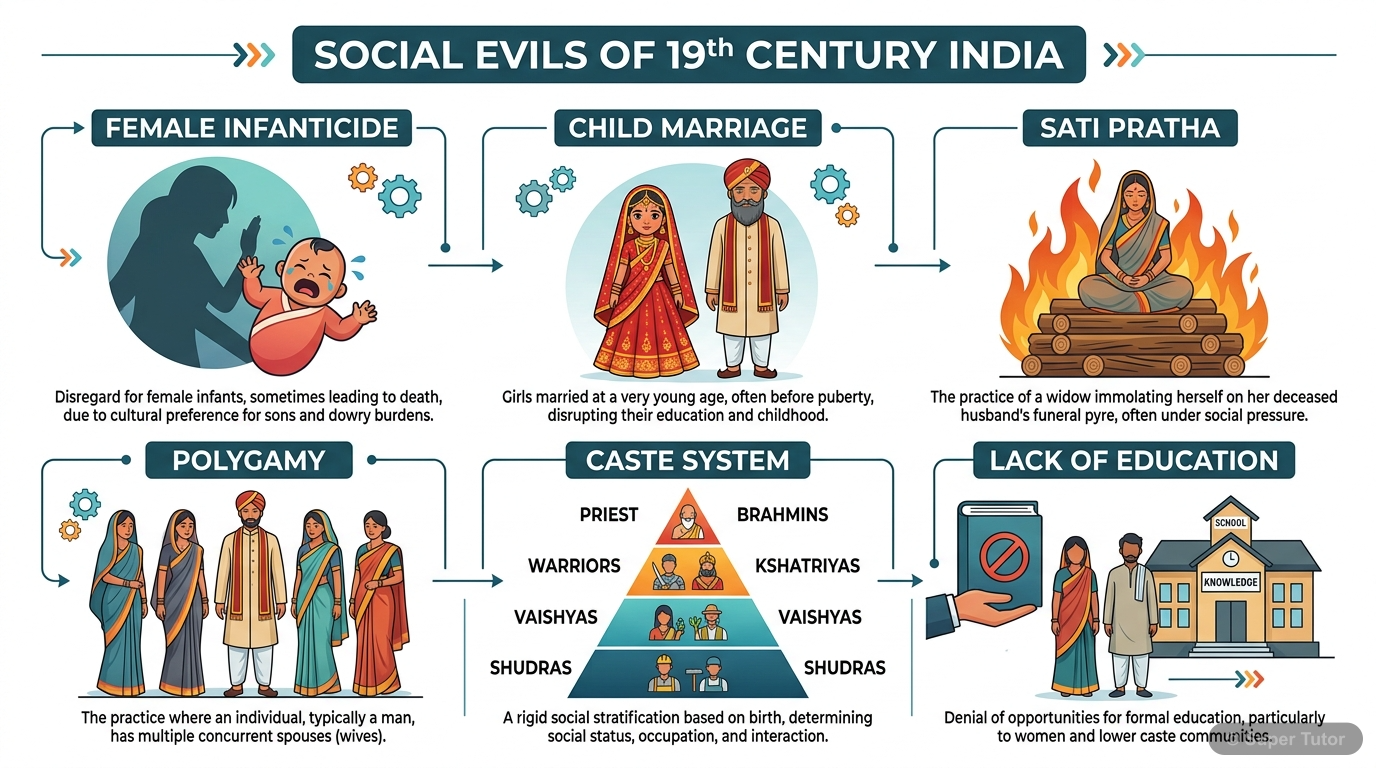
One of 4 illustrations for Religious And Social Awakening In Colonial India in Super Tutor — alongside flashcards, concept maps and practice questions.
Overview
Colonial India saw a strong need for reform because society was affected by illiteracy, child marriage, sati pratha, polygamy, untouchability, and the low status of women. Many reformers believed that social change and religious reform had to go together. They worked through organizations, books, sp
Key Concepts
Indian society faced serious problems such
Indian society faced serious problems such as lack of education, child marriage, sati pratha, polygamy, female infanticide, and the subordination of w
Reformers felt that no lasting social
Reformers felt that no lasting social change was possible without reforming religion as well. They studied scriptures, questioned harmful customs, and
He founded the Brahmo Samaj
He founded the Brahmo Samaj in 1828, campaigned against sati, supported widow remarriage, and opposed child marriage. He promoted monotheism, English
He worked for women’s rights
He worked for women’s rights, supported widow remarriage, opposed child marriage and polygamy, and promoted girls’ education. The first Hindu Widow Re
He founded Arya Samaj in 1875
He founded Arya Samaj in 1875 and considered the Vedas infallible. The movement opposed untouchability, caste rigidities, and social inequality, and s
Learning Objectives
- Identify major social practices in 19th-century Indian society
- Explain why socio-religious reform movements became important
- Describe how reformers challenged caste, child marriage, sati, and discrimination
- Recognize the role of education, especially women’s education, in reform
- Explain the impact of reform movements on Indian society and the freedom struggle
Frequently Asked Questions
What are the important topics in Religious And Social Awakening In Colonial India for NIOS Class 10 Social Studies?
How should I revise Religious And Social Awakening In Colonial India for the NIOS Class 10 board exam?
Sources & Official References
Content is aligned to the official syllabus. Refer to the board website for the latest curriculum.
More resources for Religious And Social Awakening In Colonial India
For serious students
Get the full Religious And Social Awakening In Colonial India chapter — start free.
Quizzes, flashcards, an AI doubt solver and a study plan for NIOS Class 10 Social Studies. Free to start, no card needed.