Religious And Social Awakening In Colonial India — Practice Quiz
NIOS · Class 10 · Social Studies
Try a 4-question quiz on Religious And Social Awakening In Colonial India for NIOS Class 10 Social Studies: tap an answer to check it and see why.
Interactive on Super Tutor
Studying Religious And Social Awakening In Colonial India? Get the full interactive chapter.
Quizzes, flashcards, AI doubt-solver and a step-by-step study plan — built for practice quiz and more.
Free trial, no card needed.
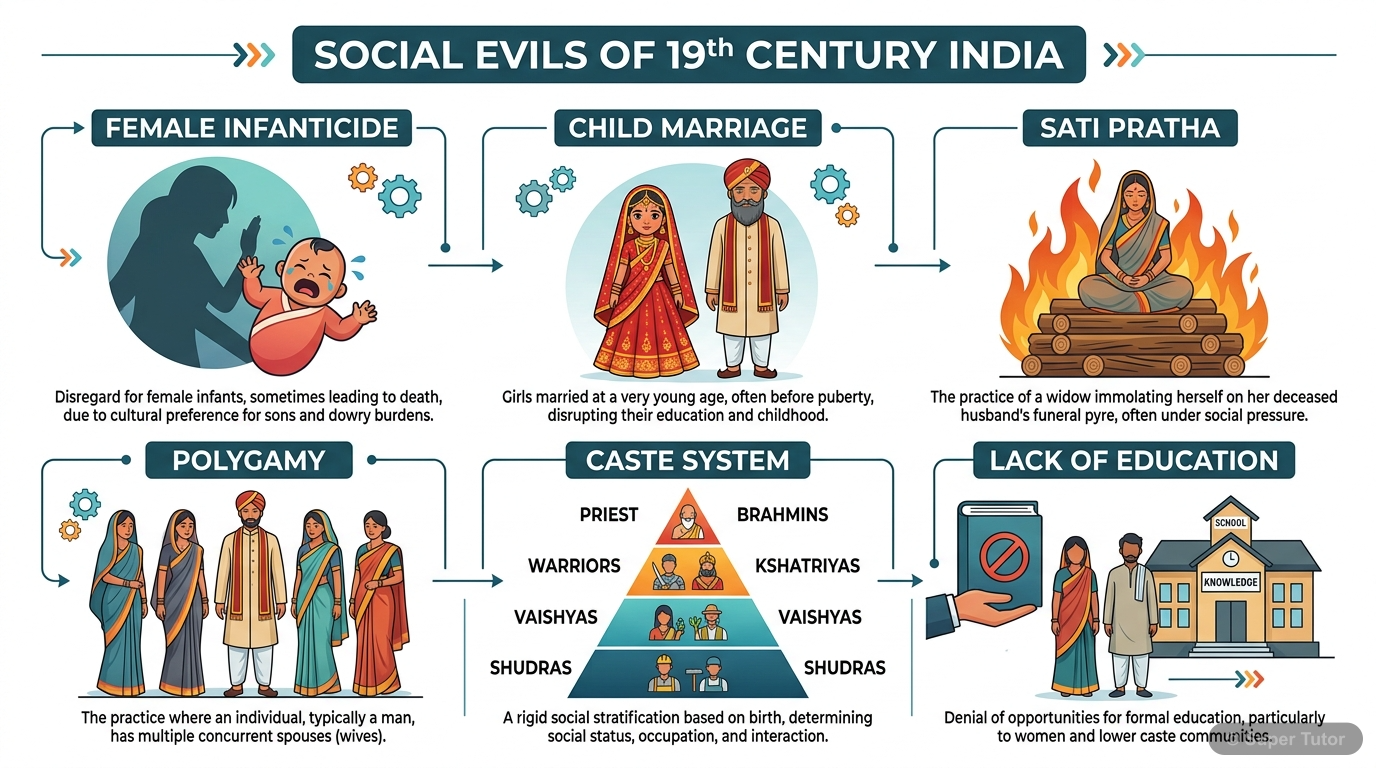
One of 4 illustrations for Religious And Social Awakening In Colonial India in Super Tutor — alongside flashcards, concept maps and practice questions.
Quick Quiz: Religious And Social Awakening In Colonial India
0/4Tap an answer to check it instantly. No sign-up needed for these 4.
Who founded the Brahmo Samaj in 1828?
In which year was Sati declared illegal and punishable by law?
Which reformer established the Arya Samaj in 1875?
Who opened the first girls' school in India in August 1848?
Sample Questions
Which college was established by Sir Syed Ahmed Khan at Aligarh in 1875?
Show answer
Mohammadan Anglo-Oriental College
Sir Syed Ahmed Khan established the Mohammadan Anglo-Oriental College (M.A.O.) at Aligarh in 1875, which later developed into Aligarh Muslim University. This college provided education in humanities and science through English medium to modernize Muslim education. It was part of the Aligarh Movement to promote modern education among Muslims. Hindu College was in Calcutta, Central Hindu College was established by Annie Besant, and D.A.V. colleges were started by followers of Dayanand Saraswati.
Who established the Ramakrishna Mission?
Show answer
Swami Vivekananda
Swami Vivekananda established the Ramakrishna Mission after the name of his guru Ramakrishna Paramhansa. While Ramakrishna Paramhansa was the spiritual teacher who highlighted the unity of religions, it was his disciple Vivekananda who founded the Mission to spread these teachings. Vivekananda believed in providing both secular and spiritual knowledge to empower people. Raja Ram Mohan Roy founded Brahmo Samaj, and Annie Besant was associated with the Theosophical Society.
Which act was passed in 1856 that allowed widow remarriage?
Show answer
Hindu Widow Remarriage Act
The Hindu Widow Remarriage Act was passed in 1856, primarily due to the relentless efforts of Ishwar Chandra Vidyasagar. This act legally allowed Hindu widows to remarry, which was a revolutionary step in improving women's condition. Vidyasagar campaigned extensively for this cause and faced strong opposition from orthodox society. The Sati Prohibition Act was passed in 1829, Child Marriage Restraint Act (Sharda Act) was passed in 1929, making the 1856 act specifically about widow remarriage.
What was the main objective of the Satya Shodhak Samaj founded by Jyotiba Phule?
Show answer
Liberating lower castes from exploitation
The Satya Shodhak Samaj (Society of Seekers of Truth) was founded by Jyotiba Phule in September 1873 with the main objective of liberating the lower castes and protecting them from exploitation and atrocities. Phule worked extensively for equal rights for peasants and lower castes, challenging the rigid caste system. While other options were also reform goals of various movements, the specific purpose of Satya Shodhak Samaj was to fight caste-based discrimination and exploitation of the lower castes.
+85 more questions on Religious And Social Awakening In Colonial India (NIOS Class 10 Social Studies)
Practise AllFrequently Asked Questions
What are the important topics in Religious And Social Awakening In Colonial India for NIOS Class 10 Social Studies?
How many practice questions are there for Religious And Social Awakening In Colonial India?
Sources & Official References
Content is aligned to the official syllabus. Refer to the board website for the latest curriculum.
More resources for Religious And Social Awakening In Colonial India
Important Questions
Exam-style questions with answers
Revision Notes
Key points for last-minute revision
Chapter Summary
Understand the chapter at a glance
Concept Maps
See how topics connect
Study Plan
Step-by-step plan for this chapter
Flashcards
Quick-fire cards for active recall
Syllabus
What topics to cover
For serious students
Get the full Religious And Social Awakening In Colonial India chapter — start free.
Quizzes, flashcards, an AI doubt solver and a study plan for NIOS Class 10 Social Studies. Free to start, no card needed.