Nuclear Fission and Fusion — Practice Quiz
NIOS · Class 12 · Physics
Try a 4-question quiz on Nuclear Fission and Fusion for NIOS Class 12 Physics: tap an answer to check it and see why.
Interactive on Super Tutor
Studying Nuclear Fission and Fusion? Get the full interactive chapter.
Quizzes, flashcards, AI doubt-solver and a step-by-step study plan — built for practice quiz and more.
Free trial, no card needed.
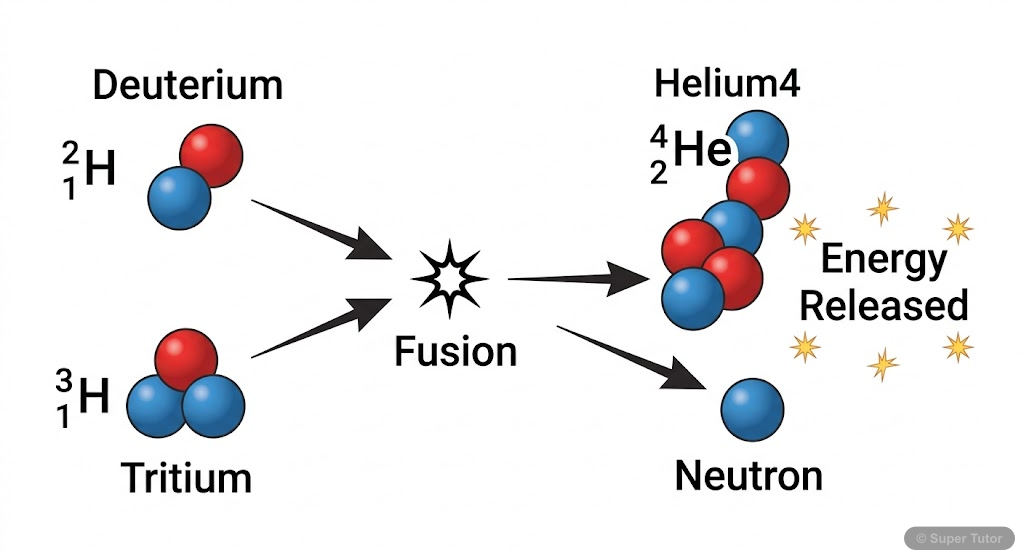
Learn better with visuals Super Tutor pairs illustrations like this with notes and quizzes for Nuclear Fission and Fusion.
Quick Quiz: Nuclear Fission and Fusion
0/4Tap an answer to check it instantly. No sign-up needed for these 4.
When uranium-235 undergoes fission by absorbing a thermal neutron, approximately how much energy is released per fission event?
Which of the following particles is the BEST projectile for initiating a nuclear reaction, and why?
In the nuclear reaction ²³⁵₉₂U + ¹₀n → ¹⁴¹₅₆Ba + ⁹²₃₆Kr + x ¹₀n, what is the value of x (number of neutrons released)?
Which of the following is a fissile material?
Sample Questions
What is the role of control rods in a nuclear reactor?
Show answer
To absorb excess neutrons and control the rate of chain reaction
Step 1: In a nuclear reactor, the chain reaction must be carefully controlled to avoid a runaway reaction. Step 2: Control rods are made of neutron-absorbing materials such as cadmium or boron. Step 3: By inserting or withdrawing these rods, the number of neutrons available to cause further fission can be regulated. Step 4: When rods are pushed in more, they absorb more neutrons → reaction rate decreases. When pulled out, fewer neutrons are absorbed → reaction rate increases. Step 5: The moderator (heavy water or ordinary water) slows neutrons – this is a different function. The reflector refl
The process of nuclear fusion requires extremely high temperatures (about 10–20 million kelvin). What is the main reason for this?
Show answer
To give nuclei enough kinetic energy to overcome the Coulomb repulsion barrier
Step 1: In nuclear fusion, two positively charged light nuclei (e.g., two deuterons) must come close enough for the strong nuclear force to take over. Step 2: Since both nuclei are positively charged, they repel each other strongly – this is the Coulomb barrier. Step 3: At room temperature, nuclei do not have enough kinetic energy to overcome this repulsion. Step 4: At temperatures of ~10–20 million kelvin, the average kinetic energy of particles becomes high enough to allow nuclei to approach each other closely and fuse. Step 5: This is why fusion is called a thermonuclear reaction – 'thermo'
In the fusion reaction ²₁H + ²₁H → ⁴₂He + Q, the total binding energy of the reactants is 4.44 MeV and that of the product is 28.295 MeV. What is the value of Q?
Show answer
23.855 MeV
Step 1: The energy released Q in a nuclear reaction equals the difference in binding energies of products and reactants. Step 2: Q = BE(products) – BE(reactants). Step 3: Q = 28.295 MeV – 4.44 MeV = 23.855 MeV. Step 4: This energy is released because ⁴He is much more tightly bound than the two deuterons. The extra binding energy is released as kinetic energy of products (and gamma rays). Step 5: Note: This is approximately 24 MeV, giving ~6 MeV per nucleon – which is about 7 times higher than the energy per nucleon from fission of ²³⁵U (~0.83 MeV per nucleon).
What is the source of energy in stars like our Sun?
Show answer
Nuclear fusion of hydrogen nuclei into helium at very high temperatures
Step 1: The Sun mainly consists of hydrogen and helium gases, so fission of heavy elements cannot be the source of its energy. Step 2: The enormous gravitational mass of the Sun compresses its core to produce temperatures of ~20 million kelvin. Step 3: At such extreme temperatures, hydrogen nuclei (protons) gain enough kinetic energy to overcome Coulomb repulsion and fuse. Step 4: The overall reaction is: 4¹₁H → ⁴₂He + 2 positrons + 26.8 MeV. Step 5: This thermonuclear fusion process releases tremendous energy. The Sun has enough hydrogen to continue shining for about 8 billion more years.
+41 more questions on Nuclear Fission and Fusion (NIOS Class 12 Physics)
Practise AllFrequently Asked Questions
What are the important topics in Nuclear Fission and Fusion for NIOS Class 12 Physics?
How many practice questions are there for Nuclear Fission and Fusion?
Sources & Official References
Content is aligned to the official syllabus. Refer to the board website for the latest curriculum.
More resources for Nuclear Fission and Fusion
Important Questions
Exam-style questions with answers
Revision Notes
Key points for last-minute revision
Formula Sheet
The chapter's formulas in one place
Chapter Summary
Understand the chapter at a glance
Concept Maps
See how topics connect
Study Plan
Step-by-step plan for this chapter
Flashcards
Quick-fire cards for active recall
Syllabus
What topics to cover
For serious students
Get the full Nuclear Fission and Fusion chapter — start free.
Quizzes, flashcards, an AI doubt solver and a study plan for NIOS Class 12 Physics. Free to start, no card needed.