Nuclear Fission and Fusion — Study Plan
NIOS · Class 12 · Physics
A step-by-step study plan for Nuclear Fission and Fusion, NIOS Class 12 Physics: what to learn first, what to practise and when to revise.
Interactive on Super Tutor
Studying Nuclear Fission and Fusion? Get the full interactive chapter.
Quizzes, flashcards, AI doubt-solver and a step-by-step study plan — built for study plan and more.
Free trial, no card needed.
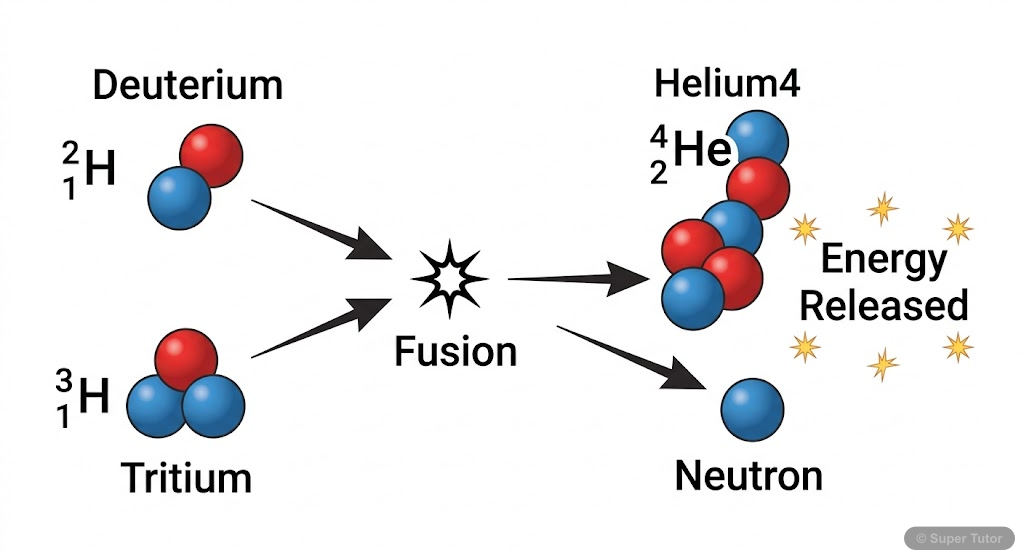
Learn better with visuals Super Tutor pairs illustrations like this with notes and quizzes for Nuclear Fission and Fusion.
Study Plan
Learn the Theory
Read the textbook chapter carefully. Note down definitions, formulas and key ideas. Focus on: Chemical Reactions vs Nuclear Reactions, Conservation Laws for Nuclear Reactions, Nuclear Fission – Discovery, Mechanism and Energy.
Practise
Solve the textbook exercises and extra practice questions. There are 45 questions available for this chapter.
Revise & Test
Revise key points without looking at your notes. Take a practice quiz and mark weak areas for another pass.
Spaced Revision
Come back to Nuclear Fission and Fusion after a week. Use flashcards for quick recall and try past exam questions on this chapter.
What to Focus On
- Chemical reactions involve valence electrons; nuclear reactions involve the nucleus itself.
- Energy in chemical reactions: few eV; in nuclear reactions: few MeV (about 10⁶ times more).
- Mass is practically conserved in chemical reactions (change ≈ 10⁻³⁵ kg).
- Nuclear fission was discovered in 1938 by Hahn and Strassmann; explained by Meitner and Frisch.
- In fission, a heavy nucleus splits into two lighter nuclei + 2-3 neutrons + ~200 MeV energy.
- Key fission equation: ²³⁵U + n → ¹⁴¹Ba + ⁹²Kr + 3n + 200 MeV
- A nuclear reactor maintains a controlled chain reaction with multiplication factor k = 1.
- Components: Fuel rods, Moderator, Control rods, Coolant, Reflector, Pressure vessel, Radiation shield.
- Fuel: Enriched uranium (3-5% ²³⁵U); Moderator: Heavy water, graphite; Control rods: Cadmium or Boron.
Common Mistakes to Avoid
Nuclear fission and nuclear fusion both release energy for the same reason — breaking bonds
Fusion releases less energy than fission because it involves smaller atoms
The moderator in a nuclear reactor slows down or stops the chain reaction
Memory Tips
Nuclear Fission — splitting of a heavy nucleus into two lighter fragments
Nuclear Fusion — combining two light nuclei to form a heavier nucleus
Conservation laws in nuclear reactions: Mass Number, Atomic Number, Energy, Momentum
Energy released in fission of U-235 is approximately 200 MeV
Want a personalised study plan?
Super Tutor builds a day-by-day plan for NIOS Class 12 Physics that fits your exam date and pace.
Create My Study PlanFrequently Asked Questions
What are the important topics in Nuclear Fission and Fusion for NIOS Class 12 Physics?
How should I revise Nuclear Fission and Fusion for the NIOS Class 12 board exam?
Sources & Official References
Content is aligned to the official syllabus. Refer to the board website for the latest curriculum.
More resources for Nuclear Fission and Fusion
Practice Quiz
Test yourself with a quick quiz
Important Questions
Exam-style questions with answers
Revision Notes
Key points for last-minute revision
Formula Sheet
The chapter's formulas in one place
Chapter Summary
Understand the chapter at a glance
Concept Maps
See how topics connect
Flashcards
Quick-fire cards for active recall
Syllabus
What topics to cover
For serious students
Get the full Nuclear Fission and Fusion chapter — start free.
Quizzes, flashcards, an AI doubt solver and a study plan for NIOS Class 12 Physics. Free to start, no card needed.