Nuclear Fission and Fusion — Revision Notes
NIOS · Class 12 · Physics
Nuclear Fission and Fusion revision notes for NIOS Class 12 Physics: 4 topics in quick points. Part of the NIOS Class 12 Physics syllabus.
Interactive on Super Tutor
Studying Nuclear Fission and Fusion? Get the full interactive chapter.
Quizzes, flashcards, AI doubt-solver and a step-by-step study plan — built for revision notes and more.
Free trial, no card needed.
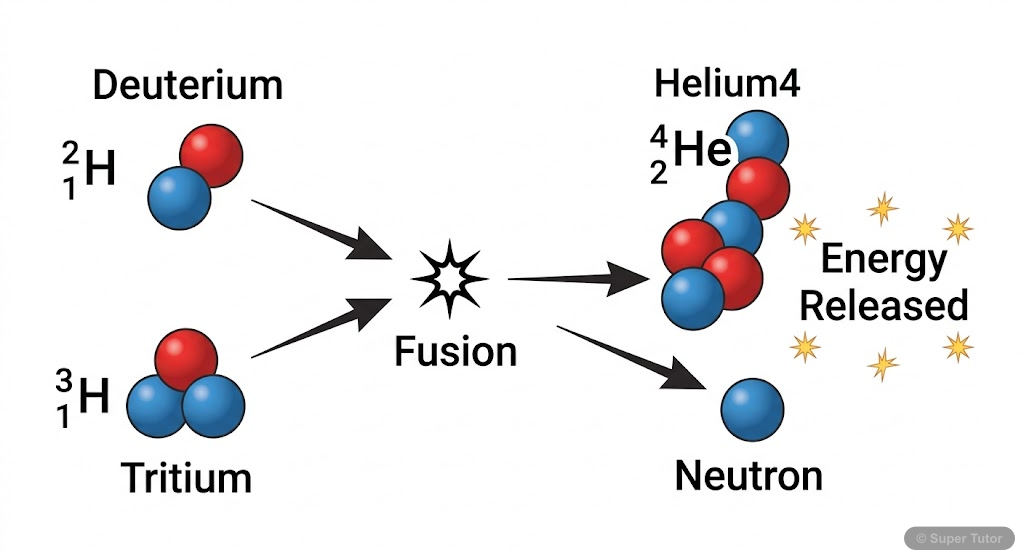
Learn better with visuals Super Tutor pairs illustrations like this with notes and quizzes for Nuclear Fission and Fusion.
Key Topics to Revise
Chemical Reactions vs Nuclear Reactions
- In chemical reactions, only the valence (outermost) electrons of atoms rearrange. The nucleus remains completely unaffected.
- Energy involved in chemical reactions is of the order of a few eV (electron volts). For example, burning one carbon atom releases 4.08 eV.
- In nuclear reactions, the nuclei of atoms interact and new elements are formed. This process is called transmutation of nuclei.
Conservation Laws for Nuclear Reactions
- Law 1 – Conservation of Mass Number: The total mass number (A) of all reactants equals the total mass number of all products.
- Law 2 – Conservation of Atomic Number (Charge): The total atomic number (Z) of all reactants equals the total atomic number of all products.
- Law 3 – Conservation of Mass-Energy: The total input kinetic energy plus the rest mass energy of reactants equals the total output kinetic energy plus the rest mass energy of products.
Nuclear Fission – Discovery, Mechanism and Energy
- Nuclear fission was discovered in 1938 by Otto Hahn and Fritz Strassmann, who found that bombarding uranium with slow neutrons produced barium (intermediate mass element), not a transuranic element.
- Lise Meitner and Otto Frisch explained the results using the liquid drop model of the nucleus and coined the term 'nuclear fission' (analogy with biological cell division).
- Bohr and Wheeler developed the complete theory and predicted that ²³⁵U is more fissile (easily undergoes fission) than ²³⁸U.
Nuclear Chain Reaction and Nuclear Reactor
- A nuclear chain reaction occurs when neutrons produced in one fission event trigger further fission events, sustaining or multiplying the reaction.
- Each fission of ²³⁵U releases 2–3 neutrons (average 2.54) which can each cause further fissions, leading to an exponential increase in reactions.
- When the rate of neutron production equals the rate of neutron loss, the reaction is self-sustained.
Get complete notes with diagrams and examples
Full NotesKey Concepts
Frequently Asked Questions
What are the important topics in Nuclear Fission and Fusion for NIOS Class 12 Physics?
How should I revise Nuclear Fission and Fusion for the NIOS Class 12 board exam?
Sources & Official References
Content is aligned to the official syllabus. Refer to the board website for the latest curriculum.
More resources for Nuclear Fission and Fusion
Practice Quiz
Test yourself with a quick quiz
Important Questions
Exam-style questions with answers
Formula Sheet
The chapter's formulas in one place
Chapter Summary
Understand the chapter at a glance
Concept Maps
See how topics connect
Study Plan
Step-by-step plan for this chapter
Flashcards
Quick-fire cards for active recall
Syllabus
What topics to cover
For serious students
Get the full Nuclear Fission and Fusion chapter — start free.
Quizzes, flashcards, an AI doubt solver and a study plan for NIOS Class 12 Physics. Free to start, no card needed.