Nuclear Fission and Fusion — Chapter Summary
NIOS · Class 12 · Physics
Summary of Nuclear Fission and Fusion for NIOS Class 12 Physics. Part of the NIOS Class 12 Physics syllabus. This chapter explores two of the most.
Interactive on Super Tutor
Studying Nuclear Fission and Fusion? Get the full interactive chapter.
Quizzes, flashcards, AI doubt-solver and a step-by-step study plan — built for chapter summary and more.
Free trial, no card needed.
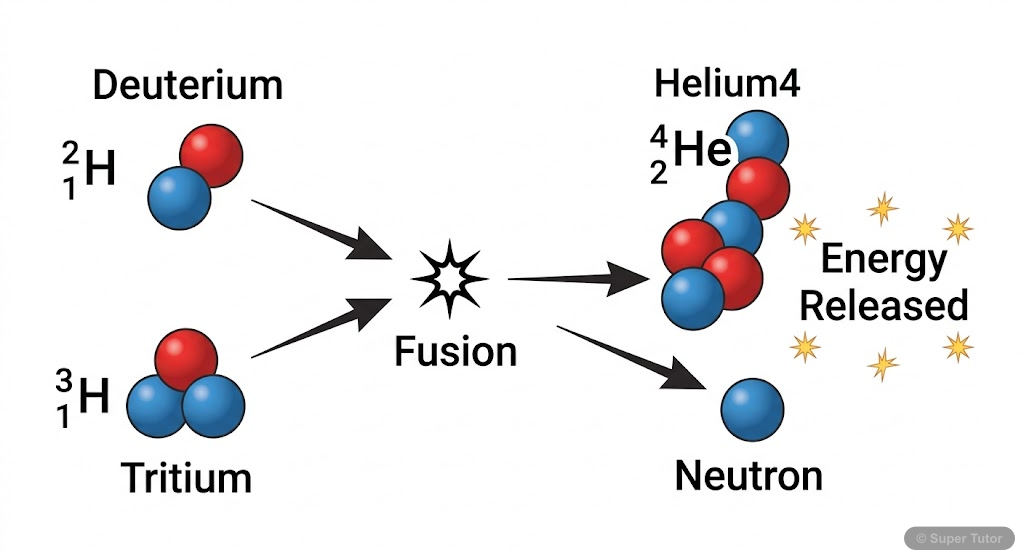
Learn better with visuals Super Tutor pairs illustrations like this with notes and quizzes for Nuclear Fission and Fusion.
Overview
This chapter explores two of the most powerful nuclear processes known to science — nuclear fission and nuclear fusion. These processes involve changes in atomic nuclei and release enormous amounts of energy, millions of times more than any chemical reaction. Nuclear fission is the splitting of a he
Key Concepts
In a chemical reaction
In a chemical reaction, only the outermost (valence) electrons of atoms rearrange. The nucleus remains completely untouched. Energy involved is of the
All nuclear reactions must obey four
All nuclear reactions must obey four fundamental conservation laws: 1. Conservation of Mass Number (A): The total mass number of all reactants equals
Nuclear fission is the process
Nuclear fission is the process in which a heavy nucleus splits into two lighter nuclei (called fission fragments) along with the release of 2-3 neutro
A fissile material is one
A fissile material is one which can undergo nuclear fission when bombarded by thermal (slow) neutrons. The key fissile materials are: 1. Uranium-235 (
When U
When U-235 undergoes fission, it releases 2-3 neutrons per event (average 2.54 for U-235). Each of these neutrons can cause further fission events, wh
Learning Objectives
- State and apply conservation laws for nuclear reactions (mass number, atomic number, charge, energy, and momentum)
- Distinguish between chemical reactions and nuclear reactions in terms of energy scales, mass change, and mechanism
- Explain the mechanism of nuclear fission using the liquid drop model of the nucleus
- Define fissile materials and identify examples such as U-235, U-233, Pu-239, and Th-233
- Explain nuclear chain reaction, and distinguish between controlled and uncontrolled chain reactions
Frequently Asked Questions
What are the important topics in Nuclear Fission and Fusion for NIOS Class 12 Physics?
How should I revise Nuclear Fission and Fusion for the NIOS Class 12 board exam?
Sources & Official References
Content is aligned to the official syllabus. Refer to the board website for the latest curriculum.
More resources for Nuclear Fission and Fusion
Practice Quiz
Test yourself with a quick quiz
Important Questions
Exam-style questions with answers
Revision Notes
Key points for last-minute revision
Formula Sheet
The chapter's formulas in one place
Concept Maps
See how topics connect
Study Plan
Step-by-step plan for this chapter
Flashcards
Quick-fire cards for active recall
Syllabus
What topics to cover
For serious students
Get the full Nuclear Fission and Fusion chapter — start free.
Quizzes, flashcards, an AI doubt solver and a study plan for NIOS Class 12 Physics. Free to start, no card needed.