Dual Nature of Radiation and Matter — Study Plan
NIOS · Class 12 · Physics
A step-by-step study plan for Dual Nature of Radiation and Matter, NIOS Class 12 Physics: what to learn first, what to practise and when to revise.
Interactive on Super Tutor
Studying Dual Nature of Radiation and Matter? Get the full interactive chapter.
Quizzes, flashcards, AI doubt-solver and a step-by-step study plan — built for study plan and more.
Free trial, no card needed.
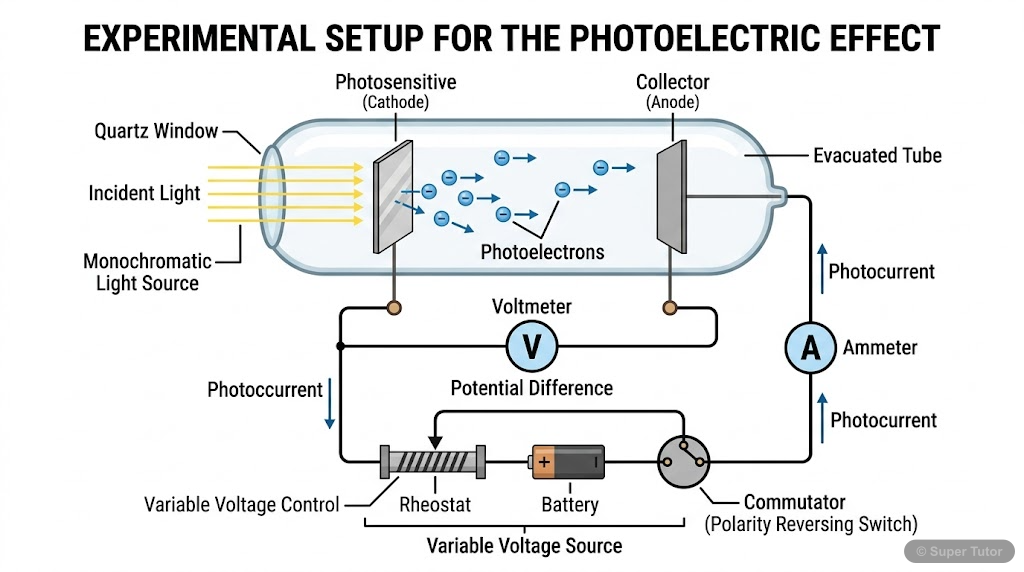
Learn better with visuals Super Tutor pairs illustrations like this with notes and quizzes for Dual Nature of Radiation and Matter.
Study Plan
Learn the Theory
Read the textbook chapter carefully. Note down definitions, formulas and key ideas. Focus on: Photoelectric Effect — Discovery and Observations, Laws of Photoelectric Emission, Einstein's Theory of Photoelectric Effect.
Practise
Solve the textbook exercises and extra practice questions. There are 45 questions available for this chapter.
Revise & Test
Revise key points without looking at your notes. Take a practice quiz and mark weak areas for another pass.
Spaced Revision
Come back to Dual Nature of Radiation and Matter after a week. Use flashcards for quick recall and try past exam questions on this chapter.
What to Focus On
- Photoelectric effect is the emission of electrons from a metal surface when light of frequency greater than threshold frequency (ν₀) falls on it.
- The emitted electrons are called photoelectrons.
- Stopping potential (V₀) is the minimum retarding potential at which photoelectric current becomes zero.
- Maximum KE of photoelectrons increases with frequency of incident light — independent of intensity.
- Number of photoelectrons emitted is proportional to intensity of incident light.
- Threshold frequency (ν₀) is a characteristic property of the metal surface.
- Light consists of photons — discrete packets of energy. Energy of each photon = hν.
- Work function (φ₀) = minimum energy needed to release an electron from metal surface = hν₀.
- Einstein's photoelectric equation: hν = φ₀ + K_max = hν₀ + eV₀.
Common Mistakes to Avoid
Increasing the intensity of incident light increases the kinetic energy (speed) of emitted photoelectrons.
If the frequency of incident light is below the threshold frequency, increasing intensity will eventually cause photoelectric emission.
Stopping potential is the potential that stops ALL electrons, meaning it is equal to the potential that decelerates the slowest electrons.
Memory Tips
Photoelectric Effect — definition and basic idea
Laws of Photoelectric Emission — 5 key laws
Stopping Potential — definition and formula eV₀ = ½mv²max
Einstein's Photoelectric Equation: hν = φ₀ + Kmax
Want a personalised study plan?
Super Tutor builds a day-by-day plan for NIOS Class 12 Physics that fits your exam date and pace.
Create My Study PlanFrequently Asked Questions
What are the important topics in Dual Nature of Radiation and Matter for NIOS Class 12 Physics?
How should I revise Dual Nature of Radiation and Matter for the NIOS Class 12 board exam?
Sources & Official References
Content is aligned to the official syllabus. Refer to the board website for the latest curriculum.
More resources for Dual Nature of Radiation and Matter
Practice Quiz
Test yourself with a quick quiz
Important Questions
Exam-style questions with answers
Revision Notes
Key points for last-minute revision
Formula Sheet
The chapter's formulas in one place
Chapter Summary
Understand the chapter at a glance
Concept Maps
See how topics connect
Flashcards
Quick-fire cards for active recall
Syllabus
What topics to cover
For serious students
Get the full Dual Nature of Radiation and Matter chapter — start free.
Quizzes, flashcards, an AI doubt solver and a study plan for NIOS Class 12 Physics. Free to start, no card needed.