Properties of Fluids — Study Plan
NIOS · Class 12 · Physics
A step-by-step study plan for Properties of Fluids, NIOS Class 12 Physics: what to learn first, what to practise and when to revise.
Interactive on Super Tutor
Studying Properties of Fluids? Get the full interactive chapter.
Quizzes, flashcards, AI doubt-solver and a step-by-step study plan — built for study plan and more.
Free trial, no card needed.
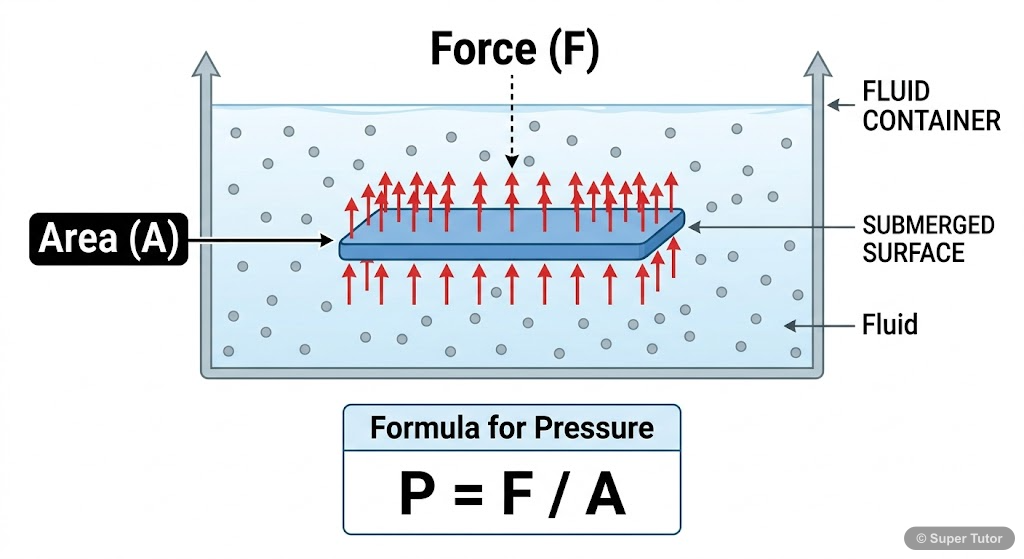
Learn better with visuals Super Tutor pairs illustrations like this with notes and quizzes for Properties of Fluids.
Study Plan
Learn the Theory
Read the textbook chapter carefully. Note down definitions, formulas and key ideas. Focus on: 9.1 Hydrostatic Pressure, 9.2 Buoyancy and Archimedes' Principle, 9.3 Pascal's Law and Its Applications.
Practise
Solve the textbook exercises and extra practice questions. There are 44 questions available for this chapter.
Revise & Test
Revise key points without looking at your notes. Take a practice quiz and mark weak areas for another pass.
Spaced Revision
Come back to Properties of Fluids after a week. Use flashcards for quick recall and try past exam questions on this chapter.
What to Focus On
- Pressure P = F/A; SI unit is Pascal (Pa) or N m⁻²
- Hydrostatic pressure at depth h: P = Pₐₜₘ + ρgh
- Pressure increases linearly with depth — this is why dam walls are thicker at the base
- Buoyant force acts vertically upward on a submerged object
- Archimedes' Principle: Buoyant force = Weight of fluid displaced
- A floating body displaces fluid equal to its own weight
- Pascal's Law: Pressure applied on enclosed liquid is transmitted equally in all directions
- Hydraulic machines work on Pascal's law: F₂ = F₁ × (A₂/A₁)
- Mechanical advantage = A₂/A₁ (ratio of piston areas)
Common Mistakes to Avoid
Pressure at the bottom of a container depends on the volume or total amount of liquid, not just the height (depth) of the liquid.
In a hydraulic lift, the output force is greater than the input force, so it violates the law of conservation of energy — you get more work out than you put in.
A heavier object always sinks in a fluid and a lighter object always floats — it depends on mass.
Memory Tips
Hydrostatic Pressure Formula: P = ρgh
Dam wall is thicker at the base because pressure increases with depth
Atmospheric Pressure = 1.01 × 10⁵ Pa (measured by Torricelli's barometer using 76 cm Hg column)
Archimedes Principle — Buoyant force equals weight of fluid displaced
Want a personalised study plan?
Super Tutor builds a day-by-day plan for NIOS Class 12 Physics that fits your exam date and pace.
Create My Study PlanFrequently Asked Questions
What are the important topics in Properties of Fluids for NIOS Class 12 Physics?
How should I revise Properties of Fluids for the NIOS Class 12 board exam?
Sources & Official References
Content is aligned to the official syllabus. Refer to the board website for the latest curriculum.
More resources for Properties of Fluids
Practice Quiz
Test yourself with a quick quiz
Important Questions
Exam-style questions with answers
Revision Notes
Key points for last-minute revision
Formula Sheet
The chapter's formulas in one place
Chapter Summary
Understand the chapter at a glance
Concept Maps
See how topics connect
Flashcards
Quick-fire cards for active recall
Syllabus
What topics to cover
For serious students
Get the full Properties of Fluids chapter — start free.
Quizzes, flashcards, an AI doubt solver and a study plan for NIOS Class 12 Physics. Free to start, no card needed.