Electric Current — Study Plan
NIOS · Class 12 · Physics
A step-by-step study plan for Electric Current, NIOS Class 12 Physics: what to learn first, what to practise and when to revise.
Interactive on Super Tutor
Studying Electric Current? Get the full interactive chapter.
Quizzes, flashcards, AI doubt-solver and a step-by-step study plan — built for study plan and more.
Free trial, no card needed.
One of 8 illustrations for Electric Current in Super Tutor — alongside flashcards, concept maps and practice questions.
Study Plan
Learn the Theory
Read the textbook chapter carefully. Note down definitions, formulas and key ideas. Focus on: Electric Current — Definition and Basics, Ohm's Law, Resistance and Resistivity, Grouping of Resistors — Series and Parallel.
Practise
Solve the textbook exercises and extra practice questions. There are 45 questions available for this chapter.
Revise & Test
Revise key points without looking at your notes. Take a practice quiz and mark weak areas for another pass.
Spaced Revision
Come back to Electric Current after a week. Use flashcards for quick recall and try past exam questions on this chapter.
What to Focus On
- Electric current = rate of flow of charge through a cross-section: I = ΔQ/Δt
- SI unit of current is Ampere (A); 1 A = 1 C/s
- Conventional current direction is opposite to electron flow direction
- Ohm's Law: V = IR, where R = resistance in ohms (Ω)
- Ohmic conductors give a straight-line I-V graph; non-ohmic devices give a curve
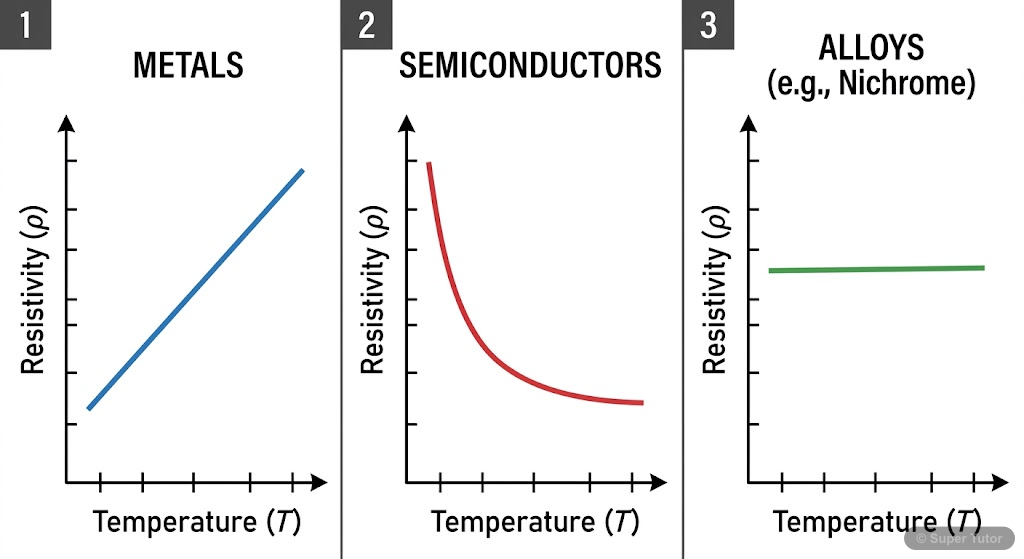
- Resistivity formula: R = ρl/A; ρ depends only on material nature and temperature
- For metals: R = R₀[1 + α(T – T₀)]; resistance increases linearly with temperature
- Temperature coefficient α = ΔR / (R₀ × ΔT); unit is per °C or per K
- Metals have positive α; semiconductors have negative α
Common Mistakes to Avoid
Electric current flows from the negative terminal to the positive terminal of a battery (in the direction electrons move).
Electrons travel through a wire at nearly the speed of light when current flows, which is why a bulb lights up almost instantly when you flip a switch.
In a parallel combination, current always divides equally between the branches regardless of the resistance values.
Memory Tips
Electric Current Definition — Rate of flow of charge
Direction of conventional current vs electron flow
Ohm's Law — V = IR
Resistance formula — R = ρl/A
Want a personalised study plan?
Super Tutor builds a day-by-day plan for NIOS Class 12 Physics that fits your exam date and pace.
Create My Study PlanFrequently Asked Questions
What are the important topics in Electric Current for NIOS Class 12 Physics?
How should I revise Electric Current for the NIOS Class 12 board exam?
Sources & Official References
Content is aligned to the official syllabus. Refer to the board website for the latest curriculum.
More resources for Electric Current
Practice Quiz
Test yourself with a quick quiz
Important Questions
Exam-style questions with answers
Revision Notes
Key points for last-minute revision
Formula Sheet
The chapter's formulas in one place
Chapter Summary
Understand the chapter at a glance
Concept Maps
See how topics connect
Flashcards
Quick-fire cards for active recall
Syllabus
What topics to cover
For serious students
Get the full Electric Current chapter — start free.
Quizzes, flashcards, an AI doubt solver and a study plan for NIOS Class 12 Physics. Free to start, no card needed.