Dual Nature of Radiation and Matter — Syllabus
NIOS · Class 12 · Physics
What Dual Nature of Radiation and Matter covers in NIOS Class 12 Physics: 4 topics, for the 2026-27 session. Part of the NIOS Class 12 Physics syllabus.
Interactive on Super Tutor
Studying Dual Nature of Radiation and Matter? Get the full interactive chapter.
Quizzes, flashcards, AI doubt-solver and a step-by-step study plan — built for syllabus and more.
Free trial, no card needed.
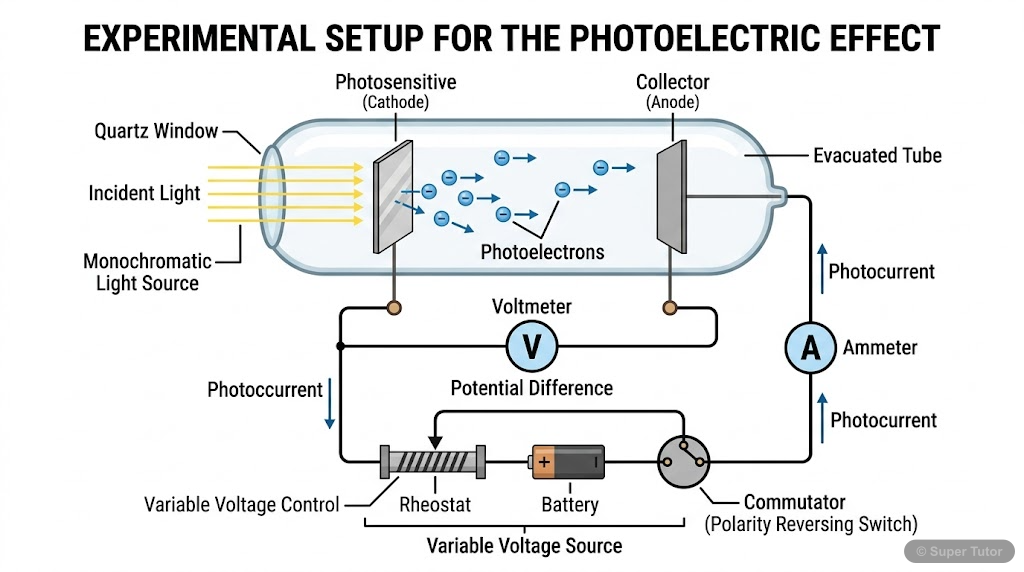
Learn better with visuals Super Tutor pairs illustrations like this with notes and quizzes for Dual Nature of Radiation and Matter.
Topics in Dual Nature of Radiation and Matter
Photoelectric Effect — Discovery and Observations
- Photoelectric effect was discovered by Hertz in 1887 while studying electromagnetic waves. He noticed that ultraviolet light made a spark gap conduct better.
- Lenard (1900) confirmed that electrons are emitted from metal surfaces when light of sufficiently high frequency falls on them.
- The emitted electrons are called photoelectrons.
Laws of Photoelectric Emission
- Law 1 — Effect of Frequency on Maximum Velocity: The maximum velocity (and hence maximum kinetic energy) of photoelectrons INCREASES with INCREASE in frequency of incident light. It also depends on th
- Law 2 — Intensity does NOT affect Maximum Velocity: The maximum velocity of photoelectrons is INDEPENDENT of the intensity of incident light. Doubling the intensity does NOT increase the speed of any
- Law 3 — Threshold Frequency: For every material, there exists a minimum threshold frequency ν₀ below which NO photoelectrons are emitted, no matter how intense the light.
Einstein's Theory of Photoelectric Effect
- Einstein proposed in 1905 that light is made of discrete bundles of energy called PHOTONS (quanta of light).
- Each photon carries energy E = hν, where h is Planck's constant (6.626 × 10⁻³⁴ Js) and ν is the frequency of light.
- Photons travel at the speed of light and have zero rest mass.
Solved Numerical Examples on Photoelectric Effect
- EXAMPLE 1 (NCERT type): Sodium has work function φ₀ = 2.3 eV. Light of wavelength λ = 5×10⁻⁷ m is incident on it.
- STEP 1 — Find Threshold Frequency: ν₀ = φ₀/h = (2.3 × 1.6×10⁻¹⁹) / (6.6×10⁻³⁴) = 3.68×10⁻¹⁹ / 6.6×10⁻³⁴ = 5.6×10¹⁴ Hz
- STEP 2 — Find Energy of Photon: E = hc/λ = (6.6×10⁻³⁴ × 3×10⁸) / (5×10⁻⁷) = 1.98×10⁻²⁵ / 5×10⁻⁷ = 3.96×10⁻¹⁹ J
Key Concepts
Central concept: Wave-Particle Duality
Work through every topic in Dual Nature of Radiation and Matter with notes and quizzes
Start This ChapterFrequently Asked Questions
What are the important topics in Dual Nature of Radiation and Matter for NIOS Class 12 Physics?
How should I revise Dual Nature of Radiation and Matter for the NIOS Class 12 board exam?
Sources & Official References
Content is aligned to the official syllabus. Refer to the board website for the latest curriculum.
More resources for Dual Nature of Radiation and Matter
Practice Quiz
Test yourself with a quick quiz
Important Questions
Exam-style questions with answers
Revision Notes
Key points for last-minute revision
Formula Sheet
The chapter's formulas in one place
Chapter Summary
Understand the chapter at a glance
Concept Maps
See how topics connect
Study Plan
Step-by-step plan for this chapter
Flashcards
Quick-fire cards for active recall
For serious students
Get the full Dual Nature of Radiation and Matter chapter — start free.
Quizzes, flashcards, an AI doubt solver and a study plan for NIOS Class 12 Physics. Free to start, no card needed.