Applications of Semiconductor Devices — Study Plan
NIOS · Class 12 · Physics
A step-by-step study plan for Applications of Semiconductor Devices, NIOS Class 12 Physics: what to learn first, what to practise and when to revise.
Interactive on Super Tutor
Studying Applications of Semiconductor Devices? Get the full interactive chapter.
Quizzes, flashcards, AI doubt-solver and a step-by-step study plan — built for study plan and more.
Free trial, no card needed.
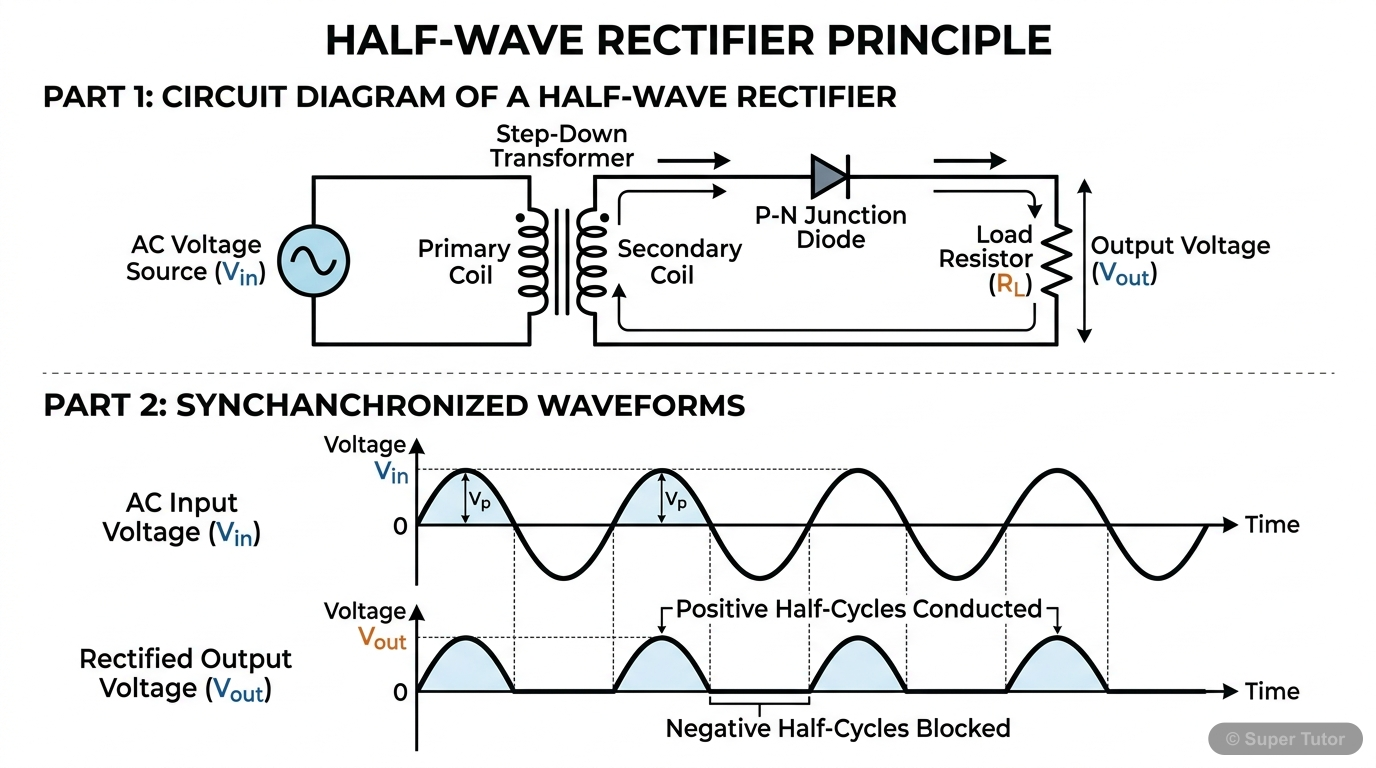
One of 4 illustrations for Applications of Semiconductor Devices in Super Tutor — alongside flashcards, concept maps and practice questions.
Study Plan
Learn the Theory
Read the textbook chapter carefully. Note down definitions, formulas and key ideas. Focus on: p-n Junction Diode as a Rectifier, Zener Diode as a Voltage Regulator, Transistor as an Amplifier.
Practise
Solve the textbook exercises and extra practice questions. There are 45 questions available for this chapter.
Revise & Test
Revise key points without looking at your notes. Take a practice quiz and mark weak areas for another pass.
Spaced Revision
Come back to Applications of Semiconductor Devices after a week. Use flashcards for quick recall and try past exam questions on this chapter.
What to Focus On
- Rectification is the conversion of AC to DC using a p-n junction diode.
- Half-wave rectifier uses ONE diode and utilizes only one half of the AC input. V_dc = V_m/π
- Full-wave rectifier uses TWO diodes and a centre-tapped transformer. V_dc = 2V_m/π
- A Zener diode operates in the reverse breakdown region where V across it remains constant = V_z.
- The input voltage V_i must always be greater than the Zener breakdown voltage V_z.
- Series resistance R_s is essential to limit the current and drop the excess voltage.
- Transistor amplification is based on the principle: small ΔI_B → large ΔI_C, with ΔI_C = β × ΔI_B
- CE mode amplifier gives the highest voltage gain and is most commonly used.
- Voltage Gain: A_V = -β × R_L / r_i (negative sign = 180° phase inversion between input and output)
Common Mistakes to Avoid
A full-wave rectifier produces a perfect DC output (constant voltage) just like a battery.
The Zener diode works as a voltage regulator in FORWARD bias, just like a normal diode.
In a transistor amplifier, the output signal has MORE power than the input signal, so energy is being created — violating conservation of energy.
Memory Tips
Half-Wave Rectifier — only positive half cycle passes
Full-Wave Rectifier — both half cycles are used
Filter Capacitor smooths out pulsating DC
Zener Diode as Voltage Regulator — maintains constant output
Want a personalised study plan?
Super Tutor builds a day-by-day plan for NIOS Class 12 Physics that fits your exam date and pace.
Create My Study PlanFrequently Asked Questions
What are the important topics in Applications of Semiconductor Devices for NIOS Class 12 Physics?
How should I revise Applications of Semiconductor Devices for the NIOS Class 12 board exam?
Sources & Official References
Content is aligned to the official syllabus. Refer to the board website for the latest curriculum.
More resources for Applications of Semiconductor Devices
Practice Quiz
Test yourself with a quick quiz
Important Questions
Exam-style questions with answers
Revision Notes
Key points for last-minute revision
Formula Sheet
The chapter's formulas in one place
Chapter Summary
Understand the chapter at a glance
Concept Maps
See how topics connect
Flashcards
Quick-fire cards for active recall
Syllabus
What topics to cover
For serious students
Get the full Applications of Semiconductor Devices chapter — start free.
Quizzes, flashcards, an AI doubt solver and a study plan for NIOS Class 12 Physics. Free to start, no card needed.