Motion in a Plane — Study Plan
NIOS · Class 12 · Physics
A step-by-step study plan for Motion in a Plane, NIOS Class 12 Physics: what to learn first, what to practise and when to revise.
Interactive on Super Tutor
Studying Motion in a Plane? Get the full interactive chapter.
Quizzes, flashcards, AI doubt-solver and a step-by-step study plan — built for study plan and more.
Free trial, no card needed.
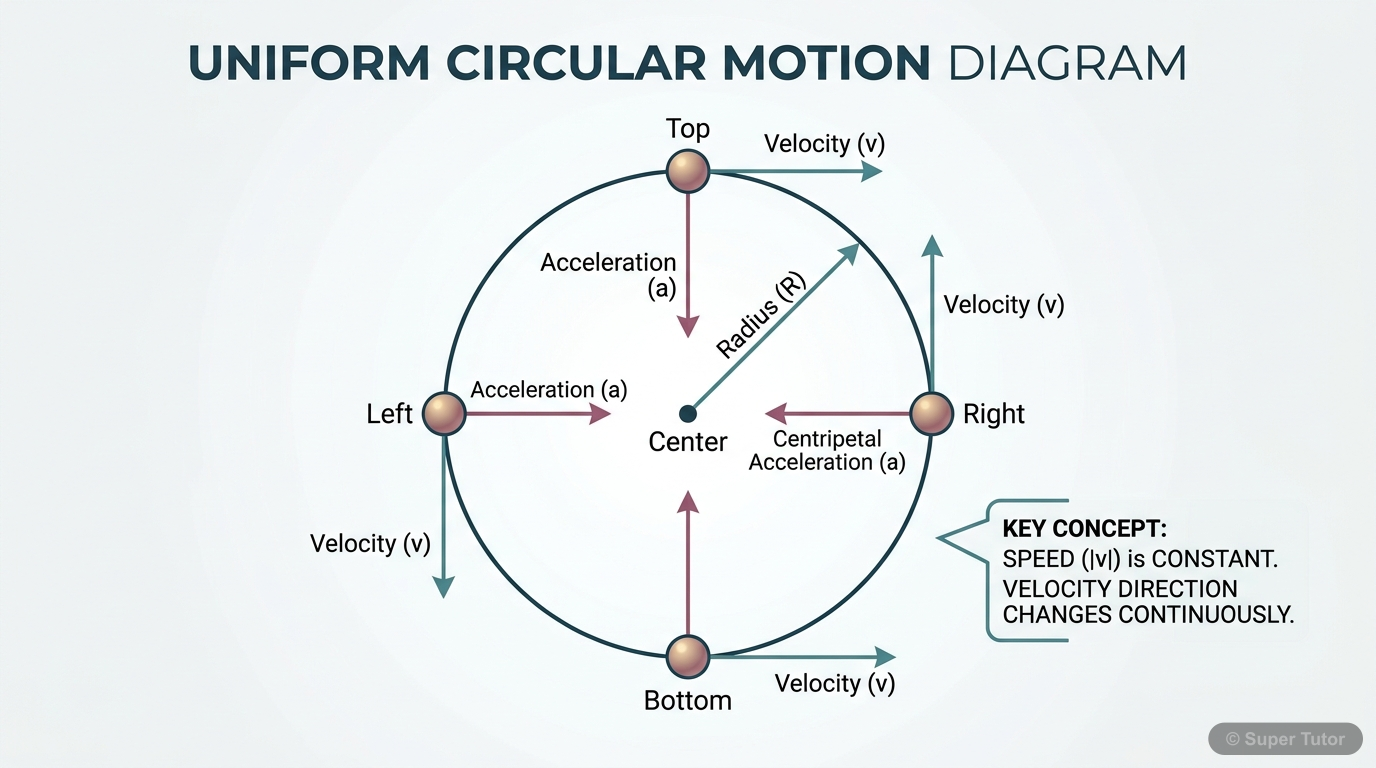
Learn better with visuals Super Tutor pairs illustrations like this with notes and quizzes for Motion in a Plane.
Study Plan
Learn the Theory
Read the textbook chapter carefully. Note down definitions, formulas and key ideas. Focus on: 1. Projectile Motion – Fundamentals, 2. Projectile Motion – Key Derived Quantities, 3. Circular Motion – Concepts and Centripetal Acceleration.
Practise
Solve the textbook exercises and extra practice questions. There are 45 questions available for this chapter.
Revise & Test
Revise key points without looking at your notes. Take a practice quiz and mark weak areas for another pass.
Spaced Revision
Come back to Motion in a Plane after a week. Use flashcards for quick recall and try past exam questions on this chapter.
What to Focus On
- Projectile motion combines horizontal uniform motion with vertical uniformly accelerated motion
- Horizontal and vertical motions are independent of each other
- Horizontal velocity (vₓ) remains constant throughout flight: vₓ = v₀cos(θ₀)
- Initial velocity components: v₀ₓ = v₀cos(θ₀), v₀ᵧ = v₀sin(θ₀)
- Velocity at time t: vₓ = v₀cos(θ₀), vᵧ = v₀sin(θ₀) - gt
- Position at time t: x = v₀cos(θ₀)·t, y = v₀sin(θ₀)·t - ½gt²
- Time to maximum height: t = v₀sin(θ₀)/g
- Total time of flight: T = 2v₀sin(θ₀)/g
- Maximum height: h = (v₀²sin²(θ₀))/(2g)
Common Mistakes to Avoid
Centripetal force is a separate real force that acts outward on a body in circular motion (commonly called 'centrifugal force')
In projectile motion, the horizontal velocity continuously decreases because gravity acts on the projectile
Maximum range of a projectile is always achieved at 45°, regardless of the launch conditions
Memory Tips
Two independent components of projectile motion: horizontal (constant velocity) and vertical (free fall under gravity)
At maximum height, vertical velocity (vᵧ) = 0
Formula for Maximum Height: h = v₀²sin²θ₀ / 2g
Formula for Time of Flight: T = 2v₀sinθ₀ / g
Want a personalised study plan?
Super Tutor builds a day-by-day plan for NIOS Class 12 Physics that fits your exam date and pace.
Create My Study PlanFrequently Asked Questions
What are the important topics in Motion in a Plane for NIOS Class 12 Physics?
How should I revise Motion in a Plane for the NIOS Class 12 board exam?
Sources & Official References
Content is aligned to the official syllabus. Refer to the board website for the latest curriculum.
More resources for Motion in a Plane
Practice Quiz
Test yourself with a quick quiz
Important Questions
Exam-style questions with answers
Revision Notes
Key points for last-minute revision
Formula Sheet
The chapter's formulas in one place
Chapter Summary
Understand the chapter at a glance
Concept Maps
See how topics connect
Flashcards
Quick-fire cards for active recall
Syllabus
What topics to cover
For serious students
Get the full Motion in a Plane chapter — start free.
Quizzes, flashcards, an AI doubt solver and a study plan for NIOS Class 12 Physics. Free to start, no card needed.