Heat Transfer and Solar Energy — Study Plan
NIOS · Class 12 · Physics
A step-by-step study plan for Heat Transfer and Solar Energy, NIOS Class 12 Physics: what to learn first, what to practise and when to revise.
Interactive on Super Tutor
Studying Heat Transfer and Solar Energy? Get the full interactive chapter.
Quizzes, flashcards, AI doubt-solver and a step-by-step study plan — built for study plan and more.
Free trial, no card needed.
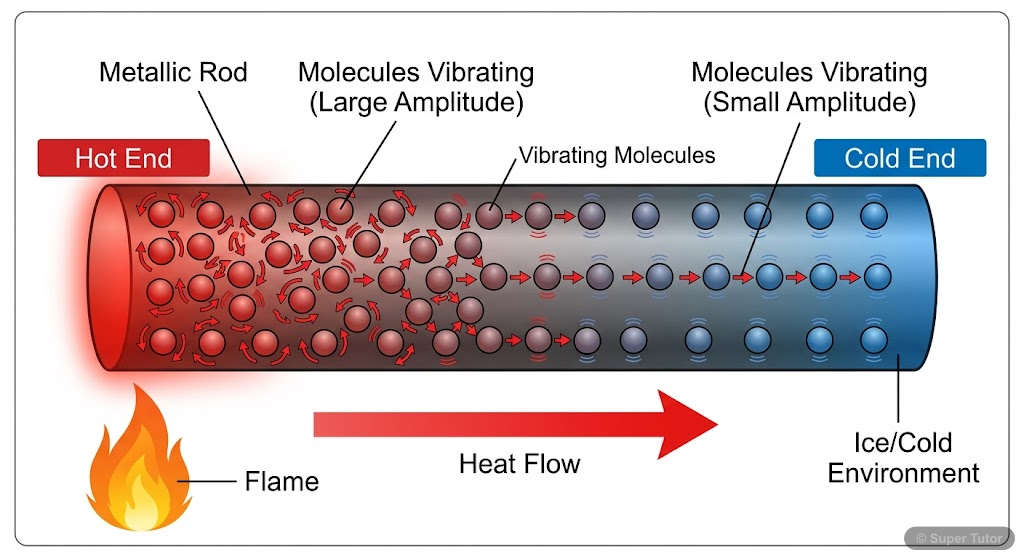
Learn better with visuals Super Tutor pairs illustrations like this with notes and quizzes for Heat Transfer and Solar Energy.
Study Plan
Learn the Theory
Read the textbook chapter carefully. Note down definitions, formulas and key ideas. Focus on: Processes of Heat Transfer, Radiation Laws, Solar Energy, Greenhouse Effect and Newton's Law of Cooling.
Practise
Solve the textbook exercises and extra practice questions. There are 45 questions available for this chapter.
Revise & Test
Revise key points without looking at your notes. Take a practice quiz and mark weak areas for another pass.
Spaced Revision
Come back to Heat Transfer and Solar Energy after a week. Use flashcards for quick recall and try past exam questions on this chapter.
What to Focus On
- Heat flows from higher temperature to lower temperature spontaneously (Second Law of Thermodynamics).
- Three modes of heat transfer: Conduction (solids, atomic vibration), Convection (fluids, bulk motion), Radiation (EM waves, no medium needed).
- Fourier's Law: Q = KA(T_h - T_c)t / d. K is the thermal conductivity of the material.
- Wien's Displacement Law: λ_m × T = 2.884 × 10⁻³ mK. Hotter bodies emit radiation of shorter peak wavelength.
- Wien's law is used to find temperatures of stars and celestial bodies from their radiation spectra.
- Kirchhoff's Law: e_λ / a_λ = E_λ. Good emitters are also good absorbers at any given temperature.
- Solar constant C = 1.36 × 10³ Wm⁻². It is the solar energy received per unit area per second at Earth's mean distance from the sun.
- Total solar power received by Earth ≈ 3.5 × 10¹⁷ W.
- Solar constant varies inversely with the square of distance from the sun: E'/E = (R/R')².
Common Mistakes to Avoid
Heat and Temperature are the same thing — a hotter body always has more heat energy.
Radiation requires a material medium to travel — it cannot pass through vacuum like conduction and convection.
In Stefan-Boltzmann Law (E = eσAT⁴), T can be substituted in degrees Celsius.
Memory Tips
Three modes of heat transfer: Conduction, Convection, Radiation
Conduction — heat transfer through atomic vibrations without body movement
Thermal conductivity formula: Q = KA(Th - Tc)t / d
Thermal conductivity K — metals have high K, insulators have low K
Want a personalised study plan?
Super Tutor builds a day-by-day plan for NIOS Class 12 Physics that fits your exam date and pace.
Create My Study PlanFrequently Asked Questions
What are the important topics in Heat Transfer and Solar Energy for NIOS Class 12 Physics?
How should I revise Heat Transfer and Solar Energy for the NIOS Class 12 board exam?
Sources & Official References
Content is aligned to the official syllabus. Refer to the board website for the latest curriculum.
More resources for Heat Transfer and Solar Energy
Practice Quiz
Test yourself with a quick quiz
Important Questions
Exam-style questions with answers
Revision Notes
Key points for last-minute revision
Formula Sheet
The chapter's formulas in one place
Chapter Summary
Understand the chapter at a glance
Concept Maps
See how topics connect
Flashcards
Quick-fire cards for active recall
Syllabus
What topics to cover
For serious students
Get the full Heat Transfer and Solar Energy chapter — start free.
Quizzes, flashcards, an AI doubt solver and a study plan for NIOS Class 12 Physics. Free to start, no card needed.